On This Page
Key Facts
- Singapore hosts over 2,000 single family offices (SFOs) managing an estimated $66.8 billion in assets. This represents 59% of the region's total family office population.
- The regional family office count grew roughly 400% between 2020 and 2024. Wealth migration from China, Indonesia, India, and Malaysia into Singapore and Hong Kong drove this surge.
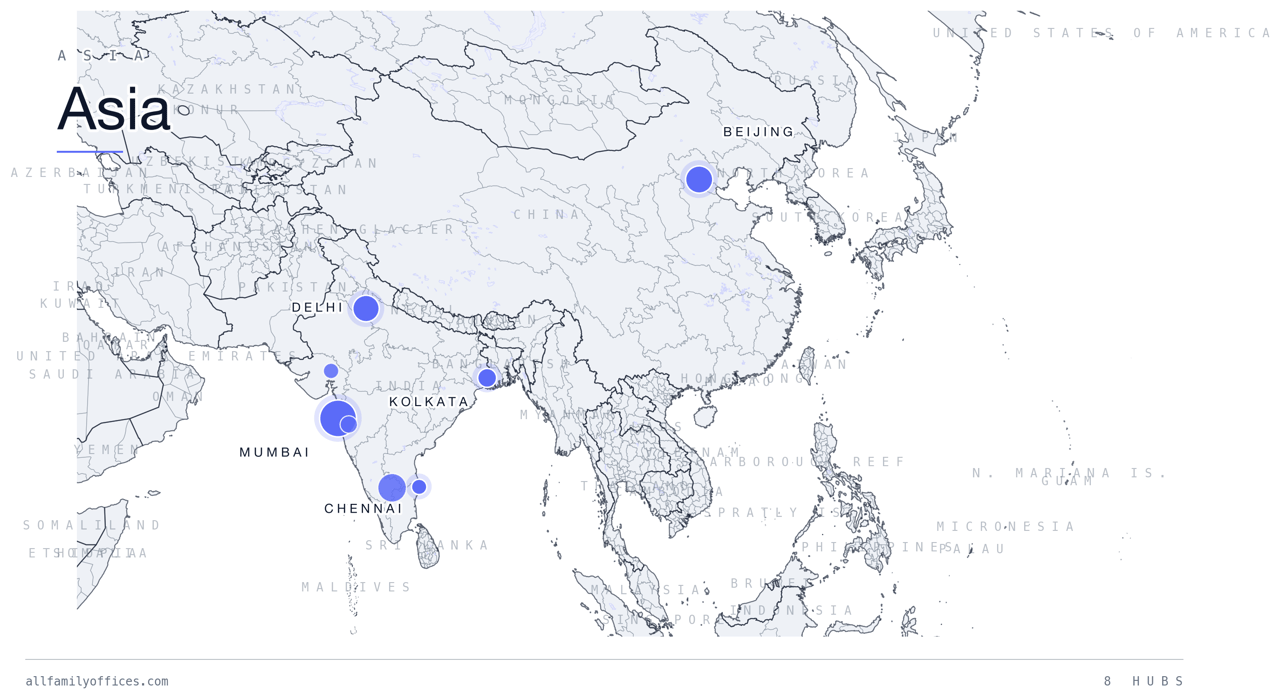
- At least 103 multi-family offices (MFOs) operate in the region, with 34 in Singapore, 22 in Hong Kong, and 18 in India.
- Industry databases track 1,182 single family offices in the region that have collectively invested over $488 billion in more than 16,300 rounds.
- The ultra-high-net-worth (UHNW) population stood at 165,400 in 2023 and may reach 230,000 by 2028. An estimated $5.8 trillion in intergenerational wealth transfers is expected through 2030.
- Over 70% of Singapore-based family offices apply ESG criteria. Climate tech and renewable energy draw the strongest new capital.
Family Offices in Asia: Landscape Overview
Singapore is the undisputed capital of family offices in Asia. The city-state combines political stability, a clear regulatory framework under the Monetary Authority of Singapore (MAS), and dedicated tax incentives through Section 13O and Section 13U schemes. These features have drawn wealth from every corner of the continent. Hong Kong remains a gateway to Mainland China capital, while Mumbai, Tokyo, Seoul, and Bangkok serve as regional hubs with smaller but growing clusters.
Singapore and Hong Kong together host roughly 4,000 family offices, up from fewer than 1,000 in 2020. Singapore alone saw 43% growth in 2024, adding hundreds of new offices in a single year. Wealth origins span Chinese tech entrepreneurs, Indonesian conglomerates like the Widjaja family behind Sinar Mas, and Malaysian dynasties such as the Kuok family.
Indian industrialists including Mukesh Ambani also maintain offices in the region. Western billionaires have relocated operations too. Google co-founder Sergey Brin and Bridgewater founder Ray Dalio both run Singapore-based offices.
SFOs dominate structurally. Most serve first-generation wealth and often remain embedded within existing business operations. The 103 MFOs in the region provide shared platforms for families that prefer professional wealth management without the overhead of a standalone office. Singapore's Variable Capital Company (VCC) structure has streamlined operations by improving tax and fund efficiency for pooled vehicles.
Family Office Comparison at a Glance
The table below captures a cross-section of leading offices in the region, spanning SFOs and MFOs from multiple hubs. AUM data remains scarce for most Asian family offices, so the AUM column appears only where figures are available.
| Family Office | Type | Investment Focus | Notable Detail | Location |
|---|---|---|---|---|
| Kuok (Singapore) Limited | SFO | Hospitality, real estate, agribusiness | Manages Shangri-La Hotels, Kerry Properties, Wilmar stake | Singapore |
| Sinar Mas Family Office | SFO | VC/PE, renewables, tech | Privatized Sinarmas Land for $1.6B (2025) | Singapore |
| Oppenheimer Family Office | SFO | Endowment-style PE/VC, sustainability | $15-100M fund commitments; De Beers wealth origin | Singapore |
| Bayshore Global Management | SFO | Diversified | Sergey Brin's family office | Singapore |
| Dalio Family Office | SFO | Diversified | Ray Dalio's family office | Singapore |
| Raffles Family Office | MFO | Digital assets, PE, VC, growth equity | Crypto wealth platform with Huobi (2022) | Singapore |
| Analog Capital | MFO | VC, financial markets, real estate | Invested in Grab, Snapchat, Stashfin | Singapore |
| Blueprint Forest | MFO | SE Asian businesses, DeFi | $120M fund; invested in Immunefi | Bangkok |
| Topor & Co. Korea (TCK) | MFO | Global multi-asset, long-term | Howard Marks (Oaktree) as Senior Advisor | Seoul/London |
| Decent Capital | SFO | Diversified | 120 investments, largest Asian SFO by deal count | Asia |
| LionRock Capital | SFO | Enterprise apps, retail | 28 portfolio companies in India, US, and beyond | Singapore |
| Amplefields Investments | SFO | Late-stage tech (AI, fintech, healthtech) | 10 portfolio companies since 2021 launch | Asia |
Singapore-based offices dominate both SFO and MFO categories. Direct investments and co-investment structures are common, with most offices preferring ticket sizes between $5 million and $50 million. Technology, real estate, and renewable energy appear repeatedly as primary sectors.
Top Picks by Strategy
- Largest Deal by Value: Sinar Mas Family Office privatized Sinarmas Land from the SGX for $1.6 billion in 2025, showing the scale at which top Asian SFOs operate.
- Most Active Investor: Decent Capital holds the largest portfolio among Asian SFOs with 120 tracked investments.
- Best for Digital Assets: Raffles Family Office built a crypto wealth management platform in partnership with Huobi in 2022, making it the most visible MFO in digital asset advisory.
- Strongest VC Track Record: Analog Capital (formerly Alto Capital) has backed Grab, Snapchat, Stashfin, and Canopy, positioning itself as a venture-focused MFO for next-generation entrepreneurs.
- Top Multi-Generational Steward: Kuok (Singapore) Limited has managed the Kuok family's wealth since 1953, spanning hospitality, agribusiness, and logistics over seven decades.
- Leading Endowment-Style Allocator: The Oppenheimer Family Office deploys $15-100 million per fund commitment in an endowment approach rooted in third-generation De Beers diamond wealth.
- Best for Southeast Asian Exposure: Blueprint Forest, based in Bangkok, runs a $120 million fund dedicated to Southeast Asian businesses and DeFi platforms.
Leading Office Profiles in Detail
Kuok (Singapore) Limited
Few Asian wealth platforms rival the seven-decade track record of Kuok (Singapore) Limited. The office manages a portfolio anchored by Shangri-La Hotels, Kerry Properties, and a major stake in Wilmar International, one of the world's largest agribusiness firms. Capital deployment extends into logistics and technology that disrupts traditional industries.
Typical fund commitments range from $20 million to $75 million. The office favors managers who bring deep Asian operational expertise. Families with hospitality or real estate wealth will recognize the Kuok model as a benchmark for multi-generational asset management.
Sinar Mas Family Office
The Widjaja family's $1.6 billion privatization of Sinarmas Land in 2025 put this office on the global map. Indonesia's Sinar Mas conglomerate (palm oil, real estate, telecom, financial services) generated a 75% wealth increase in 2024 through renewable energy bets. The family opened its MAS-licensed office in Singapore in 2021.
Fund commitments typically range from $10 million to $50 million. The focus covers global VC/PE, direct deals, and co-investment opportunities. A team of seven professionals, several with GIC backgrounds, manages the portfolio from Singapore's CapitaSpring tower.
Oppenheimer Family Office
An endowment-style approach sets this SFO apart, with $15 million to $100 million deployed per fund commitment into private equity and venture capital. Third-generation De Beers diamond wealth underpins the office, which opened its Singapore base in 2021 to gain proximity to Asian growth markets.
Sustainability plays a central role in portfolio construction. Former Temasek professionals on the team bring institutional rigor. The office is accessible through top-tier private banks and major Singapore conferences.
Raffles Family Office
Early entry into digital assets gives Raffles a distinctive position among Asian MFOs. In 2022, the firm partnered with Huobi Technology to launch a crypto wealth management platform. This platform offers dashboards and advisory services for families with exposure to digital currencies.
The broader mandate spans private equity, venture capital, and growth equity. For UHNW families seeking a multi-family office that bridges traditional wealth management with emerging asset classes, Raffles fills a unique niche in Singapore.
Analog Capital
Venture-native capital deployment defines this Singapore MFO, formerly known as Alto Capital. Its portfolio includes high-profile bets: Grab, Snapchat, Stashfin, and Canopy. Allocations split between venture capital, financial markets, and real estate.
Tech founders with recent liquidity events will find Analog's approach well matched to their risk appetite and sector familiarity. The firm targets the region's leading entrepreneurs and next-generation investors.
Blueprint Forest
A rare non-Singapore MFO, Bangkok-based Blueprint Forest offers regional expertise outside the city-state's orbit. The firm launched a $120 million fund in 2020 focused on Southeast Asian businesses. In 2021, it invested in Immunefi, a Singapore-based DeFi bug bounty platform.
Core values include ownership, trust, and rationality. Families with Southeast Asian operating businesses or DeFi exposure will find Blueprint's Bangkok location a useful counterweight to Singapore-centric options.
Topor & Co. Korea (TCK)
Howard Marks, chairman and founder of Oaktree Capital Management, serves as Senior Advisor to this Seoul-based MFO. TCK is one of a handful of multi-family firms operating from South Korea, with a second office in London. The firm takes a global, multi-asset, long-term approach.
For Korean families seeking global diversification with access to one of the world's most respected credit and distressed-debt investors, TCK offers a compelling proposition.
Decent Capital
Market research ranks Decent Capital as the most active single family office in the region by deal count, with 120 portfolio companies. The SFO takes a broad approach, deploying capital into companies at varying stages and sectors.
Limited public data on ticket sizes or sector preferences reflects the opacity common among Asian SFOs. Its sheer volume of deals, however, makes it a notable partner for co-investment opportunities and fund managers seeking LP relationships.
LionRock Capital
A 28-company portfolio spanning enterprise applications, retail, and other sectors makes LionRock a versatile allocator. The office has operated from Singapore since 2009 and holds positions in India, the United States, and three other markets.
LionRock blends the patient capital of a private wealth office with the sector breadth of an institutional investor. Managers with enterprise software or consumer retail strategies in emerging markets will find the track record relevant.
Amplefields Investments
Late-stage technology companies are the exclusive focus of Amplefields. Target sectors include AI, transportation, fintech, and healthtech. The portfolio currently holds 10 companies, with positions in the United States, Israel, and Asia.
For tech-focused fund managers raising growth or late-stage vehicles, Amplefields represents a newer but deliberate entrant. The office launched in 2021 and has built a concentrated, thesis-driven portfolio.
Investment Trends Shaping This Market
Technology and AI Dominate Capital Allocation
Asian family offices channel 77% of their private equity capital into technology-oriented companies. Generative AI ranks as the most popular theme over the next two to three years. Singapore's position as Southeast Asia's tech hub gives local offices like Amplefields and LionRock proximity to deal flow in fintech, e-commerce, and enterprise software.
Renewable Energy and ESG Drive Next-Generation Priorities
Over 70% of Singapore family offices now apply ESG criteria when evaluating deals. The Widjaja family's 75% wealth increase from renewable energy bets in 2024 shows the financial upside. Climate tech, solar power, and electric vehicle supply chains attract the strongest interest, especially from next-generation family members who hold growing influence over allocation decisions.
Alternatives Far Exceed Global Averages
Asian family offices allocate 30-45% of their portfolios to alternative assets, compared with a global average of 15-20%. Direct deals and co-investment structures account for 15-25% of total portfolios. In practice, offices like Sinar Mas and Analog Capital rely on direct and venture positions as core portfolio components. Private credit gains traction as traditional banks retreat from certain lending segments.
China+1 Strategies Reshape Geographic Focus
Roughly 60-70% of Asian family offices maintain Asia-focused or Asia-inclusive strategies. However, US-China tensions have accelerated "China+1" rebalancing. Southeast Asia, with its 600 million population and rapid digital adoption, draws the most new capital. About 31% of family offices plan to increase holdings in wider Asia outside Greater China. Blueprint Forest's $120 million Southeast Asian fund reflects this shift.
How to Evaluate a Family Office in This Market
Regulatory status should be the first filter. In Singapore, verify whether the office holds MAS licensing and operates under Section 13O or 13U tax exemption schemes. Hong Kong offices should meet the Family-owned Investment Holding Vehicle (FIHV) standard, which signals compliance with the evolving local framework. These jurisdictional details are unique to the region and do not apply in the US or Europe.
Team pedigree carries special weight here. Offices staffed by alumni of GIC, Temasek, or global banks (UBS, JP Morgan, Goldman Sachs) tend to deliver institutional-grade reporting and risk controls. The Sinar Mas Family Office, for example, recruited former GIC professionals. Family offices with fewer than five investment staff may lack the capacity for proper due diligence on complex deals.
Cultural approach varies sharply by wealth origin. Chinese family offices often prefer personal relationships and faster, entrepreneur-led decisions. Southeast Asian offices like Kuok (Singapore) tend toward institutional committee structures. Indian offices blend corporate oversight with family involvement. Western relocations like the Dalio or Brin offices expect formal documentation and standardized processes.
Red flags include opacity on portfolio data, no clear separation between family business assets and office assets, and a lack of succession planning. In a market where first-generation wealth dominates and $5.8 trillion in intergenerational transfers loom through 2030, strong family governance will separate durable offices from those that dissolve within a generation.
Which Family Office Fits Your Needs?
UHNW families seeking full-service management with institutional depth should explore MFO platforms like Raffles Family Office or Analog Capital. Both aggregate client capital to access institutional-scale opportunities. Raffles adds digital asset advisory for families with crypto exposure, while Analog's venture focus suits tech-origin wealth. Families with $500 million or more in liquid assets may find that a standalone SFO in Singapore, using the VCC structure under Section 13O or 13U, provides greater control and tax efficiency.
Business owners planning liquidity events or privatizations can study the Sinar Mas model. The Widjaja family's $1.6 billion Sinarmas Land deal in 2025 shows how an SFO can execute transformational transactions while maintaining long-term family control. For entrepreneurs exiting technology companies, Amplefields and LionRock Capital both specialize in tech-sector investing and understand the post-exit deployment challenge.
Next-generation wealth holders navigating succession should prioritize offices with formal oversight frameworks and ESG integration. The three-generation Kuok family office, with its 70-year track record, offers a blueprint for multi-generational wealth preservation. TCK in Seoul provides global reach with world-class advisory through Howard Marks. The typical engagement timeline from first meeting to commitment runs six to twelve months, so families should expect a deliberate process.
Methodology
This list of family offices in Asia draws on publicly available data from regulatory filings, industry databases, conference disclosures, and published reports. Office profiles reflect information available as of early 2026. AUM figures appear only where verifiable data exists; most Asian SFOs do not disclose managed assets publicly. The article covers offices operating in Singapore, Hong Kong, India, Japan, South Korea, Thailand, and broader Asia-Pacific. Offices were selected based on deal activity, market visibility, and regional significance. No office paid for inclusion, and no data provider is endorsed over another.