On This Page
- Key Facts About Family Offices in Japan
- Japan Family Office Landscape: Market Overview
- Family Office Comparison at a Glance
- Top Picks by Strategy
- Top Family Offices in Japan: Detailed Profiles
- Investment Trends Shaping Japan's Family Office Market
- How to Evaluate a Family Office in Japan
- Which Family Office Fits Your Needs?
- Methodology
- Frequently Asked Questions
Key Facts About Family Offices in Japan
- Japan's family office market reached $1.23 billion in value in 2024. Projections point to $1.82 billion by 2030, a compound annual growth rate of 6.75%.
- An estimated 50 single family offices (SFOs) operate in Japan. The true count is likely higher, as many wealthy families use private holding companies without formal labels.
- Japanese households collectively hold over $17 trillion in financial assets. Much of this capital sits idle, creating strong demand for structured wealth management.
- SFOs dominate the market by share, while virtual family offices (VFOs) represent the fastest-growing segment.
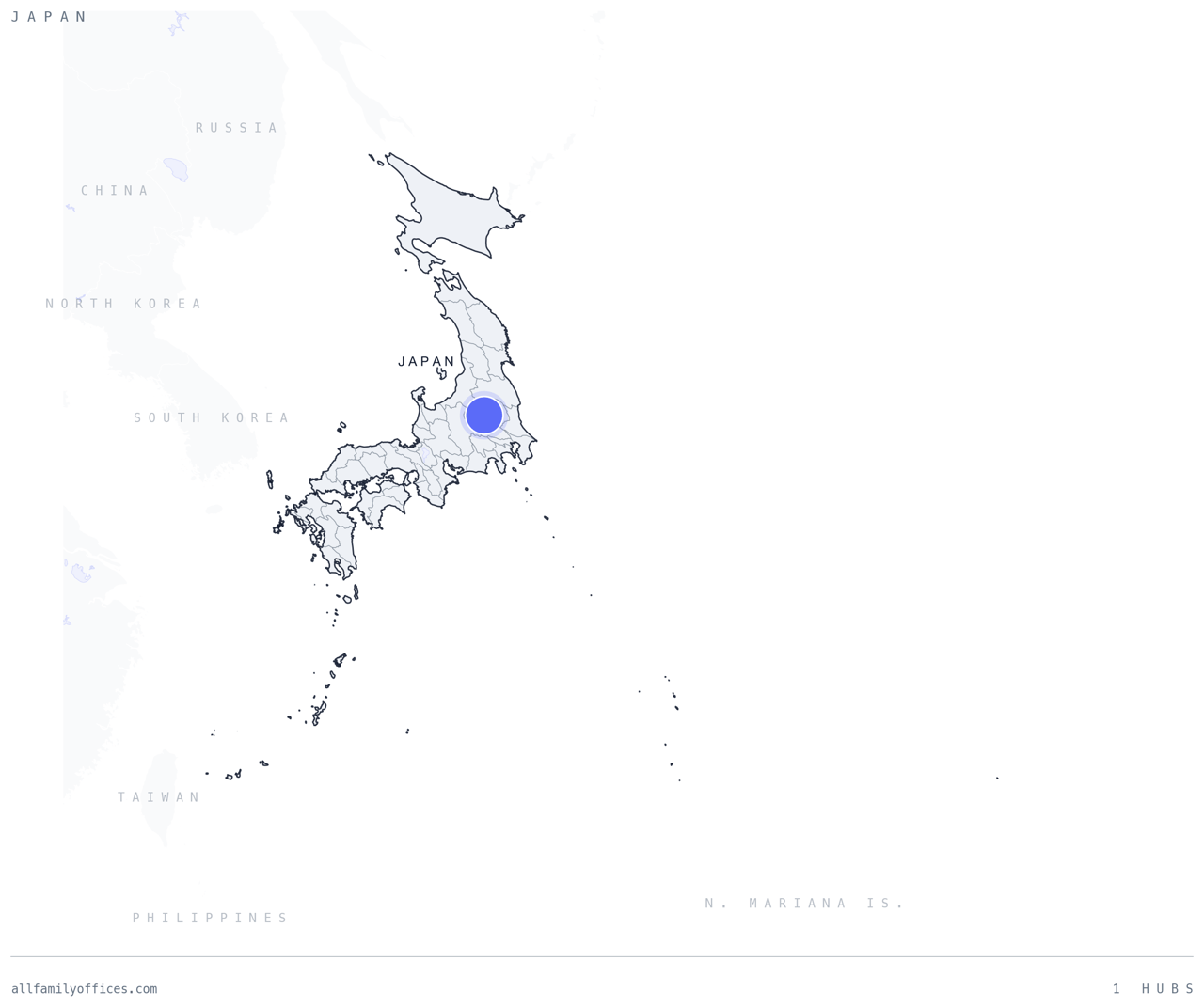
- Tokyo serves as the primary hub. Kyoto is home to the largest known SFO: Yamauchi No.10, managing $1 to $1.5 billion in assets under management (AUM).
- Japan's 55% top inheritance tax rate, among the world's highest, pushes ultra-high-net-worth (UHNW) families toward formal family office structures.
- Three major launches took place in 2024: Deloitte Tohmatsu family office services, the Money Forward PrivateBank joint venture, and Takashimaya's purchase of Vaste Culture.
Japan Family Office Landscape: Market Overview
Japan's family office market stands apart from its Asian peers. A deep-rooted savings culture, preference for privacy, and zaibatsu conglomerate legacies mean many wealthy families manage assets through holding companies. Formal office structures remain less common than in Singapore or Hong Kong.
That picture is shifting fast. The yen's 27% decline against the dollar since early 2022 and a stock market surge of roughly 50% have changed attitudes. Record Tokyo condo prices add further momentum toward active wealth management.
Roughly 90,000 high-net-worth households each hold at least $3.3 million in net assets. As of 2022, 1,094 individuals had a net worth above $100 million. The domestic family office sector remains small compared to Singapore (1,400+ SFOs) and Hong Kong (2,700 SFOs), but the gap is narrowing.
Growth draws on several forces. An aging population of 36.25 million people aged 65+ drives intergenerational wealth transfer. Startup IPOs create new tech wealth, and a 2024 government policy aims to position Japan as a leading asset management center.
Multi-family offices (MFOs) gain ground as cost-effective alternatives for families below the ¥10 billion ($66 million) SFO threshold. VFOs, which use technology and outsourced professionals instead of full-time staff, are the fastest-growing segment by type.
Family Office Comparison at a Glance
The table below compares the major family offices operating in Japan. AUM data remains scarce because most Japanese offices prioritize confidentiality. Where figures are unavailable, investment focus and services offer the clearest basis for comparison.
| Family Office | Type | AUM Estimate | Investment Focus | Key Services | Location |
|---|---|---|---|---|---|
| Kotobuki Realty (Saji/Torii Family) | SFO | ~$9.3B family fortune | Suntory Holdings (89% stake), real estate | Asset holding, corporate governance, wealth preservation | Osaka |
| Yamauchi No.10 Family Office | SFO | $1–1.5B | Deep tech, AI, healthcare, space, activist investing | Business incubation, investment, philanthropy, research | Kyoto/Tokyo |
| PrivateBank (Money Forward) | MFO | Target: ¥10T partnership | Wealth management, asset growth | Asset management, concierge, succession, philanthropy | Tokyo |
| Vaste Culture (Takashimaya) | MFO | Target: ¥1T | Wealth management, art, jewelry | Education, philanthropic advisory, art investment | Japan |
| Hidaka Family Office | SFO | — | Venture capital, private equity, real estate | Direct investments, co-investments | Tokyo |
| Terrasias Capital | SFO | — | Alternative investments | Investment management | Tokyo |
| Banyan Pacific Capital | MFO | — | Multi-family wealth management | Wealth management, investment advisory | Tokyo |
| Heathridge Partners Tokyo | MFO | — | Bespoke portfolio management | Estate planning, succession, cross-border wealth | Tokyo |
| IQ-EQ Japan | MFO | — | Fund admin, family office structuring | Compliance, legal support, private asset owner services | Tokyo |
Kotobuki Realty stands apart on scale, though its role is primarily as a family holding vehicle for Suntory. Yamauchi No.10 is the most active standalone SFO by investment breadth. Among MFOs, PrivateBank's partnership with Money Forward targets the largest AUM goal.
Top Picks by Strategy
- Largest Family Fortune: Kotobuki Realty (Saji/Torii family) controls 89% of Suntory Holdings with an estimated $9.3 billion family fortune, making it the wealthiest family office structure in Japan.
- Most Active Direct Investor: Yamauchi No.10 Family Office has deployed roughly half of its $1 to $1.5 billion into 24 next-gen technology projects. These span AI, space debris cleanup, and brain-machine interfaces.
- Best for Tech-Forward Wealth Management: PrivateBank (Money Forward) combines mobile-first fintech tools with traditional wealth advisory for startup founders and tech entrepreneurs.
- Top Charitable and Lifestyle Platform: Vaste Culture (Takashimaya group) blends wealth management with art investment, overseas education, and charitable advisory in a unique lifestyle-oriented model.
- Leading VC and PE Allocator: Hidaka Family Office has focused on early-to-growth-stage venture capital and private equity since 2009 with a direct investment approach.
- Strongest Cross-Border Reach: Banyan Pacific Capital serves high-net-worth families in both Asia-Pacific and the United States from its Tokyo base.
Top Family Offices in Japan: Detailed Profiles
Yamauchi No.10 Family Office
The most visible japan family office belongs to the Nintendo founding family. With $1 to $1.5 billion in AUM and a staff of about 10, this Kyoto-and-Tokyo-based SFO invests where few others dare. Roughly half its assets sit in 24 frontier-science projects: AI-driven rare earth exploration, lab-grown meat, brain-machine interfaces, and space debris cleanup.
What sets Yamauchi No.10 apart is its activist stance. The office holds a significant minority stake in Toyo Construction and has pushed for oversight and leadership reforms. A 2023 partnership with Taiyo Pacific Partners, a U.S.-based firm focused on Japanese and Indian equities, extended this strategy.
CIO Hirowaka Murakami now serves as co-CEO of the combined entity. Families seeking a model for deep tech conviction and shareholder activism in one SFO will find no better reference point in Japan.
Kotobuki Realty (Saji/Torii Family)
This Osaka-based holding company manages Japan's largest family fortune. Kotobuki Realty controls 89% of Suntory Holdings, one of the world's biggest private beverage companies. The family fortune totals an estimated $9.3 billion.
The Torii and Saji clans, descendants and in-laws of Suntory founder Shinjiro Torii, use this vehicle for corporate oversight, real estate, and wealth preservation. The firm operates more as a legacy management structure than an active investment office. Its primary function is maintaining family control of Suntory while managing the surrounding real estate and asset base.
For multigenerational industrial families, this model is instructive. A single holding entity can serve both family governance and preservation goals around a core operating company.
Hidaka Family Office
Venture capital and private equity define this Tokyo-based SFO, which has made direct investments since 2009. Under CIO Nobuyuki Hidaka, the office targets companies from early stage through growth stage. Co-investment is a core strategy alongside solo deals.
The long track record gives Hidaka an edge that newer entrants lack. While many Japanese wealth firms are still defining their mandates, Hidaka brings over 15 years of deal flow and portfolio discipline in VC and PE. Founders seeking a partner with hands-on PE experience will find few options with this operational depth in Japan.
PrivateBank (Money Forward PrivateBank)
Money Forward's fintech platform meets decades of wealth management expertise in this MFO, launched in February 2024. The partnership targets families holding ¥10 billion ($66 million) or more in financial assets. Its goal: overseeing ¥10 trillion in managed assets.
Services span asset management, concierge, inheritance, gifting, business succession, charitable giving, healthcare, and education. President Takayuki Sato serves dozens of wealthy families and sees the client base expanding among tech company owners who went public in the last decade. For next-generation wealth holders from startup exits, the mobile-native approach and tech-sector network make this the most modern MFO in Japan.
Vaste Culture (Takashimaya Group)
No other wealth management firm in Japan blends financial services with art, jewelry, and lifestyle offerings the way Vaste Culture does. Takashimaya, the department store group, acquired this MFO in June 2024. It now targets ¥1 trillion in capital managed by leveraging the retailer's affluent customer base.
Co-CEO Kotaro Yamamoto built a service model that includes overseas education, charitable advisory, and access to art and jewelry allocations through the Takashimaya network. Families who want values-aligned wealth management with a cultural dimension will find this model distinctive.
Terrasias Capital
Alternative investments are the sole focus of this Tokyo SFO in Shiroyama Trust Tower, Toranomon. The investment team draws on long careers at Royal Bank of Scotland, ABN AMRO, JP Morgan, and Bear Stearns. That pedigree brings global capital markets experience to a Japan-based family structure.
Specific holdings remain private, consistent with Japanese norms around discretion. The emphasis on alternatives suits families seeking exposure beyond traditional equities and bonds. The team's banking background suggests comfort with complex instruments and structured products.
Banyan Pacific Capital
Global reach from a Tokyo base defines this MFO, established in 2015 with offices in Asia-Pacific and the United States. Banyan Pacific serves high-net-worth families who need coordinated wealth management in multiple jurisdictions.
For expatriate families, multinational executives, or Japanese families with overseas assets, this cross-border capability fills a clear gap. The firm's dual presence in Asia and North America allows coordinated tax planning, estate structuring, and investment advisory. Single-country offices struggle to match this reach.
IQ-EQ Japan
Global fund administration and compliance systems set IQ-EQ apart from investment-led offices. Operating from ARK Hills Sengokuyama Mori Tower in Tokyo, the firm handles administration, investment structuring, and regulatory support. It serves both domestic and international families with Japan interests.
Where other offices lead with investment strategy, IQ-EQ leads with operational backbone: fund services, legal support, and AML/KYC/FATCA/CRS compliance. Families establishing formal office structures for the first time benefit most from this compliance-first approach. Those with complex cross-border reporting needs also gain from IQ-EQ's global framework.
Investment Trends Shaping Japan's Family Office Market
Deep Tech and Frontier Science
Yamauchi No.10 has deployed roughly half of its $1 to $1.5 billion into 24 frontier projects. These include AI, space debris removal, brain-machine interfaces, and lab-grown meat. This signals a broader shift among Japanese private wealth offices from passive allocation to direct capital deployment in frontier technologies.
Former civil servants, investment bankers, and consultants are joining startups in growing numbers. This feeds the deal pipeline for offices willing to write patient capital checks.
Weak Yen and Cross-Border Capital Flows
The yen's 27% decline against the dollar since 2022 has changed how wealthy Japanese families think about currency risk. Some capital flows to Singapore and Hong Kong, where tax incentives for family offices are more generous. Japan's government responded in 2024 with policy to become a leading asset management center, aiming to keep domestic wealth onshore while attracting foreign managers.
Real Estate and Alternative Asset Allocation
Record Tokyo condominium prices and rising tourism-linked real estate values in Hokkaido and Tohoku draw family office capital into property. Younger wealth creators from startup IPOs also add cryptocurrency to portfolios. Hidaka Family Office exemplifies the alternative asset tilt, with real estate alongside its venture and private equity holdings.
Activist Investing as a Family Office Tool
Yamauchi No.10's engagement with Toyo Construction, including reform proposals and leadership oversight demands, marks a new trend. Tokyo Stock Exchange reforms pushing companies to improve shareholder value have created openings for constructive activism. SFOs can pursue these strategies with more patience than hedge funds because they face no quarterly redemption pressure.
ESG and Impact Investing Growth
Family offices in the Asia-Pacific region expect to double their sustainability-led allocations within five years. In Japan, Vaste Culture's charitable advisory model reflects growing demand for values-aligned capital deployment. Yamauchi No.10's social mission, focused on nurturing Japan's next generation of innovators, blends impact goals with commercial returns.
How to Evaluate a Family Office in Japan
Japan's 55% top inheritance tax rate makes tax planning expertise the single most important capability to verify. Any office serving Japanese families must show deep knowledge of succession law, gift tax thresholds, and strategies for transferring business ownership without forced asset sales. PrivateBank's dedicated business succession services and Deloitte Tohmatsu's advisory practice both benchmark well on this criterion.
Many Japanese business owners run personal holding companies without a family constitution, conflict resolution council, or active investment strategy. A genuine family office operates for the family's benefit with formal rules and active oversight. Red flags include commission-driven product sales, no written family charter, and no proactive portfolio management.
Independence matters in Japan, where bank-affiliated wealth managers may favor in-house financial products over client interests. Verify whether the office earns fees from advisory work or from commissions on product placement. Money Forward PrivateBank's independent model and IQ-EQ's administration-focused approach offer contrasting but transparent fee structures.
For families below the ¥10 billion threshold, an MFO like Vaste Culture or Banyan Pacific Capital provides professional services without SFO overhead. These costs can run into tens of millions of yen per year. Confirm that any provider handles FSA registration, AML and KYC protocols, and FATCA/CRS cross-border reporting.
Which Family Office Fits Your Needs?
UHNW families with $500 million or more seeking full control and total privacy should explore the SFO model. Yamauchi No.10 shows how a bespoke SFO can combine activist investing with deep tech conviction. Kotobuki Realty shows how a holding structure anchors multigenerational wealth around a core operating company like Suntory.
Business owners preparing for succession face Japan-specific challenges that general wealth managers often miss. PrivateBank offers dedicated succession planning alongside asset management, and its Money Forward partnership brings a tech-literate client network. Families holding between ¥1 billion and ¥10 billion get cost-effective access through MFOs like Vaste Culture (lifestyle services) or Banyan Pacific Capital (multi-jurisdiction coverage).
Next-generation wealth holders from tech exits want modern platforms, venture exposure, and digital reporting. Money Forward PrivateBank targets exactly this profile. Expatriates and multinational families with assets in Japan and abroad should prioritize cross-border specialists like Heathridge Partners Tokyo or IQ-EQ Japan.
Methodology
This guide to the japan family office landscape draws on public company filings, industry surveys, and news coverage from financial media. Office selection prioritized entities with documented Japan operations, confirmed investment activity, or recognized industry presence. Many Japanese family offices operate with minimal public disclosure, and AUM data was unavailable for several offices. Where figures could not be verified, the article describes investment focus and services. Research covers data through early 2026. The offices profiled represent the most visible operators in Japan's market but do not form a complete census.
Frequently Asked Questions
 Google AI Mode
Tells Google to show you more from AllFamilyOffices in AI, Search and Discover.