On This Page
Key Facts
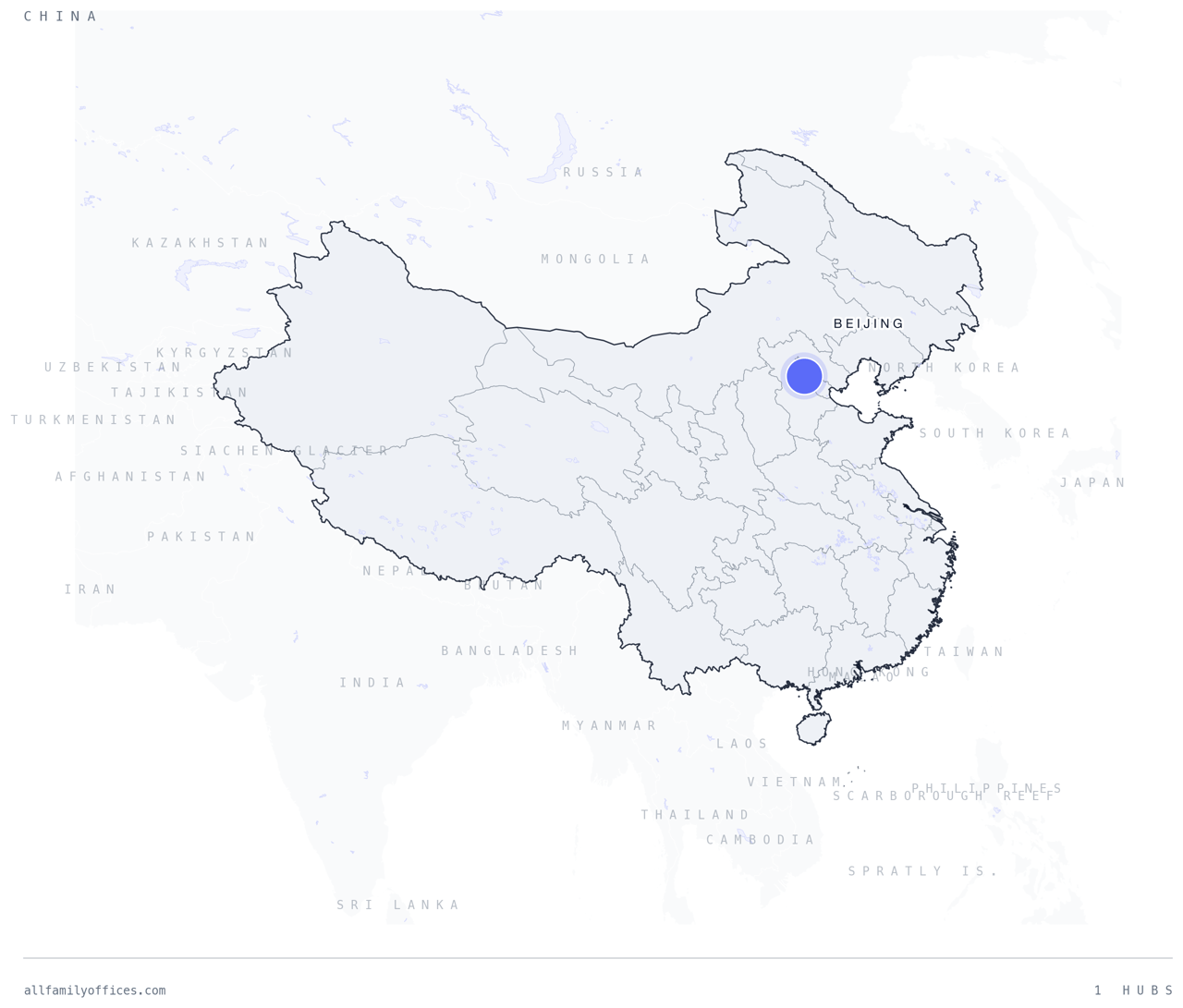
- China has 93 tracked single family offices (SFOs) that have collectively deployed over $394 billion in more than 8,700 investment rounds.
- Chinese billionaires numbered 814 as of 2024, with Beijing home to over 100 billionaires alone.
- Hong Kong hosts roughly 2,700 family offices and serves as the primary offshore hub for mainland Chinese wealth.
- Singapore houses over 2,000 SFOs managing $66.8 billion, with Chinese entrepreneurs among the largest cohort of new arrivals.
- Most Chinese SFOs operate as single-family structures, with a recommended threshold of RMB 1 billion ($140 million or more) in investable assets.
- Next-generation heirs now drive 90% of venture capital activity from Hong Kong and nearby wealth platforms.
- Chinese SFOs show a strong late-stage bias, putting $118 billion into late-stage rounds versus $2.16 billion at seed stage over the past five years.
Chinese Family Office Landscape Overview
Chinese family offices sit at the center of the fastest wealth creation cycle in modern history. China produced 238 new billionaires in 2021 alone, bringing the total to 626. By 2024, that count reached 814.
This surge has fueled demand for dedicated wealth management structures. Yet the country still lacks unified family office regulation. The result is a split geography.
Mainland offices in Beijing and Shanghai handle operating company wealth and domestic capital deployment. Offshore offices in Hong Kong and Singapore manage global portfolios, tax planning, and cross-border capital flows. Hong Kong's 2,700 wealth firms benefit from English common law, deep capital markets, and proximity to the Greater Bay Area.
Singapore's 2,000-plus SFOs attract Chinese tech entrepreneurs with Section 13O and 13U tax incentives. The Monetary Authority of Singapore processes approvals in roughly three months.
Beijing holds more billionaires than any city on Earth. Yet fewer than 5% of Asia-based private wealth offices operate there. The gap reflects a shortage of specialized service providers, not a shortage of wealth. Shanghai, with 10 tracked SFOs, serves as the secondary mainland hub.
For fund managers and service providers, engaging these offices requires navigating at least three jurisdictions. Each has distinct regulatory, cultural, and operational norms.
Family Office Comparison
Because most SFOs in this market do not publicly disclose individual assets under management (AUM), the table below omits that column. It covers the most prominent Chinese-origin private wealth offices with verifiable data.
| Family Office | Type | Investment Focus | Services | Location |
|---|---|---|---|---|
| Blue Pool Capital (Jack Ma, Joe Tsai) | SFO | Diversified | Investment management | Hong Kong |
| YF Capital (Jack Ma, David Yu) | SFO | Diversified | Investment management | Shanghai |
| Cool River Venture (Zhang Yiming) | SFO | Technology | Investment management | Hong Kong |
| Fortune Fountain Capital | SFO/MFO | Financial services, principal investment | Wealth management, family office | Hong Kong |
| Decent Capital | SFO | Diversified (120 investments) | Investment management | China |
| Double Peak | SFO | Digital assets, blockchain, gaming | Venture capital | China/Singapore |
| China Oceanwide Holdings Group | SFO | Enterprise apps, EdTech | Investment management | China |
| Midea Holding (He Xiangjian) | SFO | Home appliances, real estate | Investment management | China |
| Zhen Cheng Capital | SFO | Enterprise apps, high tech | Venture capital | China |
| Yintai Group | SFO | Consumer, media, entertainment | Investment management | China |
Decent Capital leads in portfolio breadth with 120 investments, making it the most active SFO by deal count in this market. Double Peak follows with 84 portfolio companies in 22-plus countries, reflecting a global digital-asset thesis. Fortune Fountain Capital stands out as the only office straddling SFO and multi-family office (MFO) models while maintaining a principal allocation arm.
Top Picks by Strategy
- Most Active by Deal Count: Decent Capital, with 120 investments making it the largest Chinese SFO by portfolio size.
- Best for Digital Assets: Double Peak, with 84 portfolio companies spanning blockchain, gaming, NFTs, and asset management in 22-plus countries.
- Top Cross-Border Acquirer: Fortune Fountain Capital, which acquired an 88% stake in French crystal maker Baccarat for $190 million.
- Strongest Tech Pedigree: Cool River Venture, the wealth office of ByteDance founder Zhang Yiming ($43.4 billion net worth), focused on technology industries.
- Leading Dual-Office Structure: Blue Pool Capital and YF Capital, jointly linked to Jack Ma, covering Hong Kong and Shanghai for global and domestic mandates.
- Enterprise and EdTech Specialist: China Oceanwide Holdings Group, with 11 portfolio companies in enterprise applications and education technology since 1985.
- Emerging High-Tech Investor: Zhen Cheng Capital, with 29 portfolio companies in enterprise applications and high tech since launching in 2016.
Top Chinese SFOs in Detail
Cool River Venture
ByteDance generated $120 billion in revenue in 2023. Its founder Zhang Yiming ($43.4 billion net worth) channels personal wealth through Cool River Venture in Hong Kong. The office targets technology industries, drawing on deep operational knowledge of consumer internet and AI-driven platforms.
Cool River Venture represents a new wave of Chinese tech wealth choosing Hong Kong's regulatory clarity over mainland structures.
Blue Pool Capital
Jack Ma and Alibaba co-founder Joe Tsai run this Hong Kong office as a vehicle for diversified global investing. Blue Pool Capital manages the combined personal fortunes tied to Alibaba, with Ma's net worth alone at $24.5 billion. Its broad mandate means it operates without a narrow sector tilt, positioning it for opportunistic plays in public and private markets.
YF Capital
Jack Ma's second wealth platform, co-managed with David Yu from Shanghai, captures mainland China deal flow. YF Capital complements Blue Pool Capital by providing domestic market access and local regulatory navigation. The dual-office structure lets Ma's operation pursue opportunities on both sides of the Hong Kong-mainland divide.
Fortune Fountain Capital
This Hong Kong office blends SFO and MFO functions, serving both the founding family (descended from calligrapher Wang Xizhi) and external clients. Its $190 million acquisition of an 88% stake in Baccarat, the French crystal maker, signals willingness to deploy capital into Western luxury brands. Fortune Fountain Capital covers financial services, wealth management, and principal allocation, with clients in Asia, North America, and Europe.
Decent Capital
No SFO in this market matches Decent Capital's 120 portfolio investments. The office runs a high-volume, diversified strategy spanning multiple sectors and stages. Fund managers pitching to wealth platforms in this space often cite Decent Capital as a benchmark for appetite and pace, given that few SFOs deploy capital at this frequency.
Double Peak
Digital assets define this office. With 84 portfolio companies in 22-plus countries since 2017, Double Peak invests in blockchain, banking, payments, gaming, and NFTs. It focuses on early funding rounds and secondary markets, making it one of the few private wealth offices with a dedicated crypto and Web 3.0 thesis.
Allocators exploring digital asset exposure in Asia will find few SFOs with comparable portfolio depth.
China Oceanwide Holdings Group
Enterprise applications and EdTech anchor this SFO, which has backed 11 portfolio companies in China and the United States. China Oceanwide has operated since 1985, giving it one of the longest track records among offices profiled here. Its cross-border deal history reflects a more established approach compared to the tech-wealth newcomers.
Midea Holding
He Xiangjian built Midea into a home appliance giant with $42 billion in annual revenue and over 130,000 employees. His private wealth office manages assets through Midea Holding and Midea Real Estate Holding, combining industrial operating assets with real estate. This structure is typical of first-generation Chinese industrialists who keep family wealth tied to the founding enterprise.
Zhen Cheng Capital
A 29-company portfolio in enterprise applications and high tech makes Zhen Cheng Capital one of the faster-growing SFOs profiled here. The office invests from seed through Series C, covering a broader stage spectrum than most firms in this market. That range offers a useful counterpoint to the late-stage bias that dominates Chinese SFO capital deployment.
Yintai Group
Consumer and media allocations give this SFO a distinct profile among Chinese wealth platforms. Yintai Group has operated since 1997 and holds six portfolio companies focused on entertainment and consumer brands. Its narrow sector focus sets it apart from the tech-heavy majority of offices in this space.
Investment Trends Shaping This Market
Late-Stage Bias in Chinese SFO Capital
Chinese SFOs invested $118 billion into late-stage rounds over the past five years, dwarfing the $2.16 billion deployed at seed stage. Offices like Midea Holding and China Oceanwide exemplify this pattern, favoring proven business models and de-risked deals. Seed-stage fund managers seeking capital from these firms need exceptional team pedigree or a sector thesis aligned with national priorities.
Offshore Structuring Through Hong Kong and Singapore
Capital controls on the mainland push wealthy families to build offshore structures. Hong Kong's 2022 Inland Revenue Amendment Bill now exempts family-owned vehicles from tax on qualifying transactions. Singapore's Variable Capital Company (VCC) framework and Section 13O/13U incentives offer competing advantages.
By 2026, more than half of wealth inflows into Hong Kong will come from mainland China. Blue Pool Capital and Cool River Venture both chose Hong Kong for this reason.
Next-Generation Venture Capital
Younger heirs from Chinese families are reshaping allocation patterns. An estimated 90% of venture capital activity from Hong Kong wealth offices comes from next-generation leaders. Their priorities tilt toward generative AI, healthcare, green technology, and fintech.
This generational shift also drives ESG adoption, with over 70% of Singapore-based offices now applying ESG criteria. Succession planning has become a core driver as founding patriarchs transfer control to heirs with different risk appetites.
Digital Assets and Blockchain
Double Peak's 84-company portfolio illustrates growing appetite for digital assets among SFOs in this market. Blockchain technology, payment systems, and NFTs attract capital from families comfortable with high-volatility strategies. Offices like Tsangs Group in Hong Kong also focus on Web 3.0 and fintech as part of a tech-forward thesis.
China-Plus-One Geographic Strategies
Wealthy Chinese families increasingly spread capital beyond the mainland. Southeast Asia, with its 600-million-person market, serves as the primary expansion target. Families invest in commercial property, manufacturing, food and beverage, and logistics in Singapore, often at 3 to 5 times price-to-earnings ratios.
This pattern reflects both wealth preservation goals and a hedge against domestic regulatory risk. Fortune Fountain Capital's Baccarat acquisition shows this cross-border ambition extending to European luxury brands as well.
How to Evaluate a Chinese Family Office
Regulatory status varies sharply by jurisdiction. A Singapore-based SFO with a MAS license operates under strict substance requirements, while a mainland office faces no unified regulation. Verify licensing status before any engagement, and confirm whether the office holds assets domestically, offshore, or both.
Team composition matters more than headcount. In Asia, 80% of family office CEOs are non-family professionals, often drawn from GIC, Temasek, or global banks like JP Morgan and UBS. An SFO like Blue Pool Capital with former institutional staff signals structured decision-making. Offices staffed mainly by family members may move faster but carry higher key-person risk.
Cultural engagement style requires adaptation. Offices in this market favor personal relationships and long-term partnerships over cold pitches. Warm introductions through private banks or existing limited partners remain essential. Expect a 6-to-12-month decision timeline, with due diligence including ESG review and family governance alignment.
Separate operating company assets from discretionary family capital. Many SFOs in this space, like Midea Holding, keep wealth intertwined with the founding business. Confirm whether the office deploys independently or acts as an extension of the family enterprise before committing to a partnership.
Fee transparency is limited in China's private wealth market. MFOs require an estimated minimum of RMB 100 million ($14 million or more), while SFOs typically serve families with RMB 1 billion ($140 million or more). Ask for a clear breakdown of management fees, performance fees, and any costs tied to proprietary products.
Which Family Office Fits Your Needs?
Ultra-high-net-worth (UHNW) families with $140 million or more in investable assets should study the SFO model used by Cool River Venture and Blue Pool Capital. Both show how a single-family structure preserves privacy while enabling global portfolio spreading from a Hong Kong base. Families below that threshold can explore MFO platforms like Raffles Family Office in Hong Kong or Pushi Family Office, which spans Singapore and Shanghai.
Business owners planning liquidity events from tech or industrial exits will find the dual-office approach of YF Capital (Shanghai) and Blue Pool Capital (Hong Kong) instructive. Maintaining one onshore and one offshore vehicle lets families optimize tax treatment while keeping mainland deal flow accessible.
Fund managers seeking commitments from this market should target offices with active deployment histories. Decent Capital (120 investments) and Double Peak (84 portfolio companies) both show established cadence that signals openness to new manager relationships.
Next-generation wealth holders drawn to digital assets, climate tech, or venture capital will find kindred strategies at Double Peak and Zhen Cheng Capital. Both invest at earlier stages than the typical SFO in this space and welcome co-investment (investing alongside another fund or family) structures. Institutional allocators evaluating this broader market should note that 36% of Asia-Pacific wealth firms manage over $1 billion in managed assets, making them meaningful limited partners for funds with $250 million or more.
Methodology
This list of Chinese family offices draws on publicly available data, regulatory filings, and industry reports tracking single and multi-family office activity in China, Hong Kong, and Singapore. The analysis prioritized verifiable capital deployment, named founding families, and documented portfolio data. It excluded offices without confirmed investment records or public profiles. All figures reflect data available as of early 2026. This analysis omits individual AUM figures where offices do not publicly disclose them, as these firms maintain strict privacy around asset totals.