
On This Page
Key Facts
- India hosts over 300 family offices as of 2025, up from roughly 45 in 2015, with 220 single family offices (SFOs) tracked through industry databases.
- These offices collectively manage an estimated $200 billion in assets, with $30 billion formally tracked through investment platforms.
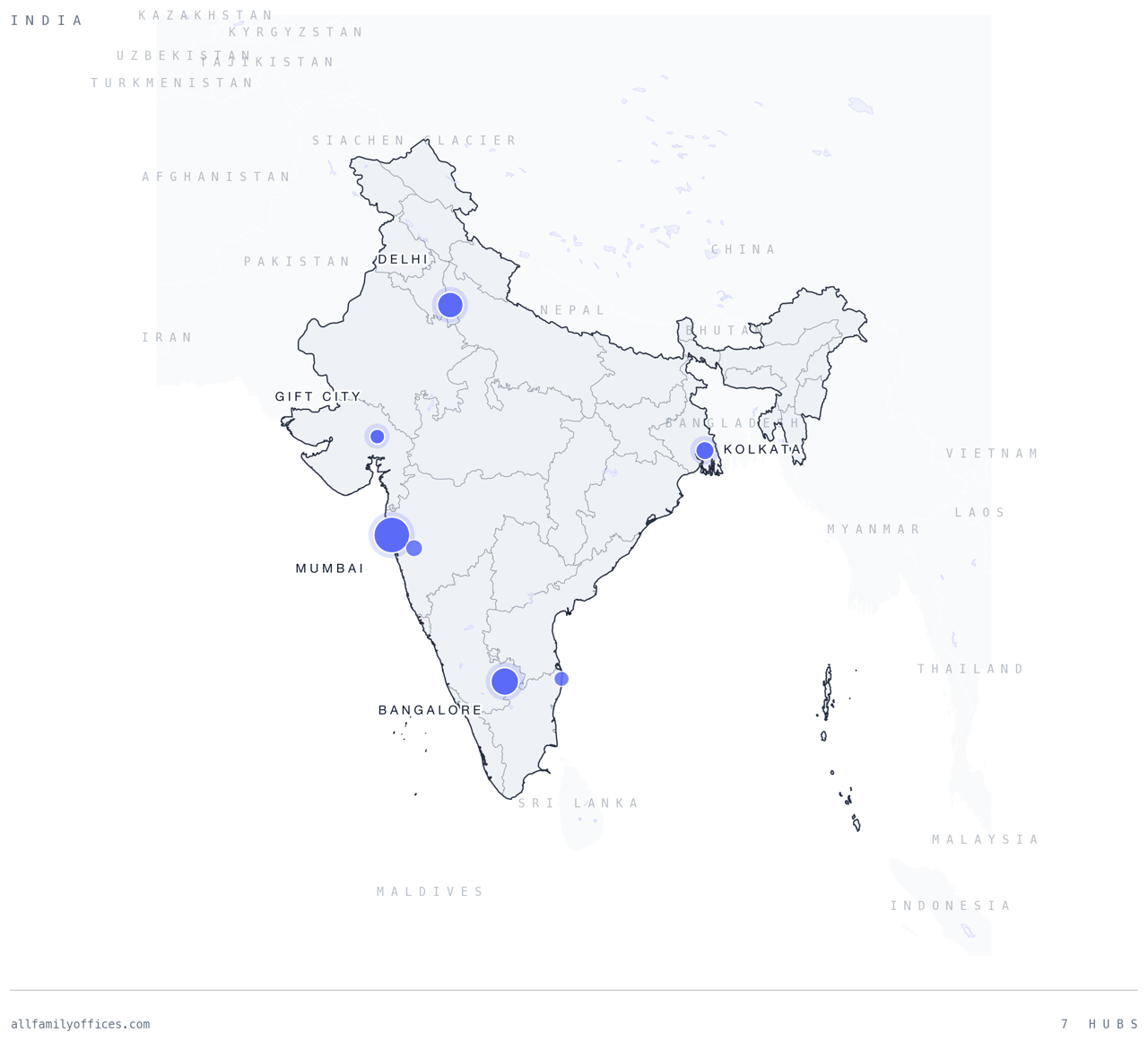
- Mumbai leads with 78 SFOs, followed by Delhi NCR with 36. Bengaluru has emerged as the hub for tech-entrepreneur family offices.
- SFOs have deployed more than $353 billion in over 10,327 rounds, backing 1,700+ companies in the past decade.
- Private market allocation by Indian family offices has nearly doubled to 40% of portfolios, with 47% directed to startup equity.
- India's ultra-high-net-worth (UHNW) population reached 85,698 in 2024, growing 6% year over year, with 334 billionaires fueling new office formation.
Indian Family Office Landscape Overview
India's family office ecosystem has grown 567% since 2018. A surge in UHNW wealth from both legacy business dynasties and first-generation tech founders drives that expansion. The country's 334 billionaires hold nearly $1 trillion in combined assets. A growing share of that capital now flows through structured family offices rather than informal wealth management setups. SFOs dominate the landscape, typically requiring a net worth of ₹500 crore ($60 million or more) to justify a dedicated office.
Mumbai and Delhi NCR hold the largest concentration, with 78 and 36 SFOs respectively. Bengaluru ranks third, powered by Infosys and Wipro alumni who built some of the country's most active investment platforms. Offices have also appeared in Tier 2 and Tier 3 cities such as Raipur, Kanpur, Lucknow, and Mysore, reflecting wealth creation beyond traditional metros.
Capital from these private wealth offices now rivals institutional venture capital. Indian family offices contribute an estimated ₹9 billion annually to startups. That figure represents roughly 40% of total domestic venture funding by some measures. Cross-border activity is accelerating too. Offices are setting up in Singapore, Dubai, and Gujarat's GIFT City to access global deal flow and favorable regulatory frameworks under IFSCA.
Family Office Comparison
The table below compares the most active family offices in India by type, focus, and location. Assets under management figures appear only where publicly reported.
| Family Office | Type | AUM Estimate | Investment Focus | Services | Location |
|---|---|---|---|---|---|
| Narotam Sekhsaria Family Office | SFO | $1B+ | Private equity, capital markets, disruptive ventures | Long-term strategic allocations | Mumbai |
| PremjiInvest | MFO | Portfolio value ₹1.5 lakh crore | Technology, consumer, healthcare, fintech | Growth-stage capital deployment, public equities | Bengaluru |
| Pratithi Investments | SFO | $500M+ | Late-stage debt and equity, sector-agnostic | PE deals in 20+ sectors | Bengaluru |
| Burman Family Holdings | SFO | $500M+ deployed | Healthcare, fintech, enterprise, consumer | Seed and Series A rounds | Delhi NCR |
| Catamaran Ventures | MFO | — | Public markets, early to growth-stage ventures | Strategic JVs, PE, growth-stage VC | Bengaluru |
| Artha India Ventures | SFO | — | Early-stage, consumer, fintech, deeptech | Direct deals, Artha Venture Fund | Mumbai |
| Sharrp Ventures | SFO | — | Consumer brands, F&B, beauty, personal care | Seed, venture, PE investing | Mumbai |
| Yukti Securities | SFO | — | Early-stage, sector-agnostic | Hands-on founder support | Delhi NCR |
| Unilazer Ventures | SFO | — | Ecommerce, education, fashion, IT | Early and late-stage rounds | Mumbai |
| Survam Partners | SFO | — | Technology, ecommerce, fitness, consumer electronics | Direct capital deployment | Delhi NCR |
NSFO leads in reported AUM at over $1 billion, while PremjiInvest commands the largest portfolio by value. Offices without disclosed AUM are not necessarily smaller; most Indian family offices keep financial details private. The strongest concentration of multi-family offices (MFOs) sits in Bengaluru, where Credence Family Office, Aarin Capital, and PremjiInvest all serve multiple families.
Top Picks by Strategy
- Largest Portfolio by Value: PremjiInvest, with a portfolio valued at ₹1.5 lakh crore and 165+ deals including Zomato, Swiggy, and Lenskart
- Top AUM: Narotam Sekhsaria Family Office (NSFO), managing over $1 billion with 46 positions spanning Upgrad, Pilgrim, and Garuda Aerospace
- Best for Early-Stage Founders: Artha India Ventures, with 127 deals and a dedicated micro-VC fund targeting ₹500 crore
- Strongest Consumer Brand Track Record: Sharrp Ventures, backed by Marico founder Harsh Mariwala, with portfolio hits including Mamaearth, Nykaa, and Purplle
- Leading Impact Investor: Spectrum Impact, with 40 allocations in renewable energy, healthcare, and financial inclusion
- Most Active in Deeptech: Catamaran Ventures, with bets on SpaceX, Log9 Materials, and Aequs
- Best for Delhi NCR Deal Flow: Burman Family Holdings, deploying $500M+ into healthcare, fintech, and enterprise startups from their Dabur Group base
Top 15 Family Offices in India in Detail
PremjiInvest
Wipro founder Azim Premji's office has backed 165+ companies since 2006, making it the most prolific family office investor in India by deal count. Its portfolio reads like a who's who of Indian consumer tech: Zomato, Swiggy, FirstCry, Lenskart, and Flipkart all received PremjiInvest capital at the growth stage. The office also invests in public equities and US-based companies such as Robinhood and Moderna. Check sizes typically range from ₹75 to ₹250 crore, placing PremjiInvest in direct competition with institutional venture funds for growth-stage deals.
Artha India Ventures
The Damani family's 127-deal portfolio makes Artha one of the most active seed-stage investors in India's family office landscape. Backed companies include OYO, Lyft, Rapido, Purplle, and spacetech startup Agnikul Cosmos. In 2025, Artha closed the first tranche of a micro-VC fund at ₹250 crore, targeting a total corpus of ₹500 crore.
This fund structure lets the office write smaller checks into pre-seed companies while maintaining its direct pipeline. Founders building in fintech, deeptech, or consumer sectors will find Artha among the most accessible firms for first institutional checks.
Pratithi Investments
Infosys co-founder Kris Gopalakrishnan's SFO competes with private credit funds rather than seed investors, managing over $500 million and backing 89 companies. Pratithi specializes in late-stage debt and equity. Its portfolio includes Lenskart, Cult.fit, MobiKwik, and Bluestone. The MobiKwik IPO in December 2024 marked a high-profile exit.
Pratithi often co-invests alongside institutional investors. This approach reduces risk while giving access to larger rounds that most wealth managers cannot reach alone.
Catamaran Ventures
Infosys founder N.R. Narayana Murthy's willingness to invest globally sets Catamaran apart from consumer-focused Indian peers. Launched in 2010, the office holds a 45-company portfolio spanning public and private markets. It backs SpaceX alongside Indian companies like Acko, Udaan, and Dailyhunt.
Catamaran also invests in industrial companies such as Aequs, a contract manufacturer in aerospace and electronics. This blend of frontier tech and traditional manufacturing is uncommon in India's family office market.
Narotam Sekhsaria Family Office (NSFO)
NSFO's $1 billion-plus AUM makes it one of the largest SFOs in India by disclosed managed assets. Its 46 deals target private equity, capital markets, and ventures that disrupt established industries. Portfolio companies include edtech platform Upgrad, dairy startup Sid's Farm, and drone maker Garuda Aerospace.
NSFO takes a long-term approach, holding positions for years rather than seeking quick exits. For growth-stage companies seeking patient capital above ₹50 crore, NSFO offers one of the few domestic balance sheets large enough to write such checks.
Sharrp Ventures
Marico founder Harsh Mariwala's FMCG expertise gives Sharrp portfolio companies an operational edge in branding, distribution, and retail strategy that pure financial investors cannot match. The office has backed 34 companies including Mamaearth, Nykaa, Purplle, FirstCry, and Mcaffeine.
Successful exits include Vyome Biosciences, Wooqer, and Securens. For consumer brand founders, Sharrp offers something rarer than capital: a mentor who scaled Marico into a multi-billion-dollar consumer goods company.
Burman Family Holdings
The Dabur Group's Burman family has deployed over $500 million through their SFO, mainly in seed and Series A rounds. Healthcare, fintech, enterprise applications, and consumer goods form the core thesis. Portfolio companies include Isprava, Centricity, and Melorra.
Fifth-generation family member Gaurav Burman serves as a partner, reflecting the generational shift in Indian family office leadership. The office's deep roots in consumer healthcare give it a natural advantage when evaluating healthtech and wellness startups.
Unilazer Ventures
Ronnie Screwvala's 29-deal portfolio, built since 1991, makes Unilazer one of India's longest-running family wealth platforms. Lenskart, ShopClues, DailyObjects, and Zivame are all in the portfolio. Screwvala's background as the founder of UTV and co-founder of Upgrad gives him a unique lens on media, education, and consumer internet businesses.
Successful exits from ShopClues and InI Farms show the office's ability to back companies through full cycles.
Yukti Securities
Ashish Chand's 46 deals concentrate on early-stage, sector-agnostic companies from a Delhi NCR base. The portfolio includes Infra.Market (now valued at billions), Ripplr, Atlan, InCred, and Veeba. Yukti focuses on seed to Series A rounds and provides hands-on founder support beyond the initial check.
First-time founders seeking a capital partner who will engage deeply with product and go-to-market decisions will find Yukti stands out among Delhi NCR's private wealth firms.
Survam Partners
Suman Kant Munjal of the Hero Group brings industrial manufacturing credibility to hardware and mobility startups through Survam Partners. The office has made 28 deals including BharatPe, BluSmart Mobility, Atomberg Technology, and Smytten.
Hero Group's heritage in production and distribution adds operational value for companies navigating supply chain challenges. The Pawan Munjal Family Trust, a related entity, co-invests alongside firms like Lightspeed India Partners in companies such as Rapido and Ola Electric.
Aarin Capital
Co-founded by ex-Infosys CFO Mohandas Pai and Ranjan Pai, Aarin Capital operates as an MFO from Bengaluru. The office focuses on life sciences, healthcare, education, and technology. Its 26 deals include Vyome Biosciences, EdCast, and Faircent.
Beyond direct deals, Aarin backs entrepreneurial fund managers whose theses align with its core sectors. This "fund of funds plus direct" model lets the office access deal flow at multiple stages without building a large internal team.
Reddy Ventures
GV Sanjay Reddy and Pinky Reddy's Hyderabad-based SFO is the most active family office outside the Mumbai-Delhi-Bengaluru triangle. Its 11 deals include Cred, Khatabook, Even, Hive, and Chipper Cash. The GVK Group's background in energy, airports, and hospitality gives Reddy Ventures a differentiated perspective on companies serving regulated industries.
For startups building in south India, the office provides regional access that Mumbai-centric firms often lack.
Mahansaria Family Office
Operating from both Mumbai and Singapore since 1975, the Mahansaria Family Office connects Indian founders with Southeast Asian markets and investors. Its 12 deals include InsuranceDekho, Flexiloans, GrayQuest, Agnikul Cosmos, and BigBasket.
This dual-geography setup offers a valuable bridge for companies expanding beyond domestic borders. Deep operational expertise and a five-decade track record distinguish it from newer entrants.
Spectrum Impact
Spectrum Impact evaluates every deal through an impact lens first and financial returns second, making it India's most prominent dedicated impact investing family office. Co-founded by Rajendra and Arti Gogri, the office holds 40 positions in renewable energy, education, healthcare, and financial inclusion.
Portfolio companies include Mooev Technologies, Exposome, Atomberg Technologies, and EEKI Foods. For startups solving problems in clean energy or rural financial access, Spectrum offers aligned capital that does not push for premature scale.
Gruhas (Emerging)
Zerodha co-founder Nikhil Kamath represents the new wave of family offices started by India's first-generation tech-finance entrepreneurs. Bengaluru-based Gruhas invests in proptech, cleantech, AI, and content. Kamath's visibility in fintech circles and his public commentary on markets give portfolio companies media exposure and credibility that older, more private offices do not provide.
Gruhas exemplifies how the startup-to-family-office pipeline is reshaping India's capital landscape.
Investment Trends Shaping This Market
Private Market Allocation Doubling to 40%
Indian family offices have nearly doubled their allocation to private markets, reaching 40% of total portfolio value. Within that allocation, 47% goes to direct startup equity, 32% to LP positions in venture capital and PE funds, and 11% to venture debt. This split reflects a preference for control and co-investment rights over passive fund exposure. Offices like Pratithi and NSFO now compete directly with institutional VC funds for late-stage rounds.
NextGen Founders Creating Their Own Offices
A distinct trend separates India from more mature family office markets. Founders of startups worth hundreds of millions now set up their own offices while still in their 30s and 40s. Ritesh Agarwal (OYO) launched Aroa Ventures. Peyush Bansal (Lenskart) started Culture Cap. Nikhil Kamath (Zerodha) founded Gruhas. MS Dhoni created his own office in Bengaluru.
These offices invest in sectors they know firsthand. They often write checks at the seed stage where institutional capital is scarce.
Cross-Border Structuring via Singapore, Dubai, and GIFT City
Indian family offices are setting up offshore entities to access global deal flow and tax-efficient structures. Mukesh Ambani established an SFO in Singapore. The Mahansaria Family Office operates from both Mumbai and Singapore. Gujarat's GIFT City, regulated by IFSCA, serves as a domestic alternative to Singapore and Dubai.
About 30% of UHNW capital from Indian families now flows into overseas luxury real estate. Offices increasingly use FEMA-compliant structures for international allocation.
Patient Capital Filling the Deeptech Gap
Venture capital funds with 7- to 10-year horizons struggle to support deeptech and cleantech companies where products take years to commercialize. Indian family offices, unconstrained by LP return timelines, now provide patient capital to spacetech (Agnikul Cosmos), battery technology (Log9 Materials), and EV mobility (BluSmart).
Family offices contributed to Zepto's ₹2,800 crore round in 2025. Mankind Group, Cello, and Haldiram's family offices all participated. This willingness to hold for a decade or longer makes family offices essential for India's capital-intensive sectors.
ESG and Impact Mandates Growing
Younger family members are pushing ESG and impact investing into the mainstream of Indian wealth management. Spectrum Impact backs only mission-driven startups. Saascorp Holdings focuses on ESG, deep tech, and renewables. Amaya Ventures funds social impact companies.
This shift reflects a generational conviction that sustainable businesses deliver stronger long-term returns. For Indian founders building in clean energy or financial inclusion, ESG-aligned offices represent a growing pool of available capital.
How to Evaluate a Family Office
India's family office market is fragmented, with over 300 offices varying widely in professionalism, oversight, and capability. Start by assessing legal structure. Indian family offices organize as LLPs, trusts, private limited companies, NBFCs, or AIFs (alternative investment funds). Each carries different regulatory, tax, and compliance implications under SEBI, RBI, and FEMA frameworks. An office structured as an NBFC, like Pico Capital, can offer structured debt products that a trust-based office cannot.
Check whether the office employs a professional team or relies on family members for deal decisions. PremjiInvest and Burman Family Holdings hire dedicated partners and analysts. Others operate informally, with the patriarch reviewing pitch decks personally. A chief investment officer signals institutional rigor. For startups seeking capital, ask whether the office writes follow-on checks. Some Indian family offices invest only once and never participate in subsequent rounds.
Fee structures divide the market sharply. MFOs like Waterfield Advisors and Credence Family Office charge either fixed fees or AUM-based fees for wealth management services. SFOs deploy their own capital and charge nothing externally. Families evaluating MFO services should compare the total cost against running a standalone SFO, which typically requires ₹500 crore or more in net worth to be cost-effective. Cross-border capability matters too. Offices with Singapore or GIFT City presence, such as Mahansaria Family Office, can execute global deals that domestically-focused offices cannot.
Red flags in the Indian context include over-reliance on a single family member for all decisions, absence of a formal succession plan, and setting up an office due to peer pressure rather than genuine wealth management needs. The strongest offices, like Pratithi and Catamaran, operate with institutional transparency while retaining the flexibility that makes family capital attractive.
Which Family Office Fits Your Needs?
Ultra-high-net-worth families with ₹500 crore or more in liquid wealth should evaluate whether a dedicated SFO or an established MFO like PremjiInvest or Credence Family Office better suits their complexity. Running a standalone SFO requires hiring a CIO, legal and tax advisors, and building technology for consolidated reporting. Families with large cross-border assets should prioritize offices with Singapore or GIFT City structures, where FEMA compliance and global allocation are handled natively.
Business owners planning a liquidity event will find aligned capital at offices run by fellow entrepreneurs. Catamaran (Narayana Murthy), Unilazer (Ronnie Screwvala), and Gruhas (Nikhil Kamath) understand founder psychology and can offer mentorship alongside capital. Next-generation wealth holders who inherit family businesses often gravitate toward offices with strong ESG mandates. Spectrum Impact and Saascorp Holdings both cater to this values-driven segment.
For startups seeking family office funding in India, Artha India Ventures and Yukti Securities accept direct pitch approaches. PremjiInvest and NSFO typically invest through referral networks and co-investment syndicates.
Methodology
This list of family offices in India draws on publicly reported deal data, portfolio disclosures, and industry sources covering 2014 through early 2026. Office profiles include only entities with verified activity in Indian or India-linked companies. AUM figures appear only where publicly disclosed by the office or reported in institutional research. Deal counts and portfolio companies reflect cumulative activity, not annual figures. Offices were selected based on deal volume, portfolio breadth, and market relevance. This article covers 15 offices in detail and references additional firms in the comparison table and editorial picks.