
On This Page
- Key Facts About Family Investment Funds in GIFT City
- Gift City Family Office Landscape: What Indian HNIs Need to Know
- Family Office and Service Provider Comparison at a Glance
- Top Picks by Strategy
- Top Family Offices and Service Providers in GIFT City: Detailed Profiles
- Investment Trends Shaping This Market
- How to Evaluate a Family Office Setup in GIFT City
- Which Family Office Structure Fits Your Needs?
- Methodology
- Frequently Asked Questions
Key Facts About Family Investment Funds in GIFT City
- Approximately 12 to 15 Family Investment Funds (FIFs) have received approval from the International Financial Services Centres Authority (IFSCA) to operate in GIFT City as of 2025.
- Each FIF must accumulate a minimum corpus of $10 million within three years of IFSCA registration.
- Business income earned by FIFs in GIFT City qualifies for a 100% tax exemption for 10 consecutive years within a 15-year operating window.
- FIFs can take the form of a Company, Limited Liability Partnership (LLP), or Contributory Trust, each carrying distinct tax treatment on profits and distributions.
- India's millionaire population may rise 85% by 2034, with investable wealth potentially surging by $22.5 trillion.
- Setup and operating costs in GIFT City run lower than in Singapore, Dubai, or Mauritius due to reduced rentals, labor costs, and administration fees.
- Resident individuals invest through the Liberalised Remittance Scheme (LRS) capped at $250,000 per year. Indian entities use the Overseas Portfolio Investment (OPI) route at up to 50% of net worth.
Gift City Family Office Landscape: What Indian HNIs Need to Know
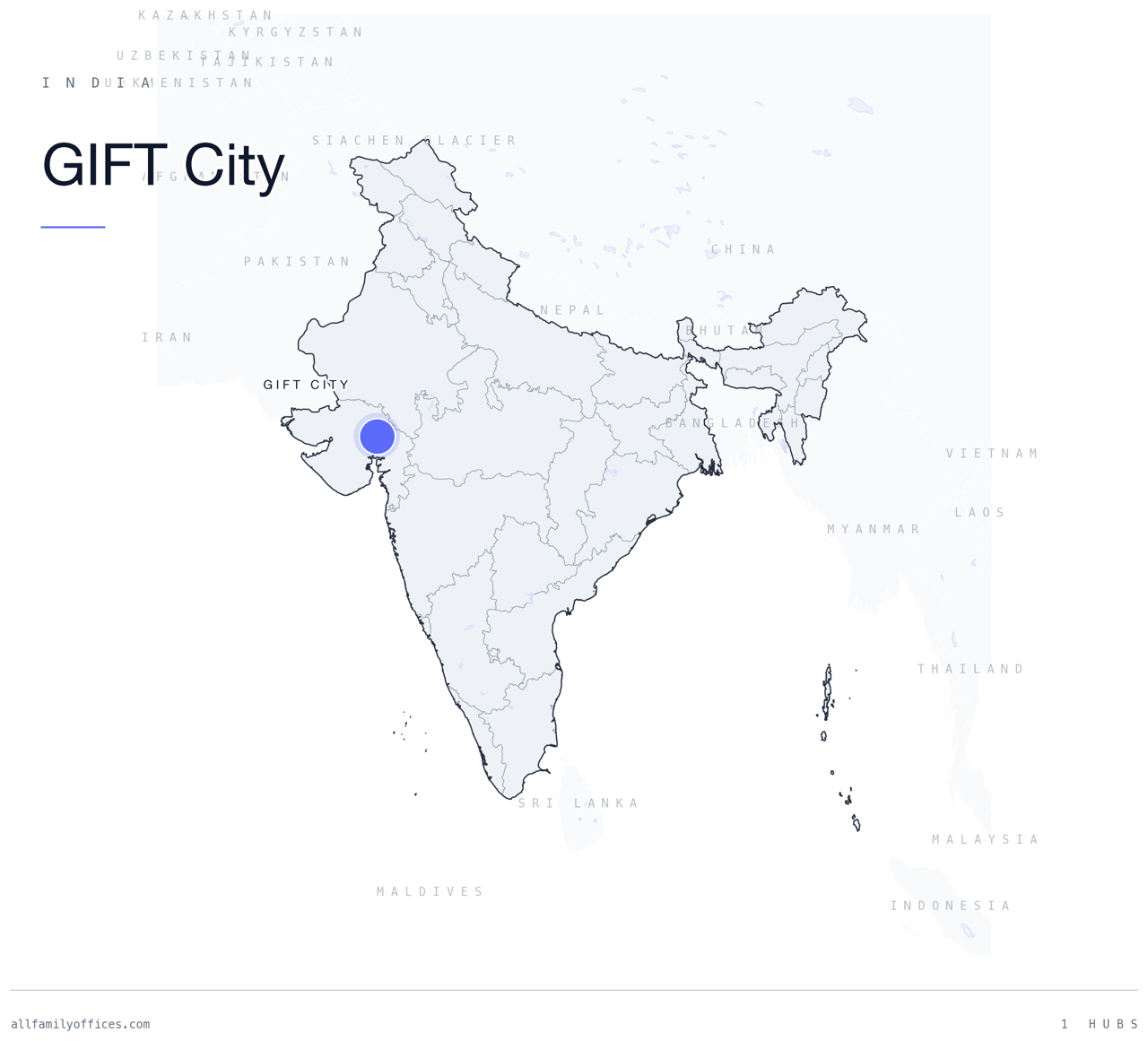
A Family Investment Fund is a self-managed fund registered with the IFSCA. It allows a single family to pool capital and invest globally through India's only International Financial Services Centre (IFSC). Located in Gandhinagar, Gujarat, GIFT City serves as India's answer to Singapore and Dubai for ultra-high-net-worth (UHNW) families seeking regulated, tax-efficient global allocation. The gift city family office ecosystem remains nascent, with roughly 12 to 15 approved FIFs, but momentum is building fast.
India's high-net-worth (HNI) population may surge 80% by 2031. The country's financial wealth could reach $5.5 trillion at a 10% annual growth rate. This expansion fuels demand for structured vehicles that offer global reach without the compliance burden of fully offshore setups.
GIFT City's cost advantage holds up under scrutiny: rentals, manpower, and fund administration fees run a fraction of what families pay in Dubai or Singapore. The $10 million minimum corpus matches Singapore's family office threshold.
Two of India's most prominent billionaires have filed applications to set up FIFs as LLPs in GIFT City. Infosys co-founder NR Narayana Murthy and Wipro founder Azim Premji both chose this route, signaling confidence in the framework.
However, a regulatory gap persists. The Reserve Bank of India (RBI) and IFSCA have yet to clarify whether FIF capital deployment counts as OPI or Overseas Direct Investment (ODI). No single family office (SFO) at GIFT City has executed foreign investments despite holding approvals. This OPI versus ODI ambiguity remains the single biggest obstacle for families considering this financial hub.
Family Office and Service Provider Comparison at a Glance
The GIFT City ecosystem blends actual family offices, fund management platforms, multi-family office (MFO) advisors, and specialist service providers. The table below categorizes each entity by its primary role.
| Entity | Role | AUM Estimate | Primary Focus | Key Services | Location |
|---|---|---|---|---|---|
| Artha Bharat Investment Managers | Fund Management Platform | $800M+ (targeting $3B by 2030) | Third-party fund management for FIFs and fund managers | Regulatory setup, fund admin, compliance | GIFT City |
| Waterfield Advisors | MFO / Advisory | — | FIF advisory and wealth management | FIF structuring, charitable giving, investment strategy | Mumbai (GIFT City practice) |
| Lighthouse Canton | Asset Management | — | Category III AIF targeting HNIs and family offices | Hedge funds, PE, real estate, venture debt | Singapore (GIFT City operations) |
| Axis Bank IBU | Banking / FIF Structuring | — | FIF setup and banking services | International banking, investment advisory, compliance | GIFT City |
| Treelife | Advisory / Consulting | — | FIF setup and IFSCA registration | End-to-end FIF advisory, AIF structuring, SEZ guidance | GIFT City |
| IQ-EQ India | Fund Administration | — | Administration for AIFs and family offices | Fund admin, compliance, corporate secretarial | GIFT City |
| Apex Group | Fund Services | — | Fund administration and FIF support | Financial reporting, corporate services, FIF setup | GIFT City |
| Catalyst Trusteeship | Trusteeship | — | First IFSCA-licensed debenture trustee (since 2021) | FIF trusteeship, AIF trusteeship, family trust drafting | GIFT City |
| GiftCFO | Advisory | — | FIF registration and CFO support | FME registration, compliance, tax structuring | GIFT City |
| Bathiya | Legal / Advisory | — | FIF structuring and FEMA compliance | Regulatory advisory, corporate finance | GIFT City |
Artha Bharat stands out as the only entity with a disclosed AUM figure, managing over $800 million with ambitions to triple that by 2030. Most other entities function as advisory or administrative partners rather than direct wealth managers. This reflects GIFT City's early-stage ecosystem, where the support layer matures faster than the family office population itself.
Top Picks by Strategy
- Largest AUM in GIFT City: Artha Bharat Investment Managers, the first IFSCA-licensed third-party fund management platform, manages over $800 million. The firm holds advanced talks with five new fund teams.
- Best for FIF Structuring Advisory: Treelife provides end-to-end guidance on IFSCA registration, AIF structuring, and SEZ approvals. Families starting from scratch find it the go-to consultant.
- Strongest MFO Platform: Waterfield Advisors offers full multi-family office services including FIF advisory, charitable giving strategy, and capital deployment planning tailored to GIFT City's rules.
- Top Fund Administration Provider: Apex Group operates a 20,000 square foot office in GIFT City with roughly 300 professionals, making it the largest single-source service provider in the zone.
- Best for NRI Investment Access: Lighthouse Canton runs a Category III AIF in GIFT City targeting HNIs, UHNIs, and family offices with strategies spanning hedge funds, real estate, and private equity.
- Leading Trusteeship Partner: Catalyst Trusteeship Limited, the first debenture trustee licensed by IFSCA in 2021, handles FIF trusteeship for contributory trust structures and private family trusts.
- Top Banking Partner for FIFs: Axis Bank's International Banking Unit pairs FIF structuring with foreign currency banking. Families gain a single counterparty for registration and capital deployment.
Top Family Offices and Service Providers in GIFT City: Detailed Profiles
Artha Bharat Investment Managers IFSC LLP
India's first IFSCA-licensed third-party fund management platform fills a critical gap for families entering GIFT City. Artha Bharat manages over $800 million (more than ₹7,000 crore) and targets $3 billion by 2030. Rather than managing a single family's wealth, it provides the regulatory rails, fund administration, and compliance oversight that enable other families and fund managers to launch FIF-style structures.
Five independent teams currently hold advanced discussions to launch funds on its platform. Families seeking to deploy capital through GIFT City without hiring a full principal officer team should evaluate Artha Bharat's model first. The firm is also expanding to Abu Dhabi Global Market and Dubai, signaling cross-border ambitions.
Waterfield Advisors
Waterfield delivers the broadest MFO advisory practice serving GIFT City families. The firm helps Indian families navigate every stage of FIF creation, from structure selection (Company versus LLP versus Trust) to allocation strategy and charitable giving. Based in Mumbai, Waterfield brings deep familiarity with both domestic wealth management and the IFSCA regulatory framework.
Families choosing between an onshore MFO model and a fully self-managed FIF benefit from Waterfield's ability to benchmark both paths. Their advisory extends beyond fund setup to family governance and succession planning, areas that become critical once wealth pools in a formal FIF structure.
Lighthouse Canton
For families who prefer a managed fund over a self-managed FIF, this Singapore-headquartered firm offers a tested alternative through its GIFT City Category III AIF. Lighthouse Canton's strategy spans hedge funds, real estate, private equity, direct lending, venture debt, venture capital, and public equities. The AIF structure sidesteps some of the OPI/ODI regulatory friction that blocks self-managed FIF foreign direct investments.
NRI families looking for diversified global exposure through a GIFT City vehicle will find this platform among the most relevant options. The firm targets HNIs, ultra-high-net-worth individuals, and family offices seeking co-investment access to institutional-grade strategies.
Axis Bank IBU (GIFT City)
Banks rarely appear in wealth platform profiles, but Axis Bank's International Banking Unit merits inclusion for a specific reason: it combines FIF structuring with foreign currency banking services. Families setting up a FIF need a banking partner inside GIFT City for corpus accumulation, foreign currency financing, and day-to-day treasury operations.
Axis Bank IBU delivers that under one roof. The unit also provides regulatory compliance support tailored to IFSCA requirements, reducing the number of counterparties a family must coordinate. GIFT City FIFs can borrow from local banks as a lower-cost alternative to Indian domestic funding, and Axis Bank facilitates those arrangements.
Treelife (GIFT City Division)
Treelife dominates the FIF setup consulting space in GIFT City, specializing in IFSCA registration, AIF structuring, and SEZ compliance. Families unfamiliar with GIFT City's regulatory specifics (principal officer requirements, fit and proper criteria, physical office mandates) rely on Treelife's end-to-end advisory to accelerate their applications.
The firm's roots in India's startup ecosystem bring a practical, execution-first approach rather than purely legal counsel. For families in the early stages of evaluating whether GIFT City suits their needs, Treelife's published guides and consultation services offer a low-friction entry point.
IQ-EQ India (GIFT City Office)
IQ-EQ brings institutional-grade fund administration to GIFT City's family office ecosystem. The global firm provides licensed administration, compliance, and corporate secretarial services for AIFs and family offices under IFSCA. Every FIF needs a fund administrator to handle net asset value calculations, regulatory filings, and investor reporting.
IQ-EQ's processes draw on experience servicing single family offices and pension funds in multiple markets. Their GIFT City office supports both FIF and non-retail AIF structures, giving families flexibility to evolve their vehicle type without changing administrators.
Apex Group (GIFT City Office)
Apex Group commits the largest physical footprint in the zone: roughly 300 professionals and 20,000 square feet of office space. Their offerings span fund administration, corporate services, financial reporting, and FIF setup support. Apex publishes regular research on the rise of FIFs, positioning itself as a knowledge partner alongside its operational role.
Families who need global-standard administration from day one benefit from Apex Group's presence in over 50 countries. The scale of their GIFT City commitment suggests long-term conviction in this financial hub's trajectory, especially for multi-jurisdiction structures.
Catalyst Trusteeship Limited
Catalyst occupies a unique niche as the first debenture trustee IFSCA licensed in 2021. The firm acts as trustee for FIFs using the contributory trust model and for AIFs in GIFT City. Families choosing the trust structure for succession planning need a qualified trustee who understands both IFSCA rules and private family trust dynamics.
Catalyst provides advisory, structuring, drafting, and execution services for private family trusts alongside FIF trusteeship. Their dual capability (family trust plus FIF trust) makes them essential for patriarchs who want to hold FIF shares inside a private trust for wealth preservation from one generation to the next.
Investment Trends Shaping This Market
AIF Workarounds for Overseas Exposure
Families from the automotive, manufacturing, and tech sectors band together to form pooled AIF structures in GIFT City. These Category III AIFs operate under a shared fund umbrella but allocate portfolios informally to individual families behind the scenes, serving as a workaround for the OPI/ODI regulatory freeze on self-managed FIFs.
IFSCA has pushed back, asking fund managers to certify their fund does not serve single-family needs. This tension will likely persist until the RBI provides formal clarity on overseas investment classification. Artha Bharat's platform model offers one regulated path for families seeking this pooled approach.
NRI Capital Repatriation Through GIFT City
The 2024 SEBI relaxation allowing 100% NRI/OCI contribution in IFSCA-regulated foreign portfolio investor (FPI) structures opened a new channel. The previous 50% cap limited diaspora participation. NRIs investing through NRE accounts face no tax collection at source (TCS), while NRO account holders can repatriate up to $1 million per financial year.
This rule change positions GIFT City as a two-way bridge: outbound for resident families, inbound for the diaspora. Lighthouse Canton's Category III AIF and IQ-EQ's fund administration services stand to benefit most from this NRI inflow.
Succession Planning Through Trust-Based FIFs
Indian families increasingly gravitate toward contributory trust structures for their GIFT City FIFs, driven by estate planning objectives. A corporate FIF set up by a family patriarch can have its shares held in a private family trust. This combines wealth preservation with ring-fencing from creditor claims.
The FIF charter document offers flexibility to define beneficial interests, set decision-making committees, and codify exit strategies. Catalyst Trusteeship handles both the FIF and family trust layers. As India's first generation of major tech and industrial wealth begins transfer to heirs, these trust-based FIF structures may become the default model.
Tax-Efficient Global Portfolio Building
FIFs can invest in listed and unlisted securities, real estate, bullion, art, derivatives, mutual funds, and AIFs in India and abroad. This breadth of permissible allocations surpasses what families access through direct LRS remittances or standard OPI channels.
Combined with 10-year income tax holidays, nil Securities Transaction Tax, stamp duty exemptions on IFSC exchange trades, and GST exemptions, GIFT City offers a tax-efficient platform for global asset building. The 20% TCS on LRS remittances (since July 2023) does reduce near-term cash flow for resident investors, though it adjusts against final tax liability.
How to Evaluate a Family Office Setup in GIFT City
The most important evaluation criterion in GIFT City is regulatory viability, not fee structure or service quality. Families must verify whether their intended capital deployment will fall under OPI or ODI classification before committing funds. This classification determines the cap (50% of net worth for OPI versus 400% for ODI) and the compliance burden.
No self-managed FIF has completed overseas investments as of early 2026. Families should demand evidence of a clear pathway before proceeding. For reference, only one GIFT City FIF (backed by a prominent industrialist) has received permission to invest abroad as a test case.
Structure selection carries long-term tax and succession consequences specific to GIFT City. An LLP pays roughly 10.48% alternate minimum tax but distributes profits tax-free to partners. A Company provides a nil MAT option under the concessional regime but faces 30% dividend tax to shareholders. A Trust (where Catalyst Trusteeship operates) offers succession planning flexibility but risks other income taxed at the maximum marginal rate.
Physical substance requirements distinguish GIFT City from paper-domicile jurisdictions. Every FIF must maintain a dedicated office and appoint a principal officer with at least five years of relevant financial services experience and a qualifying professional degree. IFSCA enforces fit and proper standards and can suspend registrations. Families evaluating service providers like Treelife, GiftCFO, or Bathiya should assess whether those firms can source qualified principal officers and office space within realistic timelines.
Cost comparison matters at the margin. GIFT City's administration, rental, and manpower costs fall well below Singapore or Dubai, but the $10 million minimum corpus and three-year accumulation timeline apply regardless. Families with total investable wealth below $20 million may find the corpus requirement absorbs too large a share of liquid assets. For co-investment exposure at lower capital thresholds, the multi-family pooled AIF route through Artha Bharat or Lighthouse Canton offers an alternative.
Which Family Office Structure Fits Your Needs?
UHNW families with $50 million or more in liquid assets and a clear mandate for global portfolio building should explore the self-managed FIF route through direct IFSCA registration. Waterfield Advisors can guide the MFO-style advisory path, while Catalyst Trusteeship and Treelife support structuring and the trustee layer. These families benefit most from the 10-year tax holiday and the breadth of permissible allocations, provided they can absorb the OPI/ODI regulatory uncertainty.
Business owners planning liquidity events from manufacturing, tech, or automotive ventures may prefer the pooled AIF approach as a near-term alternative. Artha Bharat's third-party platform and Lighthouse Canton's Category III AIF provide managed exposure to global asset classes without the regulatory friction of a standalone FIF. This path suits families who want GIFT City's tax benefits but lack the bandwidth to hire a principal officer and maintain physical office substance.
NRI families and overseas citizens of India represent a distinct opportunity set. The 100% NRI/OCI contribution allowance for IFSCA-regulated FPIs removes a major barrier. NRIs investing through NRE accounts enjoy full repatriation without TCS, making GIFT City competitive with Singapore's variable capital company structure. IQ-EQ and Apex Group offer the institutional-grade fund administration that NRI families accustomed to global standards expect. Next-generation wealth holders inheriting family businesses should prioritize the trust-based FIF model for succession planning, using Catalyst Trusteeship's combined family trust and FIF trusteeship capability.
Methodology
This guide to gift city family office options and Family Investment Funds draws on IFSCA regulatory filings, the IFSCA (Fund Management) Regulations 2022 and 2025 updates, and published data from fund administrators and advisory firms operating in GIFT City. Entity profiles reflect publicly available information as of early 2026. AUM figures appear only where the entity itself disclosed them; no figures have been estimated. The ecosystem evolves rapidly, and families should verify regulatory status and pathway viability with licensed advisors before committing capital. Service provider inclusion reflects documented GIFT City operations and IFSCA licensing, not paid placement.
Frequently Asked Questions
 Google AI Mode
Tells Google to show you more from AllFamilyOffices in AI, Search and Discover.