
On This Page
- Key Facts About Latin American Family Offices
- Latin American Family Offices: Landscape Overview
- Family Office Comparison
- Top Picks by Strategy
- Top 11 Family Offices in Latin America in Detail
- Investment Trends Shaping This Market
- How to Evaluate a Family Office in Latin America
- Which Family Office Fits Your Needs?
- Methodology
- Frequently Asked Questions
Key Facts About Latin American Family Offices
- The AllFamilyOffices database lists 170+ family offices in Latin America (October 2026). Mexico hosts the largest share by assets under management (AUM).
- The Slim family's holdings through Grupo Carso and América Móvil total roughly $200 billion in assets. This makes it the largest family office structure in the region by a wide margin.
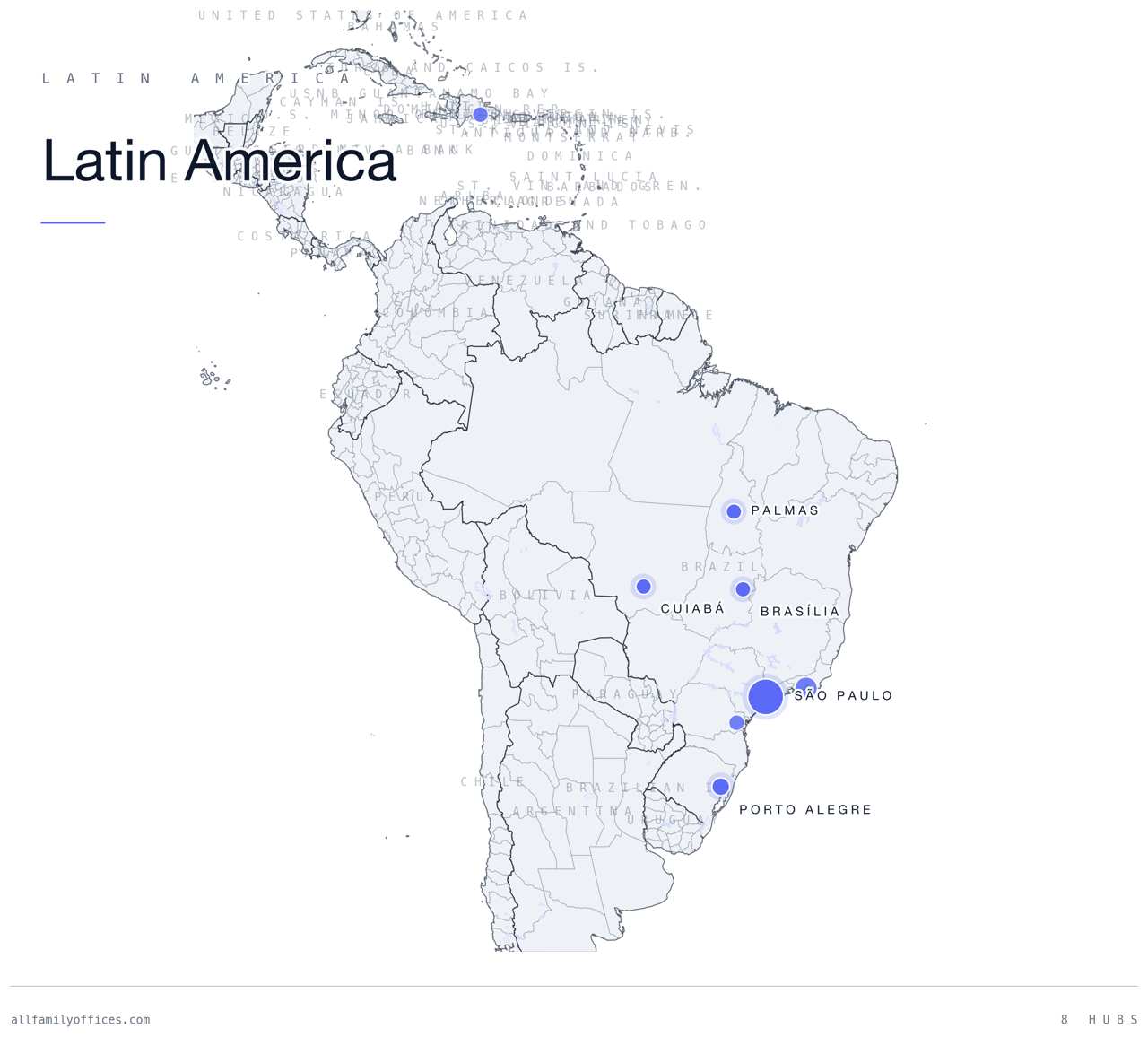
- Mexico City, São Paulo, Monterrey, and Santiago serve as primary family office hubs. Miami functions as the key US gateway for ultra-high-net-worth (UHNW) families moving capital.
- Most LATAM family offices operate as holding-company structures embedded within industrial conglomerates, not as standalone wealth advisory firms.
- Multi-family office (MFO) options remain limited. WE Family Offices ($14.1 billion AUM) and Turim (recognized as Latin America's leading FO services provider in 2025) rank among the few dedicated platforms.
- Key themes for 2025 and 2026 include operator-led energy deals, nearshoring-driven capital deployment, fintech built on retail distribution networks, and cross-border real estate.
Latin American Family Offices: Landscape Overview
Latin American family offices differ from their US and European counterparts in one critical way. Most are not standalone advisory firms. They function as holding companies controlling industrial conglomerates, with listed subsidiaries generating cash flow that gets redeployed into new sectors. The top ten offices by AUM manage a combined $237 billion. Nearly all trace their wealth to a single industry: telecom, mining, food, or energy.
Mexico dominates the landscape. Five of the ten largest offices by AUM are based in Mexico City or Monterrey, led by the Slim family's $200 billion empire. Brazil ranks second, with the Safra banking dynasty and smaller SFOs like Luxor and Maubisa operating from São Paulo and Rio de Janeiro.
Central America and the Caribbean contribute a distinct cluster. Guatemala's Bosch-Gutiérrez family (CMI), El Salvador's Kriete and Poma families, Panama's Motta family, and Jamaica's GraceKennedy conglomerate all operate from this sub-region.
Miami plays a unique bridging role. A dedicated regional network based there connects LATAM wealth platforms with the US ecosystem. Many UHNW families maintain dual structures, keeping operating businesses in their home country while managing liquid portfolios and estate planning from Florida. Cross-border tax planning, currency hedging, and asset protection drive this migration. Fort Lauderdale has also emerged as a secondary hub, hosting a dedicated LATAM family office forum each November.
Family Office Comparison
The following table compares the largest family offices in Latin America by AUM, capital focus, and structure. All figures reflect publicly available data as of 2025.
| Family Office | Type | AUM Estimate | Investment Focus | Location |
|---|---|---|---|---|
| Slim Family (Grupo Carso / América Móvil) | SFO / Holding | $200B | Telecom, energy, infrastructure | Mexico City |
| WE Family Offices | MFO | $14.1B | Diversified wealth management | New York & Miami |
| Garza Family (FEMSA / OXXO) | SFO / Holding | $6B | Proximity retail, Coke bottling, fintech | Monterrey |
| Servitje Family (Grupo Bimbo) | SFO / Holding | $5.9B | Global bakery, sustainability | Mexico City |
| Garza Sada Families (ALFA / Alpek) | SFO / Holding | $4.14B | Food, petrochemicals | Monterrey |
| Baillères Family (Grupo Bal) | SFO / Holding | $3.96B | Silver/gold mining, insurance | Mexico City |
| Kriete Family (Abra Group) | SFO / Holding | $3.88B | Aviation, transportation | El Salvador |
| Poma Family (Grupo Poma) | SFO / Holding | $3.3B | Hospitality, real estate | El Salvador |
| Motta Family (Inversiones Bahía) | SFO / Holding | $2.97B | Aviation, banking, insurance | Panama City |
| Bosch-Gutiérrez Family (CMI) | SFO / Holding | $2B | Food, renewables | Guatemala City |
| GraceKennedy (Mahfood family) | SFO / Conglomerate | $2B | Financial services, insurance | Kingston, Jamaica |
Mexican families dominate the top tier, controlling seven of the eleven entries. WE Family Offices stands out as the only MFO with publicly reported AUM. This highlights how few dedicated multi-family platforms serve the region. The AUM gap between the Slim family ($200 billion) and the next largest office ($6 billion) reflects the extreme wealth concentration typical of LATAM markets.
Top Picks by Strategy
- Largest AUM: Slim Family (Grupo Carso) controls $200 billion in assets spanning telecom, energy, and development, dwarfing every other office in the region.
- Top Energy Operator: Slim Family again, with a $1.99 billion Pemex drilling contract at the Ixachi field (September 2025) and 80% ownership of Talos Mexico's Zama position.
- Best for Proximity Retail and Fintech: Garza Family (FEMSA/OXXO) combines Latin America's largest convenience store network with emerging payments systems, posting 6.3% year-over-year revenue growth in Q2 2025.
- Strongest Renewables Platform: Bosch-Gutiérrez Family (CMI) operates 800+ MW of renewable energy in six countries. Its IERL issuer holds a BB/Stable rating as of March 2025.
- Leading MFO for LATAM Families: WE Family Offices manages $14.1 billion for 80+ families in the US, Latin America, and Europe, offering full outsourced family office services.
- Top Hospitality Allocator: Poma Family (Grupo Poma) opened two IHG-branded hotels in Lima in mid-2025. The family also secured a JW Marriott franchise in San Salvador, building a regional hotel portfolio through brand partnerships.
- Best Succession Model: Motta Family (Inversiones Bahía) completed a structured leadership transition in 2025. Founder Stanley Motta moved to Executive Chairman while maintaining patient control capital in Copa Holdings, Banco General, and ASSA.
Top 11 Family Offices in Latin America in Detail
Slim Family (Grupo Carso / Control Empresarial / América Móvil)
The Slim family office operates as the region's largest capital deployment machine, with $200 billion in assets spanning telecom to deep-water drilling. What separates this office from peers is its willingness to act as an operator-financier, taking on complex energy projects that institutional investors avoid.
In December 2024, the Slim-controlled vehicle Zamajal acquired an additional 30.1% of Talos Mexico's unit. The deal cost $49.7 million at close plus $33 million on first oil, bringing ownership to 80%. By September 2025, Grupo Carso signed a $1.99 billion contract with Pemex to drill up to 32 wells at the Ixachi field. Families or fund managers seeking co-investment in Mexico's energy sector will find few counterparties with comparable scale and regulatory alignment.
Garza Family (FEMSA / Coca-Cola FEMSA / OXXO)
FEMSA's strategic clarity makes it a case study in portfolio simplification. The Garza family spent 2024 and 2025 shedding non-core assets, completing a logistics divestiture and finalizing the Heineken stake exit. The result is a leaner entity focused on proximity retail through OXXO, Coke bottling, and emerging fintech adjacency.
Q2 2025 revenue climbed 6.3% year over year. OXXO's distribution footprint is gradually becoming a payments and financial services origination channel. The family converts foot traffic into fintech rails, a model that turns physical retail density into low-cost customer acquisition.
Servitje Family (Grupo Bimbo)
Grupo Bimbo committed over $2 billion to Mexico operations and sustainability between 2025 and 2028. This is the largest domestic capex plan among LATAM food companies. The firm is an operating compounder: global bakery brands, dense distribution routes, and disciplined capital allocation.
The spending targets automation, cold-chain efficiency, and energy reduction. For service providers or co-investors, the entry point lies in deals tied to measurable operational ROI (energy savings per plant, route density optimization) rather than broad sustainability narratives.
Garza Sada Families (ALFA / Sigma Alimentos / Alpek)
The Monterrey-based Garza Sada families executed one of the region's most notable corporate restructurings in April 2025. They spun off Controladora Alpek (CTALPEK) as a separately listed entity. Shareholders received one CTALPEK share per ALFA share.
Sigma Alimentos, the food arm, reported $305 million in Q2 2025 EBITDA ($576 million year-to-date). This is oversight-driven value creation: separating petrochemicals from food lets each business attract its own investor base and index inclusion.
Baillères Family (Grupo Bal / Peñoles / Fresnillo / GNP)
Grupo Bal pairs listed mining transparency with family control, a rare combination in Latin America. Fresnillo maintained its 2025 production guidance of 49 to 56 million ounces of silver and 525,000 to 580,000 ounces of gold. Peñoles received a stable S&P outlook in May 2025.
The family also controls GNP, one of Mexico's largest insurance companies. For wealth managers evaluating precious metals exposure with strong oversight quality, this office sets the regional benchmark.
Kriete Family (Avianca / Abra Group)
The Kriete family is building Latin America's dominant aviation platform through Abra Group. This holding company combines Avianca and GOL. In October 2025, Abra ordered 50 A320neo and five A350-900 aircraft while confidentially filing for a US IPO.
A330-900neo widebody lease agreements followed, with deliveries planned for 2026. The thesis combines network reach, loyalty programs, and cost discipline. The IPO filing signals a shift from private family control toward public capital markets, a potential liquidity event for co-investors in the aviation sector.
Poma Family (Grupo Poma / Real Hotels & Resorts)
Grupo Poma stands out for its brand-partnership strategy in hospitality. Between June and July 2025, the family opened the InterContinental Real Lima Miraflores and Hotel Indigo Lima Miraflores, expanding into Peru. A JW Marriott franchise agreement for San Salvador followed a 2024 deal. With $3.3 billion in assets, the Poma family compounds through mixed-use development anchored by global hotel brands, reducing demand risk while retaining real estate upside.
Motta Family (Inversiones Bahía)
Inversiones Bahía exemplifies patient control capital with Caribbean and Central American reach. The Motta family holds stakes in Copa Holdings (NYSE-listed airline), Banco General (Panama's largest private bank), and ASSA (regional insurer). In 2025, founder Stanley Motta transitioned to Executive Chairman as part of a formal succession plan.
This is one of the few LATAM offices where generational wealth transfer follows a visible, structured process rather than informal family negotiation.
Bosch-Gutiérrez Family (CMI / Corporación Multi Inversiones)
CMI operates a dual flywheel: food manufacturing and renewable energy. The energy arm exceeded 800 MW of installed renewable capacity in six countries, including the Mata de Palma solar project in the Dominican Republic. On the food side, CMI acquired Del Real Foods in October 2024, entering the US Hispanic foods market.
The IERL renewables issuer held a BB/Stable rating as of March 2025. This 100-year-old family corporation bridges Central America and North America with both operating businesses and structured green capital.
GraceKennedy (Mahfood Family)
GraceKennedy converts a Caribbean food distribution legacy into a regional financial services platform. By July 2025, GraceKennedy Financial Group acquired roughly 99% of Key Insurance, consolidating a core vertical. The broader strategy focuses on payments, remittances, and general insurance, building financial rails from an existing distribution network.
For allocators interested in Caribbean financial systems, GraceKennedy offers exposure to a market where few private wealth offices have comparable reach.
WE Family Offices
WE Family Offices is the largest dedicated MFO serving LATAM families. It manages $14.1 billion for over 80 families in the US, Latin America, and Europe. Services span fully outsourced family office operations, portfolio management, estate and tax planning, family governance, and risk management.
UHNW families with $100 million or more in liquid assets who need a turnkey solution should consider WE. Its platform ranks among the broadest available, eliminating the cost of building a standalone SFO.
Investment Trends Shaping This Market
Operator-Led Energy Deals in Mexico
LATAM family offices act as principal developers in energy projects, bypassing traditional private equity intermediaries. The Slim family's $1.99 billion Ixachi drilling contract with Pemex and its 80% stake in Talos Mexico's Zama field show families deploying capital as operators, not passive investors. These deals align with Mexico's national energy priorities and require EPC fluency, not fund-style pitch decks.
Corporate Restructuring to Surface Value
Monterrey-based families use spin-offs and listings to unlock trapped value. ALFA's April 2025 spin-off of Controladora Alpek created a separate petrochemicals listing, allowing Sigma Alimentos to stand on its own valuation. FEMSA followed a similar playbook by exiting Heineken and divesting logistics. These moves create index eligibility, improve free float, and attract sector-specific investors who previously avoided conglomerate discounts.
Distribution Networks Becoming Fintech Rails
Retail ecosystems built over decades are morphing into origination channels for financial services. OXXO's convenience store network is layering payments and fintech onto its foot traffic. GraceKennedy builds insurance and remittance rails from its Caribbean distribution base. This trend centers on data-rich, low-cost customer acquisition through existing physical networks rather than "fintech" as a standalone category.
Cross-Border Wealth Migration to Miami
LATAM families are accelerating their presence in Florida. Political instability, capital controls, and the need for dollar-denominated asset protection drive this shift. A dedicated regional wealth network operates from Miami specifically to bridge this migration.
Dual structures (home-country operations plus US-based wealth management) are now standard for families above $100 million in liquid assets. Cross-border estate planning and FATCA compliance add complexity that favors firms with bi-jurisdictional expertise.
How to Evaluate a Family Office in Latin America
The holding-company model dominant in this region requires different evaluation criteria than a traditional MFO assessment. Start with structure. Most LATAM offices embed within conglomerates with listed subsidiaries (Grupo Carso, ALFA, FEMSA). Verify whether the "family office" function is a formal entity or simply the family's treasury team managing excess cash flow.
Cross-border regulatory expertise matters more here than in any other region. Families operating between Mexico, Central America, and the US face capital controls, FX volatility, and changing political regimes. Evaluate whether the office or its advisors can navigate multiple jurisdictions at once. WE Family Offices and legal firms like Holland & Knight and MEG International specialize in this cross-border structuring.
Succession planning readiness is a critical differentiator. Nearly 30% of family offices globally lack a structured approach to preparing the next generation. In Latin America, where dynastic management culture runs deep, unplanned transitions carry outsized risk. The Motta family's formal succession in 2025 and CMI's 100-year multi-generational continuity represent best practices. Ask whether the office has a documented family oversight framework, a family constitution, or at minimum a succession timeline.
Currency management capability separates serious LATAM offices from those exposed to avoidable losses. Many offices denominate operations in Mexican pesos, Brazilian reais, or Colombian pesos. Yet wealth preservation goals tie to US dollars. The resulting gap means FX hedging discipline directly affects long-term returns. Evaluate track record through specific downside scenarios, not generic "risk management" claims.
Which Family Office Fits Your Needs?
UHNW families with $100 million or more in liquid assets should evaluate WE Family Offices. It is the only MFO in the region managing over $14 billion with dedicated LATAM expertise. Turim in Brazil offers a strong alternative for families prioritizing next-generation education, family oversight, and charitable giving, especially those based in São Paulo or Rio de Janeiro.
Business owners planning liquidity events from industrial or agricultural operations face a distinct challenge in Latin America. Most SFOs are closed, family-controlled entities that do not accept outside clients. The practical options include engaging an MFO like WE or building a virtual family office through firms like MEG International. Joining regional peer networks also provides deal flow and co-investment access. Families in Central America or the Caribbean may find that the Motta or Poma family networks offer informal co-investment pathways for development and hospitality deals.
Next-generation wealth holders inheriting from first-generation industrialists need offices with formal succession structures and estate planning in multiple jurisdictions. Managing assets spread between Monterrey, Miami, and Panama City requires bilingual, bi-jurisdictional advisory capability. Regional forums held in Fort Lauderdale and Mexico City provide vetted peer environments where rising-generation leaders build the relationships that drive future deal flow.
Methodology
This guide to latin american family offices draws on publicly reported AUM figures, corporate filings, deal announcements, and industry database listings from 2024 and 2025. Office profiles rely on verified transaction data, production guidance, and oversight disclosures rather than self-reported marketing materials. Capital figures for the top ten offices correspond to data compiled by industry platforms tracking LATAM family capital. When public AUM data did not exist, the analysis assessed offices based on capital focus, deal activity, and geographic reach. The article covers only offices with sufficient public data to support editorial analysis and excludes those operating entirely in private without verifiable deal records.