On This Page
Key Facts
- Mexico's 15 billionaire family clans hold a combined $33.3 billion in tracked wealth. The Slim family alone controls an estimated $200 billion in assets under management (AUM).
- Over 90% of Mexican businesses are family-owned, and 95% of those have a family member in a management role.
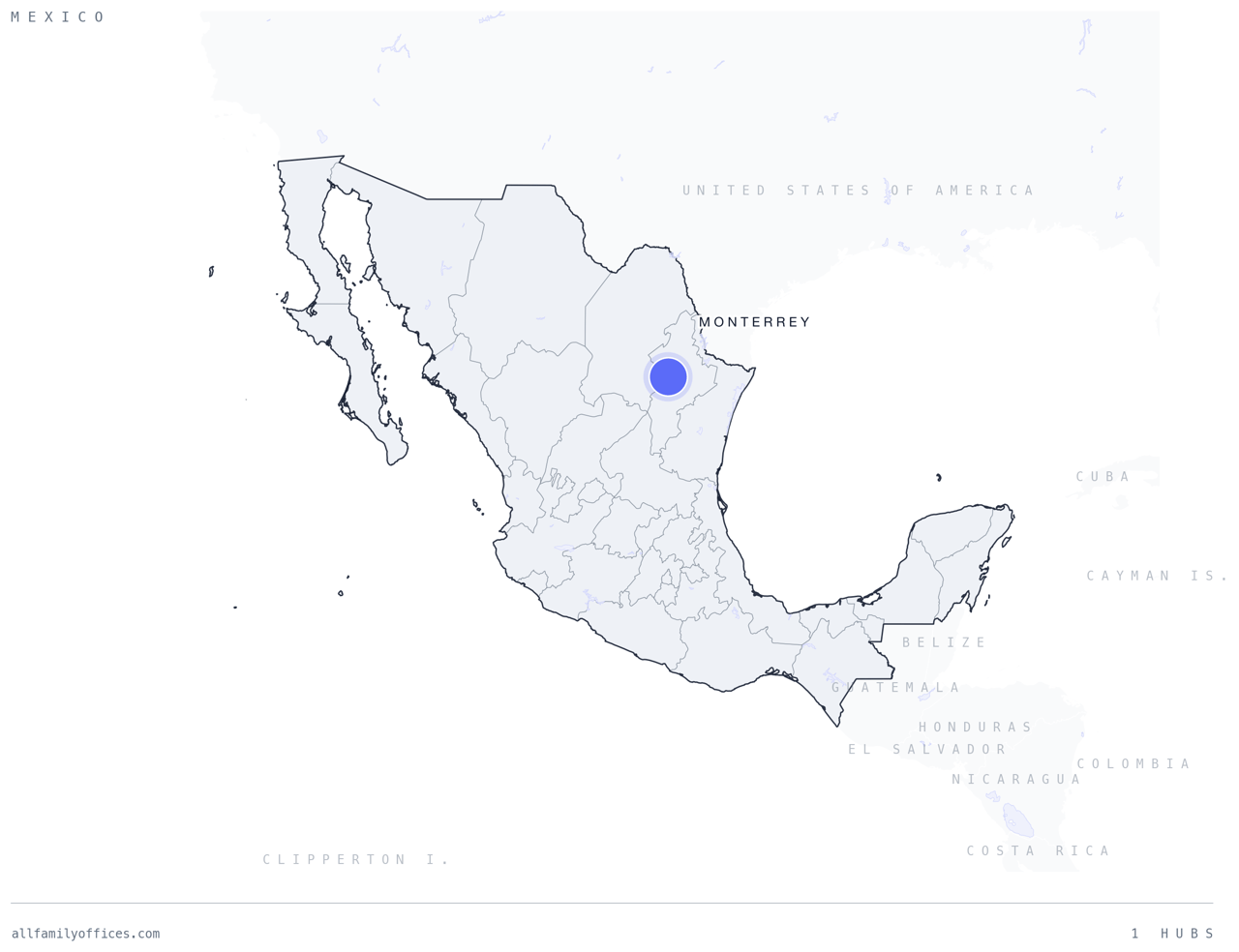
- Mexico City and Monterrey serve as the two primary hubs for family office activity. Mexico City favors conglomerate-style single family offices (SFOs), while Monterrey hosts a growing number of multi-family offices (MFOs).
- Promecap manages $3.5 billion or more from Mexico City, making it one of the few formal MFO platforms in the country.
- Nearshoring and energy transition deals drive new capital flows. Grupo Carso signed a $1.99 billion drilling contract with Pemex in September 2025.
- Only about 53% of family offices globally have wealth succession plans in place. Several prominent Mexican dynasties are now working to close that gap.
Mexican Family Office Landscape Overview
Mexico's family office market differs from those in the U.S. or Europe in one critical way: the dominant structure is a family-controlled conglomerate, not a standalone wealth management entity. Families like the Slims, the Baillères clan, and the Servitje family manage dynastic wealth through vertically integrated business empires that function as de facto SFOs. Mexico City generates roughly 16% of the nation's $1.41 trillion GDP and hosts the largest concentration of these family enterprises.
Monterrey operates as a secondary hub with a distinct industrial character. The Garza Sada families control ALFA, Sigma Alimentos, and the newly listed Controladora Alpek. The Clariond and Canales families run dedicated vehicles that emerged after the $3.2 billion sale of Grupo IMSA to Ternium in 2007. Monterrey-based private wealth offices tend to favor direct investments in manufacturing, real estate, and cross-border deals with Texas counterparts.
Formal MFO platforms remain rare compared to Brazil or Chile. Promecap transitioned from a private equity fund to an MFO in 2008 and now manages over $3.5 billion. Americana Partners International launched its Latin American division in June 2024, led by Jorge Suárez-Vélez, to serve ultra-high-net-worth (UHNW) Mexican families seeking U.S. exposure. The firm started with roughly $600 million in assets, backed by a parent company overseeing $7 billion.
Family Office Comparison
The table below ranks the largest family offices in Mexico by estimated assets where data is available. Most Mexican wealth managers do not disclose precise AUM figures, so revenue or net worth proxies appear where applicable.
| Family Office | Type | AUM Estimate | Investment Focus | Location |
|---|---|---|---|---|
| Slim Family (Grupo Carso / América Móvil) | SFO/Conglomerate | $200B | Telecom, energy, systems | Mexico City |
| FEMSA / Garza Family | SFO/Conglomerate | $5.9B | Retail (OXXO), Coke bottling, fintech | Monterrey / Mexico City |
| ALFA / Garza Sada Families | SFO/Conglomerate | $4.14B | Petrochemicals, food | Monterrey |
| Promecap | MFO | $3.5B+ | Private equity, public equities, debt | Mexico City |
| Tresalia Capital (Aramburuzabala) | SFO | — | Real estate, technology, PE, media | Mexico City |
| Grupo Bal (Baillères Family) | SFO/Conglomerate | — | Mining (silver, gold), insurance | Mexico City |
| Grupo Bimbo (Servitje Family) | SFO/Conglomerate | — | Food manufacturing, sustainability | Mexico City |
| Grupo México (Larrea Family) | SFO/Conglomerate | — | Copper mining, freight | Mexico City |
| M Mountain Capital | Investment Platform | $88M+ | Lower middle market (US) | Monterrey / Connecticut |
| Americana Partners International | MFO | $600M+ | Cross-border wealth advisory | Houston (Mexico-focused) |
The gap between the Slim family's $200 billion and the next-largest tracked entity (FEMSA at $5.9 billion) reflects both the Slim empire's sheer scale and the opacity of most Mexican family wealth. The Baillères and Servitje clans control enterprises generating $10 billion and $21.6 billion in annual revenue, respectively. Neither reports investable capital managed separately from operating businesses.
Top Picks by Strategy
- Largest AUM: Slim Family (Grupo Carso / América Móvil), with $200 billion in estimated assets and active energy deal-making worth billions
- Best for Direct Investments: Tresalia Capital, which deployed capital from a $20 billion Modelo exit into real estate (Abilia), technology (KIO Networks), and venture bets like Kavak
- Top Mining Allocator: Grupo Bal (Baillères Family), controlling Fresnillo and Peñoles with 2025 guidance of 49 to 56 million ounces of silver and 525 to 580 thousand ounces of gold
- Strongest MFO Platform: Promecap, managing $3.5 billion with membership in a leading global wealth network and a full suite of private equity, equities, and debt strategies
- Leading Cross-Border Connector: Americana Partners International, purpose-built in 2024 for Mexican UHNW families seeking U.S. real estate and technology exposure
- Most Active in Family Governance Value Unlock: Garza Sada families, who engineered the ALFA-to-CTALPEK spin-off listed April 2025 to surface petrochemical value
- Best for Nearshoring-Adjacent Deals: M Mountain Capital, backed by four Monterrey-based family offices and targeting lower middle market North American companies
Top 10 Family Offices in Mexico in Detail
Slim Family (Grupo Carso / Control Empresarial / América Móvil)
The Slim family controls an estimated $200 billion in assets spanning telecom, energy, and heavy construction, making them the undisputed leader on any list of Mexican family wealth. In December 2024, the family's Zamajal vehicle acquired an additional 30.1% stake in Talos Mexico for $49.7 million at close plus $33 million on first oil. Nine months later, Grupo Carso signed a $1.99 billion contract with Pemex to drill up to 32 wells at the Ixachi field.
Carlos Slim Domit now chairs the América Móvil board while brother Patrick serves as vice-chair. This second-generation transition keeps the family as Latin America's most powerful capital allocator.
Tresalia Capital (Aramburuzabala Family)
María Asunción Aramburuzabala turned a succession crisis into an $8.2 billion fortune. Her father died in 1995 with no finalized succession plan. She co-founded Tresalia Capital with roughly $500 million from a deal that sold a minority stake in Grupo Modelo to Anheuser-Busch for $1.6 billion.
After the full $20 billion Modelo sale in 2013, she reinvested into AB InBev shares. She then spread capital into real estate through Abilia (developer of Parques Polanco), technology through KIO Networks, media via Grupo Televisa, and venture plays including Kavak and Luuna. Two sons in their thirties now prepare to take over, this time with a formal wealth transfer framework.
FEMSA / Garza Family
FEMSA functions as a wealth preservation machine built on proximity retail and bottling. The family spent 2024 and 2025 simplifying the portfolio: exiting Heineken, divesting logistics, and concentrating on OXXO convenience stores and Coca-Cola FEMSA. Second-quarter 2025 revenue rose 6.3% year over year.
The strategic pivot toward payments and fintech adjacency through OXXO's retail network positions this conglomerate as a data-rich origination channel. Fund managers seeking co-investment should model FX translation risk and working-capital cycles rather than pitching broad themes.
Grupo Bal (Baillères Family)
The Baillères family controls the world's largest refined silver producer and one of Latin America's top gold miners through Industrias Peñoles and Fresnillo. After Alberto Baillères died in 2022, son Alejandro Baillères Gual took the reins alongside five siblings. Grupo Bal also owns GNP, which covers roughly 20% of Mexico's insurance market.
This third-generation office combines listed transparency with family control, a structure uncommon in the region. The mining portfolio provides natural commodity exposure that many institutional allocators seek through direct relationships rather than fund vehicles.
Garza Sada Families (ALFA / Sigma / Alpek)
The Monterrey-based Garza Sada dynasties executed one of 2025's most notable corporate restructurings. The ALFA-to-Controladora Alpek spin-off listed on April 7, 2025, giving shareholders one CTALPEK share per ALFA share. Post-separation, Sigma Alimentos reported $305 million EBITDA in the second quarter of 2025 ($576 million year-to-date). This split separated petrochemicals from food, letting each unit attract its natural investor base through oversight-driven value creation.
Grupo Bimbo (Servitje Family)
The world's largest baking company runs a $21.6 billion revenue operation, selling over 100 brands in 34 countries through 215 bakeries. In July 2025, Bimbo committed over $2 billion to Mexican operations and sustainability from 2025 through 2028. Daniel Javier Servitje Montull chairs the company, continuing a family enterprise that started in 1945 as Panificación Bimbo. The plan focuses on automation, cold-chain efficiency, and energy savings, translating sustainability into unit economics.
Grupo México (Larrea Mota-Velasco Family)
Grupo México is the country's and Peru's top copper producer and the world's fourth largest. The $14 billion revenue company operates mining, freight transportation, and supporting segments. With copper demand rising from energy transition and electrification, these assets position the Larrea family for long-term capital growth.
Germán Larrea Mota-Velasco co-founded the current entity in 1978 and maintains operational control with minimal outside oversight. This hands-on SFO pattern remains common in Mexico City, where conglomerate founders retain tight decision-making authority.
Promecap
Promecap stands as Mexico's most established formal multi-family office, and one of only two Latin American members of a leading global wealth management network. The firm started as a private equity fund in 1997, converted to an MFO in 2008, and now manages $3.5 billion or more. Based in the Bosques de las Lomas neighborhood of Mexico City, it invests in private equity, public equities, and debt.
UHNW families seeking a regulated, professional wealth platform with deep private equity roots will find few local alternatives with this track record.
Valores Aldabra and M Mountain Capital (Clariond / Canales Families)
The 2007 sale of Grupo IMSA to Ternium for $3.2 billion created two distinct allocation vehicles for these Monterrey families. Valores Aldabra (Clariond family) channels capital into financial services, aluminum, real estate, and sustainable packaging.
Four family offices from the same IMSA lineage backed M Mountain Capital, which targets lower middle market North American companies with an initial $88 million platform. Their portfolio includes Victor Technology, Frontera Strategies, and On Deck Sports. The platform offers co-investment access for other wealthy families looking to deploy capital in the U.S.
Americana Partners International
This Houston-based MFO launched its Latin American division in June 2024, targeting Mexican UHNW families in Mexico City and Monterrey. Led by Jorge Suárez-Vélez, formerly of Allen & Company, the firm bridges Texas and Mexican family capital. Starting assets sit around $600 million, backed by parent firm Americana Partners' $7 billion in managed assets.
The pitch is straightforward: help Mexican families access U.S. income-producing real estate, AI, biotech, and energy deals uncorrelated to their domestic business risks.
Investment Trends Shaping This Market
Operator-Led Energy Deals
Mexican family offices act as principal developers rather than passive investors in energy. Grupo Carso's $1.99 billion Ixachi drilling contract with Pemex and the Zamajal/Talos Mexico deal show families deploying capital with EPC capability and alignment to national energy priorities. This operator-financier model is distinct to Mexico, where regulatory cadence and Pemex relationships create barriers for foreign entrants.
Corporate Restructuring for Liquidity
The ALFA-to-CTALPEK spin-off typifies a Monterrey-school approach: families doing hard structural work to surface hidden value. By separating petrochemicals from food, the Garza Sada families unlocked distinct investor bases and improved index eligibility. Expect more listed Mexican family conglomerates to pursue similar strategies as free-float and liquidity considerations gain weight.
Cross-Border Capital Deployment
Mexican UHNW families move capital into U.S. real estate, technology, and energy at an increasing pace. Peso volatility, judicial reform uncertainty, and generational shifts fuel this trend. Americana Partners International exists solely for this corridor. M Mountain Capital and Investar Capital (created by the Soriana co-founders' Martin-Soberon family) both channel Monterrey wealth into U.S. lower middle market companies.
Nearshoring-Driven Industrial Capital
Global supply chain reshoring pushes industrial demand into Mexico, creating deal flow for family offices with manufacturing expertise. Monterrey families with steel, aluminum, and logistics backgrounds can invest in industrial parks and supporting operations. This trend connects directly to the Mexico-Texas corridor, where the Clariond and Canales families already operate.
Sustainability as Unit Economics
Grupo Bimbo's $2 billion Mexico plan, CMI's 800-plus megawatt renewables portfolio, and Tresalia Capital's impact ventures show Mexican families translating ESG into measurable returns: savings per megawatt-hour, capex per key, and automation ROI. This is operational efficiency with environmental co-benefits, not thematic labeling.
How to Evaluate a Family Office in Mexico
The biggest challenge in evaluating Mexican family offices is structural. Determine whether you engage with a dedicated wealth vehicle (like Tresalia Capital or Promecap) or an operating empire (like Grupo Carso or Grupo Bal). The distinction affects fee models, oversight rules, and how the family makes decisions.
Succession readiness matters more in Mexico than in most markets. The Aramburuzabala family's experience after a sudden death with no plan shows the stakes. Ask whether the family has a formal family constitution and whether next-generation members hold active roles. The Slim family's board appointments for Carlos and Patrick Slim Domit, and the Baillères family's structured transition after Alberto's death in 2022, represent two models worth benchmarking.
For MFO services, options remain limited. Promecap and Americana Partners International are the two most prominent. Evaluate Promecap on its private equity track record and global network membership. Evaluate Americana Partners on its cross-border capabilities and whether its U.S.-centric platform matches your portfolio goals. Americana's stated threshold targets families with $600 million or more in investable assets.
Regulatory and tax complexity in Mexico demands local expertise. Fideicomiso trust structures, peso-dollar hedging, and cross-border estate planning require advisors fluent in both Mexican and U.S. frameworks. A family wealth platform that lacks this dual capability may leave significant value on the table.
Which Family Office Fits Your Needs?
UHNW families with $600 million or more seeking to move capital into U.S. markets should explore Americana Partners International. The firm was built for the Mexico-to-U.S. corridor with deep ties to Texas-based family capital. Promecap offers a broader platform for families who want private equity, public equities, and debt strategies managed by a globally networked team in Mexico City.
Business owners in Monterrey's industrial sector will find natural alignment with M Mountain Capital's co-investment model, especially those with ties to the Grupo IMSA legacy families. The platform enables direct participation in lower middle market U.S. deals without building standalone deal-sourcing teams. Families planning liquidity events from manufacturing or industrial businesses can study the Clariond family's post-IMSA playbook as a template.
Next-generation wealth holders preparing for family transitions should study the Tresalia Capital model closely. María Asunción Aramburuzabala's journey from unprepared heiress to an $8.2 billion net worth offers a blueprint for turning succession crisis into strategic advantage. For families whose wealth remains embedded in operating conglomerates, the first step is separating capital from business operations, as the Garza Sada families demonstrated through their ALFA spin-off.
Methodology
This article profiles the largest family offices in Mexico based on publicly available AUM data, corporate filings, deal records, and industry research from 2024 and 2025. AUM figures appear where third-party estimates exist. Revenue serves as a proxy where investable assets are not separately disclosed. Office profiles include only entities confirmed through multiple data sources. The ranking prioritizes verified scale and recent deal activity over self-reported figures. Information reflects conditions as of early 2026. Readers should verify current details before making engagement decisions.