On This Page
- Key Facts About Brazilian Family Offices
- Family Office Brasil: Landscape Overview
- Family Office Comparison at a Glance
- Top Picks by Strategy
- Top Family Offices in Brazil: Detailed Profiles
- Investment Trends Shaping Brazilian Family Offices
- How to Evaluate a Family Office in Brazil
- Which Family Office Fits Your Needs?
- Methodology
- Frequently Asked Questions
Key Facts About Brazilian Family Offices
- Approximately 546 wealth management firms operate in Brazil, with an estimated 200 dedicated single family offices (SFOs) serving ultra-high-net-worth (UHNW) families.
- Multi-family offices (MFOs) represent 44% of the sector, SFOs account for 29%, and wealth managers make up 21%. This mix reflects a market that favors shared systems over exclusive structures.
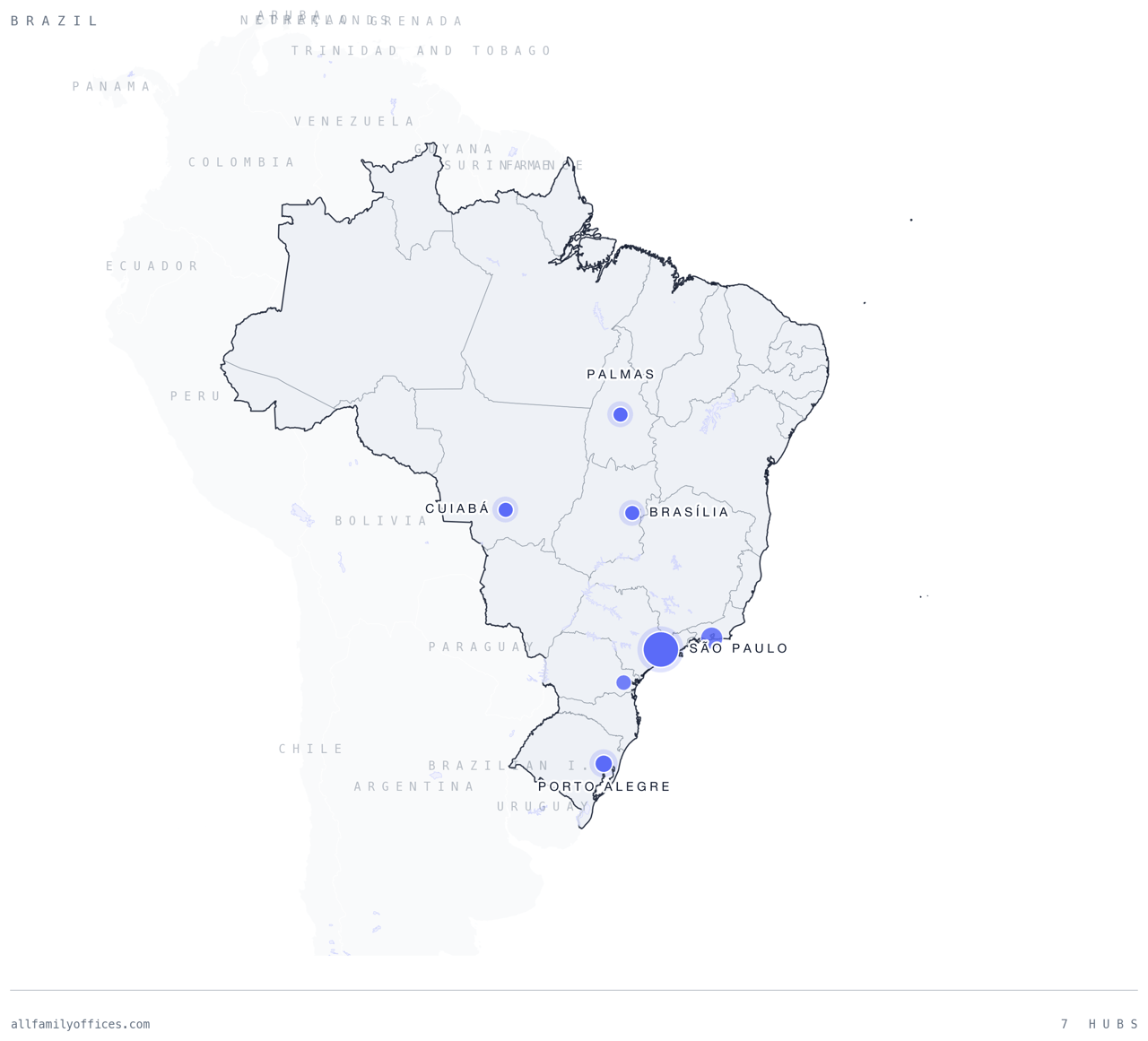
- São Paulo concentrates over 65% of all family office activity. Rio de Janeiro serves as the secondary hub, with Curitiba and Belo Horizonte emerging at roughly 5% each.
- The minimum wealth threshold for MFO services starts at R$ 30 million. SFOs typically require R$ 500 million to R$ 1 billion in assets under management (AUM).
- Brazilian family office growth runs at twice the rate of private banking. Succession urgency among founders aged 50 to 60 and ongoing tax reform pressures drive this expansion.
- Among participating offices in the Family Office Report Brasil 2023, 62.5% apply ESG or impact filters to their portfolios.
- About 10% of Brazilian firms maintain international offices in Miami, Lisbon, or Dubai for cross-border wealth preservation.
Family Office Brasil: Landscape Overview
Brazil's family office ecosystem spans 546 mapped wealth management firms. These range from independent MFOs and bank-affiliated platforms to single family offices built around industrial dynasties. The 38 families that participated in the Family Office Report Brasil 2023 declared a combined patrimônio of R$ 26 billion.
Brazilian billionaires alone hold an estimated US$ 151 billion. With 90% of Brazilian companies being family-owned, the pipeline for professional wealth oversight remains large.
The market is growing at roughly twice the pace of private banking. Succession planning is the primary catalyst: most founders are aged 50 to 60, and only 30% of family businesses survive to the second generation. Tax reform in 2023 raised rates on exclusive funds (20% short-term, 15% long-term), prompting families to restructure holdings and seek expert guidance.
São Paulo dominates with over 65% of firms. Rio de Janeiro hosts several major offices, and Curitiba and Belo Horizonte are growing as secondary poles. The North and Northeast remain underserved, though Horizonte Capital in Belém and São Luís fills that gap.
Independence from banks is a critical distinction in this market. Bank-affiliated offices may steer clients toward proprietary products. Independent MFOs like Carpa Family Office and Capri Family Office operate without product bias. Only 35.9% of firms carry public disclosure obligations, making due diligence essential for families evaluating their options.
Family Office Comparison at a Glance
The table below compares the leading family offices in Brazil by type, focus, and location. AUM figures appear only where verified data exists.
| Family Office | Type | AUM Estimate | Investment Focus | Key Services | Location |
|---|---|---|---|---|---|
| Abílio Diniz SFO | SFO | R$ 10 billion | Diversified | Full family office operations | Brazil |
| Julius Baer Family Office | MFO | Not disclosed | Independent wealth management | Wealth management, advisory | São Paulo |
| Turim MFO | MFO | Not disclosed | PE/VC, impact investing, diversified | Risk mgmt, wealth planning, charitable giving, NextGen | São Paulo |
| Carpa Family Office | MFO | Not disclosed | MFO with SFO concept, no proprietary products | Investments, wealth planning, legal, compliance | São Paulo, Rio de Janeiro |
| Mirabaud Investments Brazil | MFO | Not disclosed | Private credit, infrastructure funds | Wealth management, asset management | São Paulo |
| Capri Family Office | MFO | Not disclosed | Independent holistic wealth management | Portfolio mgmt, compliance, risk, middle office | Brazil |
| SOMMA Multi-Family Office | MFO | Not disclosed | Protection, perpetuation, multiplication | Investments, real estate mgmt, succession planning | Brazil |
| Horizonte Capital | MFO | Not disclosed | North/Northeast wealth management | Oversight, succession planning, NextGen education | Belém, São Luís |
| Top Multi-Family Office | MFO | Not disclosed | Athletes and soccer professionals | Financial planning, tax, legal, FX guidance | Belo Horizonte, Orlando |
| Grupo Tavares de Melo SFO | SFO | Not disclosed | Corporate and family oversight | Holding structure, oversight, real estate | São Paulo, Recife, Natal |
The Abílio Diniz SFO stands apart as the only office with a confirmed AUM figure. Most Brazilian family offices do not publicly disclose assets, consistent with the market's emphasis on confidentiality.
Top Picks by Strategy
- Pioneer MFO: Turim MFO, awarded best family office in Latin America by Euromoney, offers the broadest service menu of any Brazilian MFO, including a dedicated private equity and venture capital program.
- Largest Independent Platform: Julius Baer Family Office operates with 200 employees, making it the largest independent wealth management office in Brazil.
- Leading SFO by AUM: Abílio Diniz SFO manages R$ 10 billion with a team of 170, serving as the benchmark for large-scale Brazilian single family offices.
- Best for Complex Family Structures: Grupo Tavares de Melo SFO coordinates over 100 shareholders in a fifth-generation family, offering a proven model for multi-generational estate planning.
- Niche Specialist for Athletes: Top Multi-Family Office serves soccer professionals and athletes from offices in Belo Horizonte and Orlando, a unique specialization in the Brazilian market.
- North/Northeast Coverage: Horizonte Capital is the only major MFO with dedicated presence in Belém and São Luís, filling a geographic gap that leaves many wealthy families underserved.
- Global Heritage Applied Locally: Mirabaud Investments Brazil brings over 200 years of Swiss wealth management tradition to Brazilian private credit and capital deployment.
Top Family Offices in Brazil: Detailed Profiles
Turim MFO
Turim pioneered the multi-family office model in Brazil, operating since 2001. Its Euromoney award as the best family office in Latin America reflects the depth of its platform.
Turim runs a dedicated private equity and venture capital program alongside impact investing capabilities. No other Brazilian MFO matches this scope. Services span risk management, wealth planning, accounting coordination, offshore compliance, family governance, and charitable giving.
Families seeking co-investment opportunities in PE/VC alongside traditional wealth oversight will find Turim's integrated model especially relevant. The NextGen program prepares younger family members for wealth stewardship, addressing the succession gap that threatens many Brazilian fortunes.
Julius Baer Family Office
Julius Baer Family Office fields 200 employees, making it the largest independent wealth management operation in Brazil. Its Swiss parent group provides global reach, while the São Paulo team focuses on conflict-free advisory without proprietary product pressure.
CEO Fernando Vallada has publicly emphasized the firm's policy of returning all rebates and commissions to clients. This transparency standard is not universal in this market. The scale of the team allows Julius Baer to offer specialized coverage that smaller MFOs cannot replicate.
UHNW families managing complex portfolios that span domestic and international markets benefit from this combination of local expertise and global systems.
Carpa Family Office
Carpa delivers the personalized attention of a single family office through a distinctive hybrid MFO model. It maintains no proprietary products, eliminating a common source of conflicts in the Brazilian market.
The leadership team includes former executives from J.P. Morgan and Bank of America, led by CEO Ian Dubugras. Carpa serves families from both São Paulo and Rio de Janeiro, offering allocations, wealth planning, risk management, legal support, and compliance.
Its fee model uses a monthly fixed charge based on family complexity rather than a pure AUM percentage. Families wary of bank-affiliated bias will find Carpa's independent stance a strong differentiator.
Mirabaud Investments Brazil
Mirabaud applies over 200 years of Swiss private wealth expertise to Brazilian asset classes, focusing on private credit funds and infrastructure investments. These two sectors reflect Brazil's commodity-driven economy and offer direct investment access that few foreign-heritage firms provide locally.
The firm operates with full independence from Brazilian banks. Its advisory aligns exclusively with client interests. For families seeking structured credit exposure or capital deployment into real assets with institutional-grade backing, Mirabaud offers a rare blend of global pedigree and local market knowledge.
Abílio Diniz SFO
The Abílio Diniz single family office manages R$ 10 billion with a staff of 170, making it the largest confirmed SFO in Brazil. Rooted in the retail fortune of Grupo Pão de Açúcar, this operation functions more like a mid-size financial institution than a typical private wealth office.
The team's scale enables in-house capabilities that most SFOs outsource, from portfolio management to operational support. It serves as the reference point for Brazilian families considering whether their wealth justifies a dedicated SFO structure. At roughly 1.5% of patrimônio in annual operating costs, maintaining an SFO at this level demands assets well above R$ 1 billion.
Grupo Tavares de Melo SFO
Grupo Tavares de Melo coordinates over 100 shareholders in a fifth-generation family, the most complex ownership structure among Brazilian SFOs. The office took shape between 2007 and 2008 after the family sold its sugar and ethanol mills, transforming industrial wealth into a managed portfolio.
Director Marcelo Henrique Reis oversees a 15-person team split between São Paulo, Recife, and Natal. The SFO handles both corporate oversight (shared assets including former mill properties) and family rules for succession and decision-making. GTM outsources capital management to keep its structure lean, demonstrating a focused model that prioritizes multi-branch coordination over in-house fund management.
Horizonte Capital
Horizonte Capital is the only significant MFO serving Brazil's North and Northeast regions from offices in Belém and São Luís. Wealthy families in these areas have historically worked with São Paulo-based firms or managed wealth informally.
Horizonte offers financial planning, succession planning, and next-generation education tailored to the regional context. Its geographic focus fills a structural gap in Brazil's family office market, where over 65% of firms cluster in São Paulo. For families rooted in the agribusiness and commerce economies of the North and Northeast, Horizonte provides proximity that national firms cannot match.
Top Multi-Family Office
Top Multi-Family Office occupies one of Brazil's most unusual wealth management niches: professional athletes and soccer players. Operating from Belo Horizonte and Orlando, the firm addresses the specific financial planning challenges of sports professionals.
These challenges include short career windows, cross-border income, and rapid wealth accumulation. Services cover financial planning, advisory, accounting, legal support, and foreign exchange guidance. Founded by Marcelo Claudino, Top MFO provides tax planning for athletes earning in multiple currencies. Sports professionals with sudden liquidity events face unique risks that generic advisors cannot handle.
Investment Trends Shaping Brazilian Family Offices
International Capital Deployment Accelerates
About 10% of Brazilian family offices now maintain offices or affiliates in Miami, Lisbon, or Dubai. Currency volatility and rising fiscal risk within Brazil push families to allocate more capital offshore. Turim MFO offers dedicated offshore compliance services. Several firms report growing client demand for international real estate and structured products denominated in dollars or euros.
Private Equity and Venture Capital Gain Ground
Younger family members steer capital toward private equity, venture capital, and startup allocations. Turim runs the most structured PE/VC program of any Brazilian MFO, while SFOs increasingly allocate to fund-of-funds vehicles.
This generational shift mirrors a broader pattern: next-generation heirs influenced by tech entrepreneurship want exposure to early-stage companies, not just fixed income. Abílio Diniz SFO's diversified portfolio and Carpa's conflict-free model both support direct investments in alternative assets.
ESG and Impact Investing Become Standard
Among surveyed family offices, 62.5% now apply ESG or impact filters to their portfolios. Half engage in charitable giving. Unlike the U.S. model, Brazilian donors act from personal conviction rather than tax incentives, since Brazil offers limited fiscal benefits for donations.
International pressure pushes Brazilian offices toward stronger sustainability commitments. Turim's integrated impact investing program leads the sector, though Brazilian offices remain less active than global peers overall.
Tax Reform Reshapes Wealth Structures
The 2023 changes to exclusive fund taxation (20% for short-term, 15% for long-term) forced widespread restructuring. Only 18% of wealth management firms operate exclusive funds, down as cost efficiency declines under new rules.
Families now re-evaluate holding structures and offshore vehicles. This shift creates demand for MFOs with tax planning expertise, benefiting firms like Carpa and Julius Baer that offer integrated legal and compliance services.
Agribusiness and Real Assets Draw Capital
Financial sector allocations lead portfolios, but real assets and agribusiness rank among the top sectors for Brazilian family offices. Structured credit products tied to tangible assets gain traction, especially for families whose original wealth came from commodity sectors. Mirabaud's focus on private credit and Horizonte Capital's proximity to agribusiness families in the North and Northeast position both firms to capture this demand.
How to Evaluate a Family Office in Brazil
Start with independence. Only 35.9% of Brazilian firms carry public disclosure obligations through CVM or ANBIMA registration. Verify whether a prospective office is registered and whether it returns rebates and commissions to clients. Julius Baer and Carpa both publicly commit to full rebate transparency, setting a benchmark others should match.
Assess proprietary product risk. Bank-affiliated platforms may offer strong operational systems but also carry incentives to steer families toward in-house products. Independent MFOs such as Capri and Carpa operate without proprietary funds, reducing this conflict. Ask directly whether the office earns revenue from product placement.
Evaluate team depth and credentials. Look for CFP, CFA, and CVM certifications among advisors. A red flag in the Brazilian market is knowledge concentration in a single individual with no succession plan for the office itself. Turim, with specialized teams covering family oversight, PE/VC, and offshore compliance, demonstrates the breadth that complex families require.
Consider geographic reach relative to your assets. Families with holdings in multiple regions should prioritize offices with multi-city presence. Carpa covers São Paulo and Rio de Janeiro; Grupo Tavares de Melo spans São Paulo, Recife, and Natal. North and Northeast families have limited options beyond Horizonte Capital. If your estate planning needs cross borders, confirm the office has active offshore compliance capability.
Which Family Office Fits Your Needs?
UHNW families with patrimônio above R$ 500 million who prioritize maximum privacy and control should evaluate the SFO model. The Abílio Diniz SFO demonstrates what a fully resourced single family office looks like at R$ 10 billion. Grupo Tavares de Melo proves the model works for multi-branch families with over 100 shareholders. For families that want SFO-level attention without building their own operation, Carpa's hybrid MFO-SFO concept offers a practical middle ground.
Business owners preparing for succession will benefit from offices with formal transition programs. Turim's NextGen services and family structure consulting address both the operational and generational dimensions of wealth transfer. Horizonte Capital delivers similar programming for families in the North and Northeast, where local advisory options are scarce. First-generation founders should prioritize offices experienced in holding company setup and estate planning.
Athletes and entertainment professionals face compressed earning windows and cross-border tax complexity. Top Multi-Family Office in Belo Horizonte and Orlando specializes in exactly this profile. For families seeking international exposure, offices with active Miami, Lisbon, or Dubai operations provide integrated offshore compliance and currency management that domestically focused firms cannot offer.
Methodology
This guide to family office brasil draws on multiple industry data sources, including the Family Office Report Brasil 2023 published by INEO, the Wealth-X Billionaire Census, and Q1 2025 market intelligence from wealth databases and industry publications. Office profiles were cross-referenced with market research platforms, industry rankings, and wealth management directories. Selection criteria required verifiable Brazilian operations, documented service offerings, and industry recognition through awards or published rankings. AUM figures appear only where confirmed by public data; all other offices are listed without fabricated estimates. Data reflects the 2023 to 2025 reporting cycle, with the most recent updates from Q1 2025.