On This Page
- Key Facts
- São Paulo's Wealth Management Landscape
- Family Office Comparison
- Top Picks by Strategy
- Top 12 Family Offices in São Paulo and Brazil in Detail
- Investment Trends Shaping This Market
- How to Evaluate a Family Office in São Paulo
- Which Family Office Fits Your Needs?
- Methodology
- Frequently Asked Questions
Key Facts
- At least 15 tracked family offices operate in Brazil, with eight based in São Paulo, the country's financial capital.
- Combined AUM for the top 10 tracked offices exceeds $230 billion. Gerval Investimentos alone accounts for $200 billion of that total.
- The multi-family office (MFO) model dominates, with independent, conflict-free advisory as the standard market differentiator.
- São Paulo's Faria Lima corridor and Vila Olímpia district hold the highest density of wealth management firms in Latin America.
- Offshore capital deployment is growing, with several offices opening satellite operations in New York and London.
- Impact investing gained traction after Tera Capital's Viva Rio fund surpassed R$800 million in AUM.
São Paulo's Wealth Management Landscape
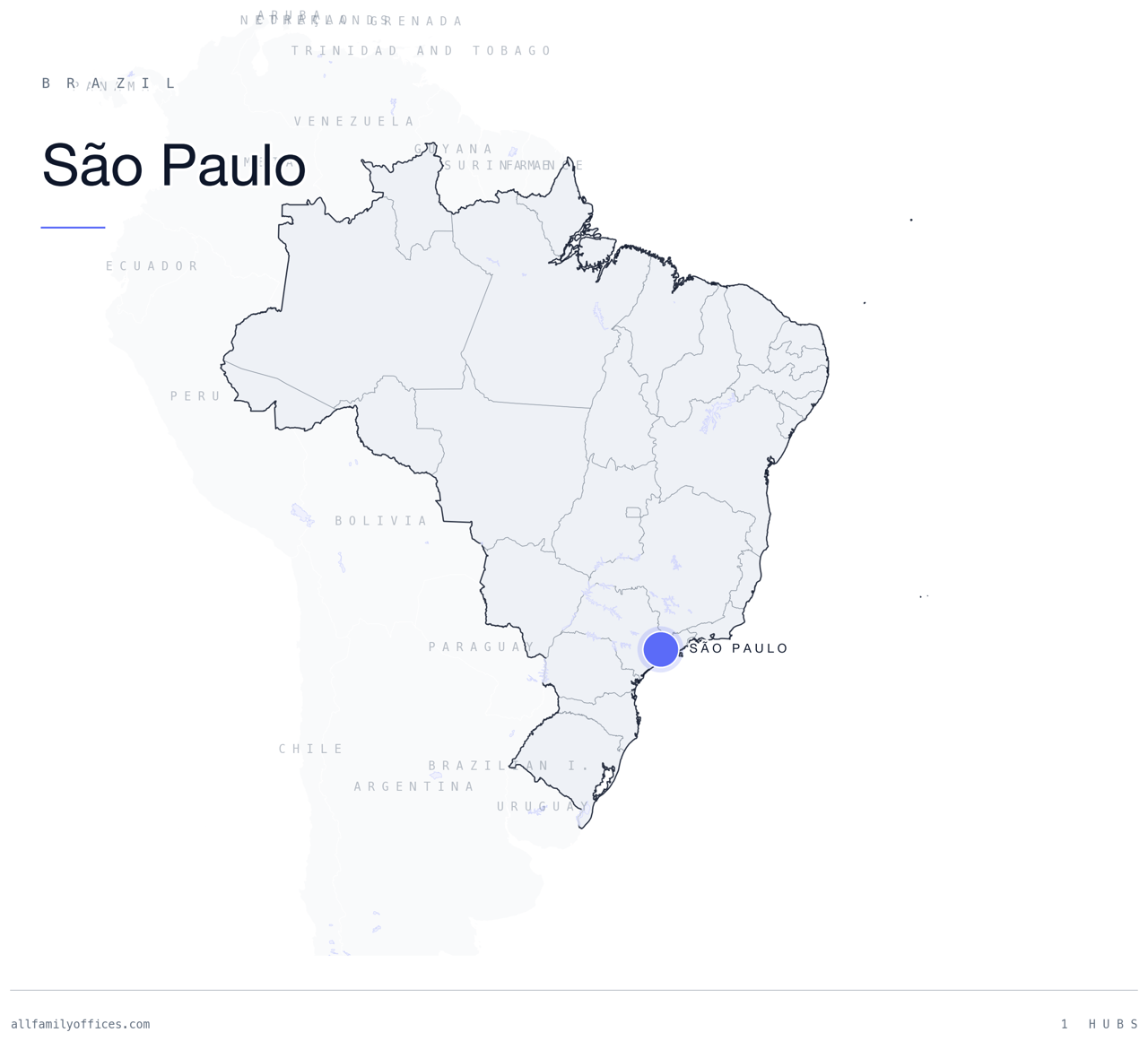
São Paulo anchors Brazil's family office market. Eight of the country's 15 tracked offices operate from the city, clustered along the Faria Lima corridor and Vila Olímpia. Rio de Janeiro hosts five offices, while Belo Horizonte has one.
This concentration mirrors São Paulo's role as Latin America's largest financial center. The city is home to the B3 stock exchange and the headquarters of most major Brazilian banks.
The MFO model is the dominant structure. Firms like G5 Partners, Tera Capital, and Monte Bravo all emphasize full independence from banks and financial groups. Open architecture, where advisors select products without proprietary bias and return rebates to clients, has become a baseline expectation.
Two prominent single family offices (SFOs) anchor the market's upper end. Gerval Investimentos, the Gerdau steel family's office, manages $200 billion in assets. Brasil Warrant Gestão de Investimentos (BWGI), the Moreira Salles family's $11 billion vehicle, rounds out the SFO tier.
Brazil's CVM (Securities and Exchange Commission) regulates all offices operating as asset managers. ANBIMA, the capital markets association, sets best-practice codes for resource management. These regulatory layers give ultra-high-net-worth (UHNW) families a compliance framework that most Latin American markets lack.
Capital is flowing offshore at an increasing rate. BWGI and Raiz Investimentos maintain New York operations. Turim Family Office connects to global networks through the UK-based Wigmore Association.
Family Office Comparison
The table below ranks São Paulo and Brazil's leading wealth management firms by AUM where data is available. Offices without disclosed AUM figures appear after those with published numbers.
| Family Office | Type | AUM Estimate | Investment Focus | Services | Location |
|---|---|---|---|---|---|
| Gerval Investimentos | SFO | $200B | Resource management, capital preservation | Fund management, managed portfolios | Rio de Janeiro |
| Brasil Warrant (BWGI) | SFO | $11B | Global diversified, alternatives, hedge funds | Asset allocation, multi-strategy hedge fund | São Paulo |
| Turim Family Office | MFO | $4.14B | PE/VC, impact, wealth planning | Full service, family governance, offshore compliance | Rio de Janeiro |
| Monte Bravo | MFO | $3.96B | Client-centric asset management | Personalized portfolio management | São Paulo |
| Pragma Patrimônio | MFO | $3.88B | PE, VC, real estate, infrastructure | Portfolio advisory, alternative investments | São Paulo |
| Portofino MFO | MFO | $2.97B | Family asset alignment, transparency | Tailored family solutions | Belo Horizonte |
| Tera Capital | MFO | $2B | Absolute return, direct investments | Global wealth management, impact investing | São Paulo |
| Raiz Investimentos | MFO | $1.5B | Public equity, EM managers, VC, growth equity | Investment management | São Paulo |
| TNA Gestão Patrimonial | MFO | $1.22B | Independent, impartial planning | Wealth planning | Rio de Janeiro |
| JGP | MFO | $1.2B | Multi-asset fund management | Multimarket, equity, credit, real estate funds | Rio de Janeiro |
| Carpa Family Office | MFO | — | Integrated investments, succession, lifestyle | Full service including heir education | São Paulo |
| Arton Advisors | MFO | — | Global allocation, tax optimization | Legal, accounting, tax, investment advisory | São Paulo |
São Paulo-based offices account for six of the 12 listed firms and hold the majority of tracked AUM outside Gerval's $200 billion SFO. The MFO segment is competitive: five São Paulo managers sit between $1.5 billion and $4 billion each, giving UHNW families meaningful choice.
Top Picks by Strategy
- Largest AUM: Gerval Investimentos, the Gerdau group's SFO, manages $200 billion from Rio de Janeiro. It is Brazil's largest private wealth office by a wide margin.
- Best for Global Allocation: Brasil Warrant (BWGI) runs an $11 billion portfolio spanning alternatives, illiquid assets, and a multi-strategy hedge fund. The firm operates from São Paulo and New York.
- Top Alternative Capital Deployment Platform: Pragma Patrimônio deploys $3.88 billion in private equity, venture capital, private debt, real estate, infrastructure, and natural resources.
- Strongest Impact Investing Record: Tera Capital donates its full management fee to Viva Rio's VRB Funds, which hold over R$800 million in assets dedicated to social inclusion.
- Most Complete Service Model: Carpa Family Office blends investments, wealth planning, succession, insurance, lifestyle management, and heir education in a hybrid MFO structure that delivers SFO-level attention.
- Leading International Network: Turim Family Office is the only South American member of the Wigmore Association, with offices in Rio de Janeiro, São Paulo, and the UK.
- Best for Emerging Market Equity: Raiz Investimentos manages $1.5 billion with a focus on emerging market active managers, venture capital, and growth equity. The firm is expanding to New York.
Top 12 Family Offices in São Paulo and Brazil in Detail
Gerval Investimentos
Brazil's largest family office by assets under management serves as the wealth vehicle for the Gerdau steel dynasty. Gerval manages $200 billion through investment funds and managed portfolios, all regulated by the CVM. The firm opened in 1973, giving it over five decades of continuity in capital preservation for one of Latin America's most prominent industrial families.
Gerval's mandate centers on safeguarding and growing client assets through disciplined resource analysis. This track record makes it the benchmark SFO in the Brazilian market.
Brasil Warrant Gestão de Investimentos (BWGI)
The Moreira Salles family built BWGI into an $11 billion global wealth platform with offices in São Paulo and New York. BWGI's portfolio stretches from liquid asset allocation to illiquid investments and a dedicated multi-strategy hedge fund.
This dual-city presence gives the office direct access to both Brazilian deal flow and US capital markets. Few Latin American SFOs replicate this structure.
G5 Partners
São Paulo's largest independent MFO manages over R$35 billion in capital. G5 Partners combines open-architecture investing with wealth planning, succession planning, and global consulting. The firm's CVM approval and ANBIMA code adherence signal institutional-grade compliance.
UHNW families and economic groups seeking a single platform for domestic and international allocation will find G5's integrated model hard to match among Brazilian MFOs.
Turim Family Office
Brazil's most globally connected private wealth office manages $4.14 billion and serves as the only South American member of the Wigmore Association. Turim's services span private equity and venture capital programs, impact investing, family governance, next-generation education, and offshore compliance.
Through the Wigmore network, Turim gives clients access to independent wealth managers in the US, UK, and Europe. Families with complex cross-border structures benefit from this reach.
Monte Bravo
Vila Olímpia's specialist MFO assigns dedicated professionals to each client portfolio, a model that sets it apart from firms relying on scaled product distribution. Pier Mattei and Filipe Portella co-founded Monte Bravo in 2010, and the office now manages $3.96 billion.
Each client relationship involves portfolio managers who actively adjust asset allocation based on changing market conditions. This hands-on model appeals to families who want direct access to their advisors.
Pragma Patrimônio
São Paulo's deepest alternative-investment platform deploys $3.88 billion in private equity, venture capital, private debt, real estate, infrastructure, natural resources, and hedge funds. Pragma advises families and foundations on preserving and growing patrimônio in line with their values.
For families seeking exposure beyond traditional fixed income and public equity, Pragma offers the broadest menu of alternative asset classes in the local market.
Portofino Multi Family Office
The only major MFO headquartered outside São Paulo and Rio, Portofino manages $2.97 billion from Belo Horizonte and Rio de Janeiro. Carolina Giovanella founded the firm in 2012 with a mandate to align family assets with client goals while minimizing conflicts of interest.
Portofino's dual-city structure serves families in Minas Gerais who want local access without relocating their advisory relationship to the Faria Lima corridor.
Tera Capital
A 29-person team with nine CFA or CFP holders runs Tera Capital's $2 billion in managed assets, focusing on absolute return strategies, direct investments, and developed-market exposure. Tera operates 10 proprietary strategies and is 100% independent.
Its most distinctive initiative is the Viva Rio VRB Funds, where Tera donates its full management fee to support social inclusion programs. The VRB Funds hold over R$800 million, backed by a council of prominent wealth managers.
Raiz Investimentos
An active shift from outsourced to in-house portfolio management defines Raiz's current strategy. The firm manages $1.5 billion and is expanding to New York to strengthen its international capabilities.
Raiz has reduced its public equity manager lineup, shifting from single Brazilian stocks to diversified emerging market active managers. In private markets, the firm maintains overweight positions in venture capital and growth equity, targeting buyouts with higher return multiples.
TNA Gestão Patrimonial
Rio de Janeiro's leading conflict-free advisory firm manages $1.22 billion with complete independence from banks and product distributors. TNA adopted the American MFO model at its 2003 launch.
Each engagement starts with the family's unique dynamics, not a preset product menu. This approach suits families who want certainty that recommendations serve their interests alone.
JGP
Four specialized teams covering multimarket, equity, credit, and real estate funds give JGP institutional-quality research from its Rio de Janeiro base. The firm manages $1.2 billion.
The multi-team structure creates an internal research environment where fixed income, equity, and real estate specialists share insights. Families looking for multi-asset fund management get this capability without the conflicts that come with bank-affiliated platforms.
Carpa Family Office
Carpa operates as an MFO with SFO-level dedication to each client family. Its integrated system covers investments, wealth planning, succession, insurance, lifestyle management, and heir education.
CEO Ian Dubugras, a former president of Bank of America Brazil and co-president of J.P. Morgan Brazil, brings institutional banking expertise to a boutique setting. CIO Celso Colombo, an economist and co-founder of CCN Invest, oversees an open-architecture approach with no proprietary products. Families with complex multi-generational needs get a single point of coordination.
Investment Trends Shaping This Market
Offshore Expansion and Global Allocation
São Paulo wealth managers are building international operations at a rapid pace. BWGI and Raiz Investimentos maintain New York offices, while Turim connects to European markets through the Wigmore Association and its UK presence.
Brazilian families are shifting capital toward developed markets. Currency exposure management and the desire to reduce concentration in domestic assets drive this trend. Several Swiss and European groups have also entered the São Paulo market to offer global advisory locally.
Private Markets and Alternative Investments
Private equity, venture capital, and private debt dominate new allocation decisions. Pragma Patrimônio deploys $3.88 billion in alternatives spanning six asset classes. Raiz Investimentos holds overweight positions in venture capital and growth equity.
This shift reflects a move away from Brazil's historically high fixed-income yields. As the Selic rate environment changes, São Paulo families are turning toward return sources less correlated with local interest rate cycles.
Impact Investing Gains Institutional Scale
Tera Capital's Viva Rio initiative represents the most concrete impact investing program among São Paulo's wealth advisors. The VRB Funds exceed R$800 million in capital managed, and Tera donates its full management fee. Turim also lists impact allocations as a core service.
The dedicated fund structures and fee donation model signal that impact investing has moved from marketing language to portfolio reality. These are not token allocations but institutional-scale commitments from regulated firms.
Independence as a Structural Norm
The most prominent MFOs in São Paulo, including G5 Partners, Tera Capital, Carpa, and TNA, all emphasize 100% independence from banks and financial groups. Several offices return rebates and third-party commissions to clients.
This trend contrasts with the bank-affiliated private banking model that still dominates wealth management in much of Latin America. Families evaluating options in São Paulo should treat independence not as a bonus feature but as a baseline requirement.
How to Evaluate a Family Office in São Paulo
Start with regulatory standing. Any office managing third-party assets in Brazil must hold CVM approval. ANBIMA code adherence adds a second compliance layer. Both Gerval Investimentos and G5 Partners hold these credentials, which should be the minimum threshold for any shortlisted firm.
Independence is the most important structural question in this market. São Paulo has both independent MFOs and bank-adjacent advisory models. Ask whether the office receives commissions from product providers and whether rebates are returned to clients. Tera Capital and TNA Gestão Patrimonial have built their positioning around full independence. Verify these claims by reviewing fee disclosure documents.
Evaluate international capabilities carefully. São Paulo families increasingly need offshore structuring, cross-border tax planning, and global asset allocation. Firms with physical presence abroad (BWGI in New York, Turim in the UK) offer different depth than those relying on third-party partnerships. If your wealth involves assets in multiple jurisdictions, prioritize offices with proven cross-border operations.
Team credentials matter more in São Paulo's competitive market than in smaller Brazilian cities. Look for CFA, CFP, and legal certifications. In practice, Tera Capital employs nine certified professionals out of a 29-person team. The density of qualified MFOs along Faria Lima means families can be selective about advisor qualifications.
Succession planning expertise varies widely. Some firms treat it as a secondary service. Carpa Family Office includes heir education and lifestyle management. Turim offers dedicated family oversight and next-generation programs. Match the office's succession capabilities to your family's complexity, especially if your wealth spans multiple business entities or generations.
Which Family Office Fits Your Needs?
UHNW families with over $100 million in liquid assets and complex cross-border holdings should prioritize G5 Partners or Turim Family Office. G5's R$35 billion platform provides scale and open architecture in São Paulo. Turim's Wigmore Association membership connects families to advisors in the US and Europe.
Business owners preparing for a liquidity event or generational transition can look to Carpa Family Office. It integrates succession planning, heir education, and capital deployment under one roof. Arton Advisors, led by former XP partner and JP Morgan managing director Bernardo Assumpção, combines tax advisory with local and offshore allocation for entrepreneurs navigating post-sale wealth structuring.
Families prioritizing alternative investments and direct deal access should consider Pragma Patrimônio for its six-category alternatives platform. Tera Capital suits those seeking absolute-return strategies and direct investment capability with co-investment access. Next-generation wealth holders interested in impact investing will find Tera's Viva Rio VRB Funds the most developed program in this market, with over R$800 million in managed assets.
Methodology
This article profiles family offices in São Paulo and the broader Brazilian market based on publicly available data, regulatory filings, and firm disclosures as of 2025. The selection criteria included confirmed AUM figures, CVM registration status, and documented service offerings. Market data draws from wealth databases, firm websites, and industry association records. AUM figures reflect the most recent available disclosures and may not capture assets held in undisclosed offshore structures. Rankings by AUM are approximate given currency conversion differences between USD and BRL-denominated figures.
Frequently Asked Questions
At least eight tracked offices operate from São Paulo. These include G5 Partners, BWGI, Monte Bravo, Pragma Patrimônio, Tera Capital, Raiz Investimentos, Carpa Family Office, and Arton Advisors. Brazil's broader market includes 15 identified firms, with five in Rio de Janeiro and one in Belo Horizonte. The actual count is likely higher, as many SFOs operate privately without public disclosure.
SFOs typically require $100 million or more in net worth. Dedicated staff and operating costs run $1 million to $2 million per year. MFOs in São Paulo generally serve families with $30 million to $100 million in investable assets, though minimum thresholds vary by firm. G5 Partners manages R$35 billion in aggregate, suggesting a client base of substantial scale.
An SFO serves a single family exclusively. Gerval Investimentos ($200 billion AUM, Gerdau family) and BWGI ($11 billion, Moreira Salles family) are São Paulo-area SFOs. An MFO serves multiple UHNW families through a shared platform. Most São Paulo offices, including G5 Partners, Tera Capital, and Monte Bravo, operate as MFOs. Carpa Family Office offers a hybrid, delivering SFO-level attention within an MFO structure.
Industry data suggests family office CEOs earn $300,000 to over $1 million in total compensation. Larger offices pay $1 million to $3 million including bonuses and co-investment incentives. Brazilian pay tends to run below US levels but above other Latin American markets. Ian Dubugras at Carpa Family Office brings experience from Bank of America and J.P. Morgan Brazil, reflecting the caliber of talent these roles attract.
Offices managing third-party assets must register with the CVM, Brazil's securities regulator. Most leading MFOs also follow ANBIMA's Third Party Resource Management Code, which sets ethical standards and professional conduct rules. G5 Partners and Gerval Investimentos both hold CVM approval and ANBIMA adherence. Families should verify these regulatory credentials during due diligence.
Yes. BWGI operates in both São Paulo and New York. Raiz Investimentos is opening a New York office as it transitions to in-house management. Turim Family Office maintains a UK presence and belongs to the Wigmore Association, a global network of independent wealth managers. Brazilian families are increasingly seeking developed-market exposure and offshore structuring, driving this expansion.