On This Page
- Key Facts About Middle East Family Offices
- Regional Landscape Overview
- Family Office Comparison at a Glance
- Top Picks by Strategy
- Leading Office Profiles in Detail
- Investment Trends Shaping This Market
- How to Evaluate a Family Office in the Middle East
- Which Family Office Fits Your Needs?
- Methodology
- Frequently Asked Questions
Key Facts About Middle East Family Offices
- The AllFamilyOffices database lists 340+ family offices in the Middle East (October 2026), spanning single family offices (SFOs) and multi-family offices (MFOs).
- These SFOs have deployed over $365 billion in capital through 8,193 funding rounds, spanning private equity, venture capital, real estate, and technology.
- Dubai hosts 110+ of them, the single largest cluster of family office activity in the region.
- The ultra-high-net-worth (UHNW) population, defined as individuals with $30 million or more, should grow 24.6% between 2021 and 2026 to roughly 18,800 individuals.
- Saudi Arabia and the UAE dominate the Top 100 Arab Family Businesses ranking, contributing 33 and 32 entries respectively.
- Multi-family offices (MFOs) serve families below the SFO threshold, offering pooled capital and shared operational costs.
- Office types range from traditional SFOs and MFOs to royal family offices, virtual family offices (VFOs), and dynastic holding groups unique to Gulf business culture.
Regional Landscape Overview
The region's family office market spans several distinct structures. Single family offices manage the assets under management (AUM) of one UHNW family. Multi-family offices pool capital from multiple families. Royal family offices serve ruling dynasties in UAE emirates such as the Al Nahyan and Al Maktoum families.
Family business groups, many of which appear on the Top 100 Arab Family Businesses ranking, function as de facto wealth managers. These groups handle diversified holdings built over decades.
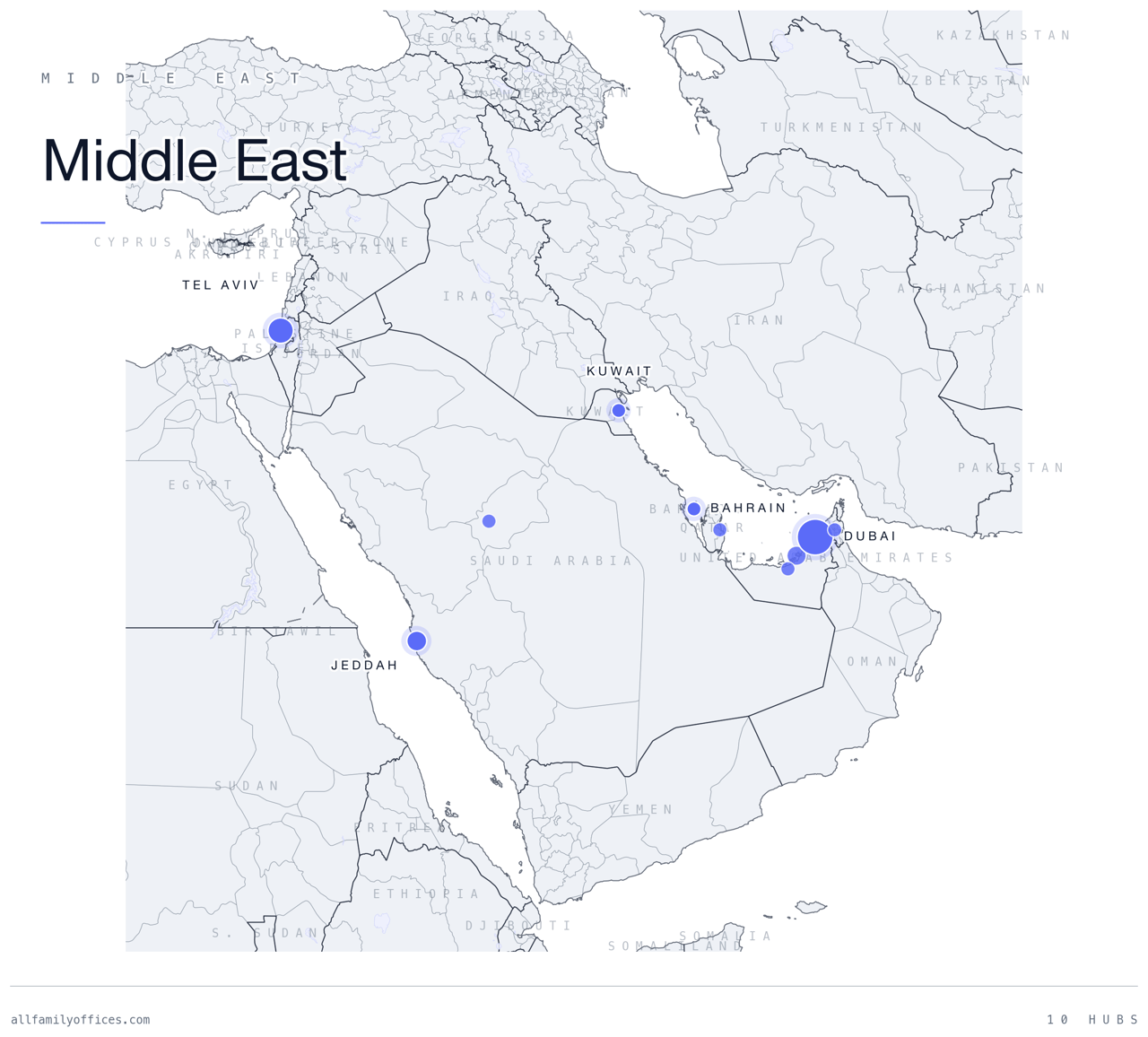
Dubai leads in sheer concentration, with 110+ family offices and a millionaire population that doubled over the past decade to roughly 81,200. Riyadh and Jeddah in Saudi Arabia host major family investors. Tel Aviv anchors a venture capital cluster of 30+ family offices. Doha, Kuwait City, Muscat, and Manama each support several offices tied to local trading and industrial dynasties.
Structural tailwinds drive growth. The UAE imposes no personal income, capital gains, or inheritance tax. Free zones like DIFC and ADGM (Abu Dhabi Global Market) offer 0% corporate tax for 50 years and full foreign ownership.
Saudi Arabia's Vision 2030 channels over $1 trillion into economic projects. Its Special Economic Zones grant corporate tax exemptions for up to 20 years. The UAE's golden visa program grants 10-year residency for investors and continues to attract global wealth. Islamic finance principles, including halal investing and the prohibition of interest-bearing assets, shape how many Gulf family offices structure their portfolios.
Family Office Comparison at a Glance
The table below groups leading family offices in the region by type. "Family Business Group" denotes large conglomerates that operate as de facto wealth management vehicles for their founding families.
| Family Office | Type | Investment Focus | Key Sectors | Location |
|---|---|---|---|---|
| Olayan Financing Company | SFO | Diversified | Enterprise apps, fintech | Saudi Arabia |
| Al-Futtaim Group | Family Business Group | Diversified | Automotive, health, real estate, retail | Dubai |
| DAMAC Group | Family Business Group | Real estate, diversified | Property development | Dubai |
| Dubai Holding | Royal Family Office | Real estate, media, tech, tourism | Hospitality, digital systems | Dubai |
| Seed Group | SFO | Technology, healthcare, tourism | Multi-sector innovation | Dubai |
| Daher Capital | SFO | Real estate, tech, PE | Consumer goods, healthcare, education | Dubai |
| AlTouq Group | SFO | Real estate, PE, growth capital | Retail, power, financial services, IT | Riyadh |
| Claridge Israel | SFO | Venture capital | Late-stage Israeli startups | Herzliya, Israel |
| Dynamic Loop Capital | SFO | Socially responsible tech VC | Disruptive technology | Tel Aviv, Israel |
| Al Ghurair Group | Family Business Group | Industrial, real estate, banking | Packaging, finance | Dubai |
| Alghanim Industries | Family Business Group | Diversified, EV vehicles | Automotive, consumer | Kuwait |
| Al Faisal Holding | Family Holdings | Diversified | Multi-sector | Qatar |
| Al Muhaidib Group | Family Business Group | Diversified | Multi-sector conglomerate | Saudi Arabia |
| Legacy Line Family Office | MFO | Multi-family services | Pooled capital | Dubai |
Saudi Arabia's family business groups dominate by scale and sector breadth. Dubai-based SFOs tend to focus on technology and real estate. Israel's entries specialize in venture capital, reflecting Tel Aviv's startup ecosystem.
Top Picks by Strategy
- Largest Diversified Portfolio: Olayan Financing Company holds 30 portfolio companies in 6 countries, making it one of the longest-running family wealth platforms in Saudi Arabia since 1947.
- Top Real Estate Allocator: DAMAC Group is synonymous with large-scale property development in Dubai and the wider Gulf.
- Leading Venture Capital Player: Claridge Israel targets late-stage and growth-stage Israeli startups, with portfolio companies including Cloudify and Cyberbit.
- Most Active Portfolio Builder: Seed Group counts 67 portfolio investments spanning technology, healthcare, tourism, and real estate from its Dubai base.
- Best for Shariah-Compliant Investing: SEDCO Holding operates from Saudi Arabia with deep expertise in Shariah-compliant structures.
- Royal Family Office Pioneer: Dubai Holding, the investment arm of Dubai's ruling Al Maktoum family, created Dubai Internet City and owns Jumeirah Hotels & Resorts.
- Strongest Multi-Sector Conglomerate: Al-Futtaim Group spans automotive, financial services, health, real estate, and retail, giving it one of the broadest sector footprints in the Gulf.
Leading Office Profiles in Detail
Olayan Financing Company
One of the oldest private wealth platforms in Saudi Arabia, Olayan manages 30 portfolio companies in the United States, Saudi Arabia, and four other countries. Its focus areas include enterprise software, fintech, and broad holdings.
Geographic reach sets it apart from peers that concentrate solely in the Gulf. UHNW families seeking a proven, multi-generational wealth preservation model often benchmark against Olayan's track record.
Al-Futtaim Group
Few family business groups match Al-Futtaim's sector range. The Dubai-based conglomerate covers automotive (it holds major dealership franchises), financial services, healthcare, real estate, and retail.
This spread gives it natural hedging against sector downturns, a model that other Gulf firms increasingly try to replicate. Business owners evaluating how to structure varied holdings can study Al-Futtaim's approach to separating operational businesses from capital deployment.
DAMAC Group
Real estate defines DAMAC. The Dubai-based group built its reputation on large-scale property development and has expanded into other sectors.
Brand recognition in Gulf property markets gives it deal flow that smaller offices cannot access. For families whose wealth originates in real estate, DAMAC's model shows how a single-sector origin can evolve into a broader platform.
Dubai Holding
The Al Maktoum royal family created Dubai Holding as its private investment arm. Its portfolio includes Dubai Internet City, Jumeirah Hotels & Resorts, and assets in media, technology, and tourism.
Royal family offices in the Gulf carry a distinct advantage: preferential access to government-backed projects and sovereign wealth fund co-investment opportunities. Dubai Holding shows how that access translates into portfolio scale.
Seed Group
With 67 portfolio companies, Seed Group has the highest publicly tracked deal count among regional SFOs. Operating from Dubai since 2004, it invests in technology, healthcare, tourism, and real estate.
Its partnership model brings global companies into the Gulf market, creating joint ventures rather than passive allocations. Tech founders entering the MENA market will find Seed Group among the most active co-investment partners.
Daher Capital
The Daher family built its fortune through Michel Daher's success in food manufacturing and distribution in Lebanon. Daher Capital now operates from Dubai, investing in real estate, tech startups, public equities, and private equity in the MENA region.
Its sector focus covers consumer goods, healthcare, education, and business services. The office represents a common Gulf pattern: entrepreneurial wealth from one sector redeployed into a varied portfolio through a formal SFO.
AlTouq Group
Riyadh-based AlTouq Group evolved from a traditional family business in the 1970s into a structured single family office. It invests in real estate (commercial, residential, and industrial), private and public equity, growth capital, mezzanine financing, and distressed buyouts.
In recent years, AlTouq shifted capital toward retail, power supply, financial services, and IT. Families weighing the transition from a family business to a formal SFO with defined family governance rules can look to AlTouq as a Saudi model of that evolution.
Claridge Israel
Venture capital is the sole focus for Claridge Israel, based in Herzliya. The office backs late-stage and growth-stage Israeli startups, with portfolio companies like Cloudify (multi-cloud orchestration) and Cyberbit (SOC skilling platform).
Israel's family offices differ from Gulf counterparts in their narrow focus on tech innovation rather than broad holdings. Institutional allocators seeking co-investment access to Israeli tech deal flow should consider Claridge as a strategic partner.
Al Ghurair Group
Dubai's Al Ghurair Group spans industrial operations, real estate, banking, and packaging. This breadth reflects the conglomerate model common among established Emirati families: wealth generated from trade and industry, then redeployed into financial assets and property.
Al Ghurair's banking interests give it capital markets expertise that pure real estate or industrial groups lack.
Alghanim Industries
Kuwait's largest private company, Alghanim Industries has expanded into automotive, consumer goods, and EV vehicles, which it introduced to the Kuwaiti market. The group shows how Gulf family businesses pivot from legacy distribution models toward sectors aligned with sustainability and economic change.
Its EV initiative marks one of the most visible sustainability commitments among regional family offices.
Investment Trends Shaping This Market
Direct Investments Over Fund Allocations
Some 83% of regional family offices invest in private equity, and a growing share prefer direct deals over blind-pool fund commitments. Saudi Arabia's Regional Headquarters Program now offers family offices access to sovereign wealth fund co-investment opportunities. This access, combined with board-level involvement in portfolio companies, shifts capital toward direct investments.
Technology and AI as Core Allocation Themes
About 58% of MENA family groups are active in venture capital, with capital concentrated in fintech, healthtech, and enterprise software. Regional SFOs deployed $33.1 billion in early-stage rounds and $108 billion in late-stage rounds over the past five years.
Israel-based offices like Claridge and Dynamic Loop Capital channel capital into growth-stage tech startups. Gulf SFOs increasingly fund AI and digital platforms.
Shariah-Compliant and Sustainable Investing
Among younger Gulf investors, 91% already allocate to Islamic strategies. Halal investing prohibits interest-bearing bonds, arms, alcohol, tobacco, and gambling-related assets.
Separately, 81% of next-generation investors consider sustainability factors, and 88% plan to increase sustainable allocations. Alghanim Industries and AW Rostamani Group introduced EV vehicles to Kuwait and the UAE, signaling how ESG and Shariah-compliant goals increasingly overlap.
Vision 2030 and Giga-Project Capital Flows
Saudi Vision 2030 drives over $1 trillion in projects including NEOM, Red Sea tourism, Qiddiya, and Diriyah Gate. Family offices co-invest alongside the Public Investment Fund in entertainment, infrastructure, and hospitality.
These giga-projects redirect family capital away from hydrocarbons and into sectors that barely existed in the region a decade ago.
Next-Generation Wealth Transfer
The region's first major generational wealth transfer is underway. Only 24% of high-net-worth individuals in the region previously had succession plans. Nearly half of family offices call robust succession planning a "major challenge."
Yet 89% of next-generation investors hold their assets in the region, showing strong loyalty. Their preferences skew toward technology (79% see major opportunities), sustainability, and global diversification, reshaping portfolios as they take control.
How to Evaluate a Family Office in the Middle East
Shariah compliance is a threshold criterion for many Gulf families. Offices like SEDCO Holding specialize in halal structures that avoid interest-bearing fixed income, arms, and alcohol. Families should verify whether an office's compliance framework aligns with their specific interpretation of Islamic finance principles, which vary by family and jurisdiction.
Regulatory jurisdiction shapes operational options. DIFC offers 0% corporate tax for 50 years and full foreign ownership. ADGM provides a separate licensing framework in Abu Dhabi. Saudi SEZs carry their own corporate tax exemptions and local data storage requirements.
Many countries require a physical office and onshore staff. Families must assess whether an office's jurisdictional setup matches their residency and operational needs.
Gulf family offices are highly private. Cold outreach rarely works. Access typically requires trusted networks and curated introductions through advisors or summit events like the Family Office Summit in Dubai.
Technology adoption remains low. Fewer than 15% of regional wealth firms use AI for automation, reporting, or forecasting. Families should evaluate whether a prospective office has modern operational systems or still relies on manual processes, especially for private equity statement reconciliation and multi-jurisdictional reporting.
Cross-border structuring capability matters for families with assets spread from the Gulf to London, New York, and Singapore. Offices must navigate multiple tax regimes and estate planning frameworks. The UAE's absence of inheritance tax does not simplify matters when assets sit in jurisdictions that do impose it.
Which Family Office Fits Your Needs?
UHNW families managing multi-generational portfolios should evaluate broad SFOs with proven succession frameworks. Olayan Financing Company and Al-Futtaim Group both operate multi-sector, multi-country portfolios suited to long-term wealth preservation. Families with $500 million or more in liquid assets typically find SFO structures more cost-effective than MFO arrangements in the Gulf.
Business owners considering a formal family office can study how AlTouq Group transitioned from a traditional Saudi enterprise into a structured SFO. DIFC and ADGM each offer licensing frameworks designed for private wealth offices, with different fee structures and regulatory requirements.
Next-generation wealth holders drawn to technology and sustainability will find alignment with Seed Group and Dynamic Loop Capital, both of which prioritize innovation-led investing. Institutional allocators seeking co-investment deal flow in the Gulf should target firms active alongside sovereign wealth funds, especially those benefiting from Saudi Arabia's Regional Headquarters Program. Families requiring strict Shariah-compliant structures should prioritize SEDCO Holding, which built dedicated Islamic finance expertise rather than treating it as an add-on service.
Methodology
This list of middle east family offices draws on data from multiple independent databases that track family office activity in the region. Office profiles, focus areas, and portfolio details were cross-referenced for accuracy. Geographic distribution data and market statistics reflect 2025 figures, the most recent available. Only offices appearing in verified databases made the list; none were added from general knowledge. AUM figures appear only where specific data existed. Offices without confirmed AUM data are described by focus and portfolio activity instead. The article covers SFOs, MFOs, royal family offices, and family business groups to reflect the full spectrum of family office structures operating in the region.
Frequently Asked Questions
 Google AI Mode
Tells Google to show you more from AllFamilyOffices in AI, Search and Discover.