On This Page
Key Facts
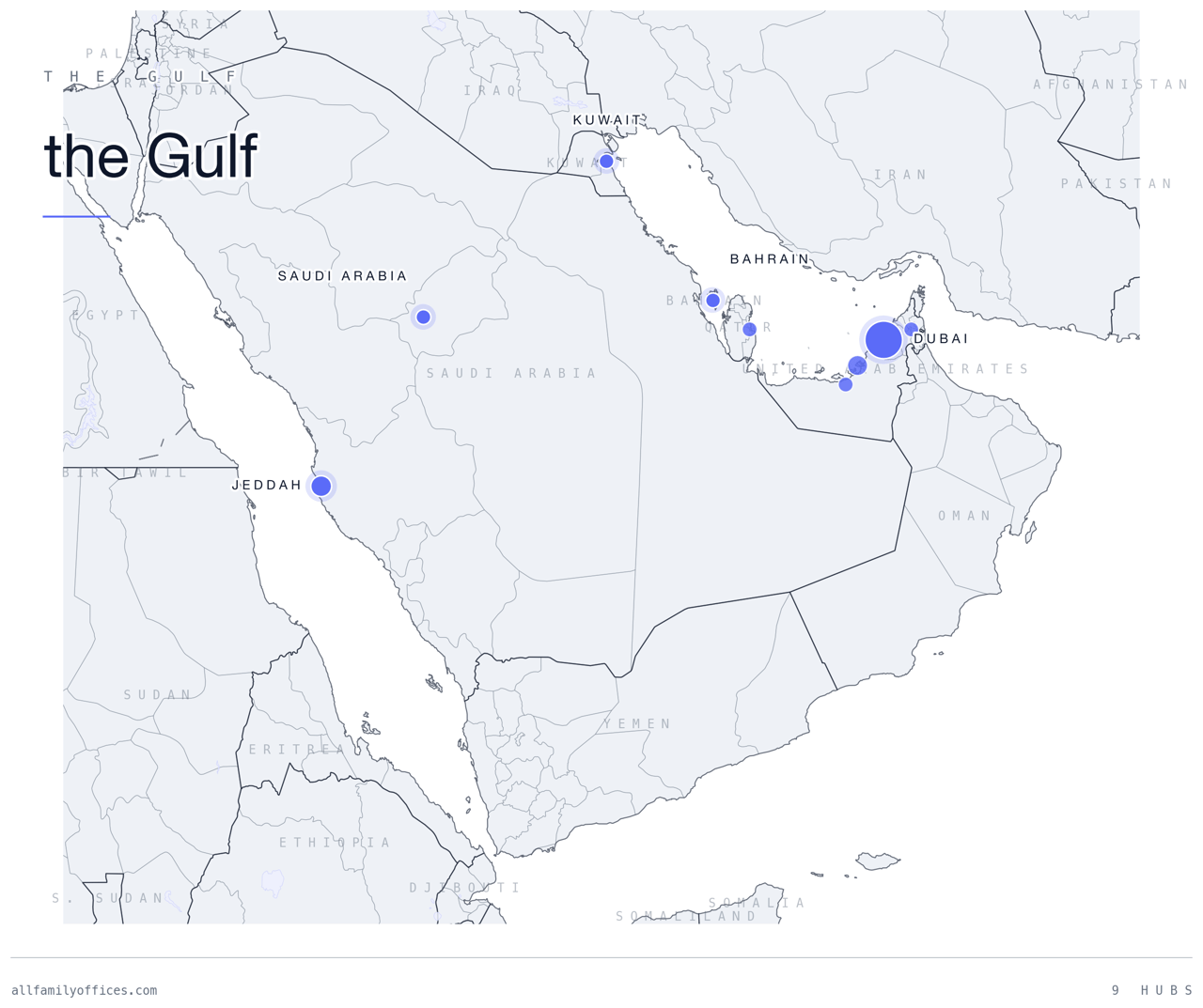
- The AllFamilyOffices database lists 270+ family offices in the GCC (October 2026). GCC single family offices have deployed over $303 billion in capital through 5,710 investment rounds.
- Dubai leads with 110+ family offices, followed by Abu Dhabi with 25+. The Dubai International Financial Centre (DIFC) alone hosts more than 800 registered family offices as of 2024.
- The UAE recorded a net inflow of 6,700 high-net-worth individuals in 2024, more than any other country globally.
- GCC family offices allocate 28% of assets to private equity, above the 22% global average. Some 51% of total holdings sit in alternative asset classes.
- Nearly 18,800 ultra-high-net-worth (UHNW) individuals reside in the Middle East, with a projected 24.6% increase from 2021 to 2026.
- Al Ghurair Investment holds the largest reported assets under management (AUM) at $35 billion. Majid Al Futtaim and Al Habtoor Group follow at $20 billion each.
GCC Family Office Landscape Overview
The six Gulf Cooperation Council nations (UAE, Saudi Arabia, Qatar, Kuwait, Bahrain, and Oman) host a fast-growing ecosystem of wealth management firms tied to ruling dynasties, merchant families, and first-generation entrepreneurs. These offices manage wealth that originated in oil and gas, real estate, and trading. Their strategies now extend into venture capital, fintech, and climate tech. Over 200 new family offices joined the DIFC in 2024 alone, reflecting the region's pull on both domestic and international capital.
Dubai serves as the primary hub because of zero personal income tax, no capital gains tax, and no inheritance tax. Saudi Arabia is emerging as a rival center through Vision 2030 and its Financial Sector Development Programme, which channels over $1 trillion into economic diversification projects including NEOM. Qatar ranks third globally in millionaires per capita, with 116 per 1,000 households.
Most Gulf private wealth offices are single family offices linked to conglomerates or ruling families. The multi-family office (MFO) model is gaining traction since Bahrain's Central Bank (CBB) introduced a formal MFO licensing framework. Virtual family office and family-office-as-a-service models are also emerging. Firms like Octagon build outsourced platforms for families that prefer not to staff a full in-house operation.
Family Office Comparison
The table below compares the largest and most active Gulf wealth platforms by reported AUM, investment focus, and headquarters. AUM figures appear only where data is available. Offices without confirmed figures are listed by portfolio activity.
| Family Office | Type | AUM Estimate | Investment Focus | Location |
|---|---|---|---|---|
| Al Ghurair Investment | SFO | $35B | Agritech, food security, startups | Dubai |
| Majid Al Futtaim Holding | SFO | $20B | Retail, real estate, entertainment | Dubai |
| Al Habtoor Group | SFO | $20B | Diversified | Dubai |
| Kingdom Holding Company | SFO | $15B | Technology, global diversified | Riyadh |
| Seed Group | SFO | $7B | Tech, healthcare, tourism, real estate | Dubai |
| Crescent Enterprises | SFO | $3B | Diversified | UAE |
| KBW Investments | SFO | $2.5B | Diversified | Dubai |
| The Olayan Group | SFO | — | Enterprise apps, fintech, diversified | Saudi Arabia |
| Alfardan Group | SFO | — | Diversified | Qatar |
| Alghanim Industries | SFO | — | Diversified industrials | Kuwait |
| Kanoo Group | SFO | — | Diversified | Bahrain |
Dubai-based offices dominate the top of this table, holding over $80 billion in combined reported AUM. Saudi Arabia's entries lack public AUM figures but rank among the region's most active by deal count and portfolio breadth.
Top Picks by Strategy
- Largest AUM: Al Ghurair Investment, with $35 billion in reported assets and deep exposure to agritech and food security ventures in the UAE.
- Most Active Portfolio: Seed Group, holding 67 portfolio companies (the highest count among GCC SFOs) spanning technology, healthcare, and tourism.
- Best for Technology Deals: Kingdom Holding Company, whose early backing of Careem (later acquired by Uber for $3.1 billion) remains the Gulf's landmark family office exit.
- Top Emerging Office: Tamasuk Al Rajhi, led by a chairman in his 30s, building an institutional-grade platform in private markets and equities from scratch since 2019.
- Strongest Climate Tech Focus: Al Nowais Investments, whose subsidiary AMEA Power operates renewable energy projects. This positions the office as the Gulf's leading clean-energy family investor.
- Leading Global Diversifier: The Olayan Group, with 30 portfolio companies spread over the US, Saudi Arabia, and four additional countries.
- Best for Digital Innovation: Private Office of Sheikh Saeed Al Maktoum, investing in blockchain (Fantom Foundation) and digital transformation (Servion Global Solutions).
Top 12 GCC Family Offices in Detail
Al Ghurair Investment
The Gulf's largest family office by reported AUM controls $35 billion in assets from Dubai. Al Ghurair Investment anchors its portfolio in agritech and food security, two sectors that align with the UAE's national strategy to reduce import dependency. The office also backs early-stage startups, giving it exposure to innovation alongside its legacy industrial and agricultural holdings.
Majid Al Futtaim Holding
Retail and real estate define this $20 billion Dubai-based office. Majid Al Futtaim operates the exclusive franchise for Carrefour in multiple markets, linking its capital deployment arm to consumer-facing operating businesses. That retail infrastructure gives the family proprietary deal flow in e-commerce, logistics, and entertainment ventures that pure financial investors rarely access.
Al Habtoor Group
Al Habtoor Group manages $20 billion through a diversified portfolio spanning hospitality, automotive, real estate, and education. The group's direct ownership of operating businesses distinguishes it from offices that mainly allocate to external funds. Families seeking co-investment (investing alongside another fund or family) in Gulf real estate and hospitality will find Al Habtoor among the most established counterparties.
Kingdom Holding Company
Prince Alwaleed Bin Talal's Riyadh-based office manages $15 billion with a heavy tilt toward global technology. Kingdom Holding backed Careem in 2017. Uber's $3.1 billion acquisition in 2019 remains the region's most prominent family office exit. The office continues to invest in diversified global assets, acting as a bridge between Saudi capital and Silicon Valley deal flow.
Seed Group
With 67 portfolio companies, Seed Group holds the largest active portfolio among Gulf SFOs. The Al Maktoum family's office manages roughly $7 billion and targets technology, healthcare, tourism, and real estate. Its high deal volume makes it a natural partner for startups seeking patient capital and regional distribution networks rather than a single check.
The Olayan Group
One of Saudi Arabia's oldest business dynasties, the Olayan family has invested in 30 companies in the US, Saudi Arabia, and four other countries. The office focuses on enterprise software, fintech, and diversified industrial holdings. Its cross-border reach, unusual for a Saudi SFO, positions it as a model for families planning to globalize their portfolios through direct investments in multiple markets.
Private Office of Sheikh Saeed Al Maktoum
This Dubai-based office bets on blockchain and digital transformation. Allocations to Fantom Foundation and Servion Global Solutions signal a conviction in decentralized finance and enterprise tech. The office represents the ruling Al Maktoum family's next-generation digital strategy, distinct from Seed Group's broader portfolio approach.
Tamasuk Al Rajhi
A younger branch of the Al Rajhi banking dynasty launched Tamasuk just before COVID. Chairman Abdulaziz Saleh Al Rajhi, in his 30s, hired Waleed Hussain from MASIC to build an institutional platform in private markets, equities, and multi-asset strategies. Tamasuk avoids rigid mandates, favoring agility to move quickly on direct deals. This marks a break from the family's traditional focus on real estate and income-generating assets.
Al Nowais Investments
Climate tech is the defining angle for this UAE-based SFO. Its subsidiary AMEA Power develops renewable energy projects, positioning the office at the center of the GCC's green hydrogen and clean-energy push. Families and institutional investors aligned with ESG and impact investing will find Al Nowais among the few Gulf offices with a dedicated energy transition portfolio.
Alfardan Group
Qatar's leading private wealth office operates from Doha with a diversified portfolio. The Alfardan family built its wealth in pearls and luxury retail, then expanded into real estate and financial services. Qatar's flat 10% corporate tax and over 80 double taxation agreements give Doha-based firms like Alfardan favorable conditions for cross-border structuring.
Alghanim Industries
Kuwait City's most prominent family conglomerate manages diversified industrial holdings spanning automotive, engineering, food, and retail. The Alghanim family operates in a market where 217,000 millionaires represent 15% of the population, creating dense local co-investment networks. The office functions as both an operating business and a capital allocator.
Kanoo Group (Yusuf Bin Ahmed Kanoo)
Bahrain's flagship family wealth platform runs a diversified conglomerate from Manama. Bahrain's status as the most cost-efficient GCC location (up to 48% cheaper than regional peers in financial services) gives the Kanoo Group a structural cost advantage. The CBB's new family office license and trust law framework provide the group with updated legal tools for succession planning and wealth transfer to the next generation.
Investment Trends Shaping This Market
Venture Capital and Direct Startup Deals
Some 58% of MENA family groups are active in venture capital, favoring an even split between angel/seed and growth-stage capital deployment. Gulf SFOs participated in 454 seed-stage rounds ($1.62 billion) and 714 early-stage rounds ($21.8 billion) over the past five years. Seed Group's 67-company portfolio and Kingdom Holding's Careem exit illustrate this regional shift from passive fund commitments to direct startup backing, especially in AI and fintech.
Alternative Assets Overtaking Traditional Holdings
Gulf family wealth platforms now allocate 51% of their portfolios to alternative asset classes, compared to 49% in traditional holdings. Private equity commands 28% of allocations (above the 22% global average), while real estate holds at 15%, also above the 10% global norm. Digital assets are next: 78% of family offices globally plan to invest in crypto and tokenized assets within two to three years. UAE virtual asset policies cater directly to this demand, giving offices like the Private Office of Sheikh Saeed Al Maktoum a regulatory advantage for blockchain allocations.
Sharia-Compliant and Impact Investing
About 31% of Middle East family offices practice Sharia-compliant investing, which overlaps with ESG principles by excluding alcohol, gambling, and arms. Nearly half pursue sustainable portfolio activity, a share projected to double within five years. The concept of "modern Waqf" (enduring capital for community benefit) is gaining traction as a framework connecting Islamic finance with impact goals. Al Nowais Investments exemplifies this trend through AMEA Power's renewable energy projects. Some 81% of younger investors in the region now factor sustainability into their decisions.
Next-Generation Leadership and Institutional Hiring
Younger family members are launching their own SFOs at an increasing rate. Tamasuk Al Rajhi and Alajlan Family Office (11 portfolio companies since its 2022 founding) illustrate this trend. These offices hire Western-trained professionals, including former investment bankers, management consultants, and chartered financial analysts, to build institutional-grade oversight. The result is a new class of Gulf investor that moves faster and deploys capital more globally than prior generations.
How to Evaluate a Family Office in the GCC
Sharia compliance is the first filter for many families in this market. Verify whether the office avoids interest-bearing instruments (riba), screens for halal sectors, and integrates zakat obligations. Al Ghurair Investment and Kingdom Holding both operate within Islamic finance parameters, but the depth of compliance varies widely between Gulf offices.
Jurisdiction choice affects cost, privacy, and legal flexibility. DIFC offers dedicated family office licensing with confidentiality and asset protection rules. ADGM consolidates wealth management, estate planning, and charitable giving under one framework. Bahrain's CBB provides the broadest operational scope, including trusts and private equity, at operating costs up to 48% lower than other GCC centers. Families should match their regulatory needs to the right free zone before selecting an office.
Cross-border capability matters because Gulf wealth managers increasingly invest in Europe, Asia, and the Americas. Assess whether the office has relationships in London, Singapore, or New York, and whether it understands tax treaties in those jurisdictions. The Olayan Group's six-country portfolio and Seed Group's allocations in India and the US offer benchmarks for global reach.
Operational maturity and family governance separate legacy conglomerates from newer offices. Ask whether the office uses a family constitution, has a formal investment committee, and employs an external CIO. Tamasuk Al Rajhi's decision to hire a former MASIC executive to build processes from scratch shows what serious oversight looks like at a young office. Families with complex multi-generational structures should prioritize advisors that have addressed succession planning directly, since only 24% of Gulf family offices historically had formal succession plans.
Which Family Office Fits Your Needs?
UHNW families seeking full-service wealth preservation with diversified managed assets should explore Al Ghurair Investment or Al Habtoor Group, both managing $20 billion or more with deep operating business ties. Their scale supports estate planning, tax structuring, and multi-generational oversight under one roof.
Business owners planning a liquidity event will find relevant models in Kingdom Holding's track record of backing high-growth companies like Careem, and in Seed Group's 67-company portfolio that offers co-investment and partnership pathways. These firms understand how to convert operating wealth into diversified portfolios without losing sector exposure.
Next-generation wealth holders drawn to technology and impact investing should study Tamasuk Al Rajhi and Al Nowais Investments. Both are built around the priorities of younger principals who favor venture capital, clean energy, and institutional discipline over legacy real estate.
Institutional allocators and advisors seeking Gulf deal flow should note that Bahrain and Saudi Arabia are actively building regulatory on-ramps. Saudi Arabia's special economic zones offer corporate tax exemptions for up to 20 years, while Bahrain's Golden Residency Programme provides permanent residency with a five-day processing window. These incentives lower the friction for non-GCC family offices looking to establish a Gulf presence.
Methodology
This article profiles GCC family offices using publicly reported AUM figures, portfolio counts, and capital deployment data current as of early 2026. We selected offices based on verified data points including assets under management, investment focus, geographic presence, and deal activity. The article covers all six GCC nations: UAE, Saudi Arabia, Qatar, Kuwait, Bahrain, and Oman. Where AUM data was unavailable, we included offices based on portfolio activity and market prominence. All statistics reflect the most recent available data. No figures were estimated or projected beyond reported values.
Frequently Asked Questions
 Google AI Mode
Tells Google to show you more from AllFamilyOffices in AI, Search and Discover.