On This Page
Key Facts
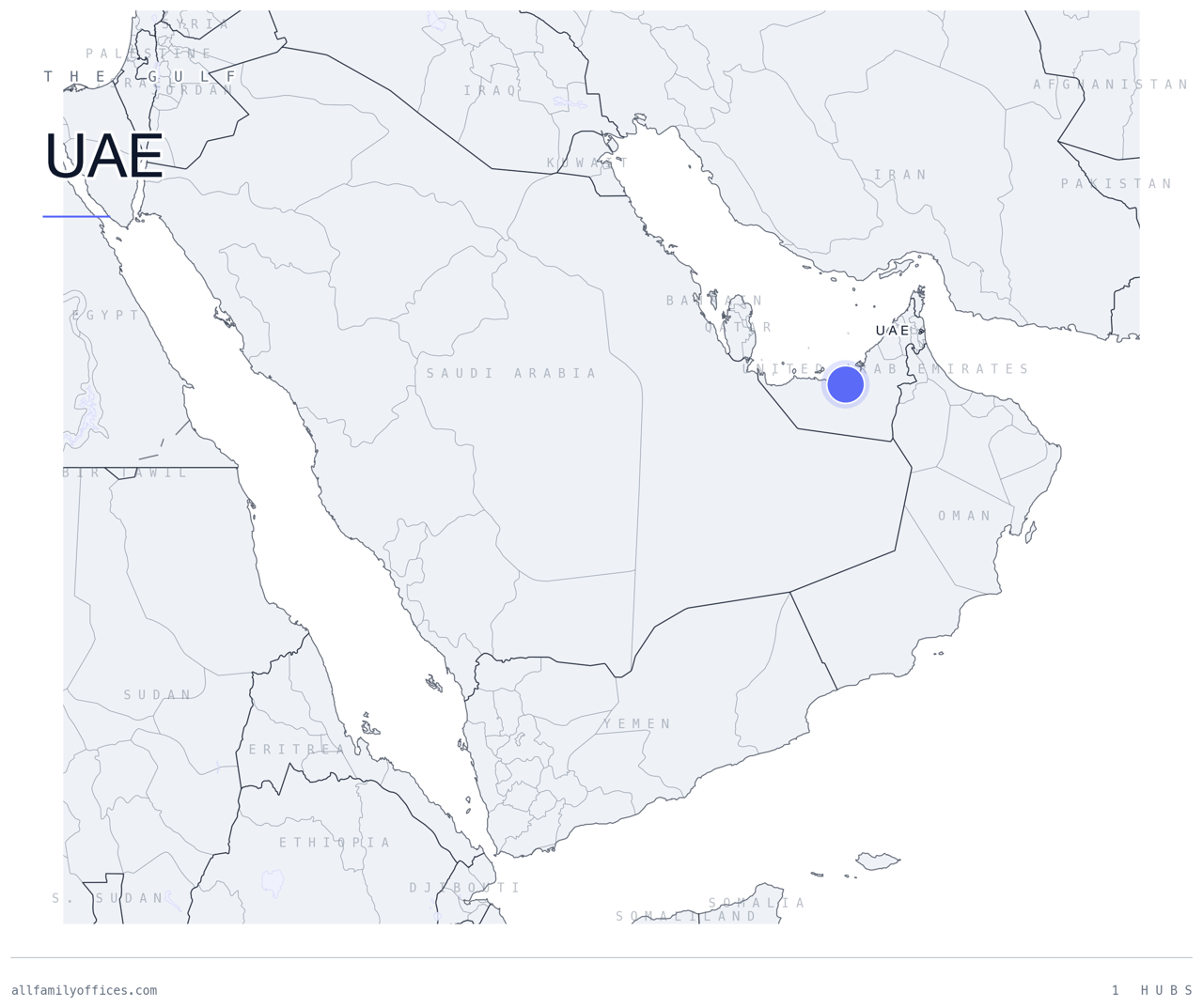
- The AllFamilyOffices database lists 170+ family offices in the UAE (October 2026), with 110+ headquartered in Dubai and 25+ in Abu Dhabi.
- The top 10 UAE family offices manage a combined $433 billion in assets under management (AUM), led by Royal Group LLC at $164 billion.
- Dubai is the primary hub, while Abu Dhabi attracts ruling family offices and sovereign-linked entities with the largest individual AUM figures.
- Family offices in the UAE are growing at 6.2% per year, with one quarter of all offices established in the last five years.
- 83% of Middle East family offices invest in private equity, and 58% are active in venture capital.
- The UAE's zero personal income tax, zero capital gains tax, and zero inheritance tax make it one of the most wealth-friendly jurisdictions globally.
- Nearly $2 trillion in family wealth is projected to transfer to the next generation in the GCC over the coming decade.
UAE Family Office Landscape Overview
The UAE hosts one of the most varied family office ecosystems in the world. Unlike markets dominated by multi-family office (MFO) platforms, the UAE landscape includes ruling family private offices, conglomerate family groups, Indian-origin family offices, and a growing number of international families establishing bases in Dubai and Abu Dhabi. The country's ultra-high-net-worth (UHNW) population stands at roughly 18,800 individuals, and Dubai's millionaire count has doubled over the past decade to about 81,200.
Several forces drive this concentration. The Dubai International Financial Centre (DIFC) and Abu Dhabi Global Market (ADGM) provide English common law frameworks, privacy protections, and modern tools for succession planning and asset governance. DIFC requires a minimum of $50 million in net assets for SFO licensing. Free zones offer 0% corporate tax for up to 50 years and full foreign ownership.
Migration trends reinforce growth. About 4,500 millionaires relocated to the UAE in 2023, making it the second most popular destination after Australia. Ray Dalio opened a branch of his family office in Abu Dhabi. European families, including the Nestlé heir and the Von Siemens family, have set up UAE operations. The India-UAE corridor is especially strong: Indian-origin family offices span retail, healthcare, real estate, and construction, reflecting the fact that roughly 51% of the UAE's population is of Indian origin.
Ajman, the smallest of the seven emirates by area, has a small family office market. Its main family investment office is Ajman Holding, established in 2000 under the ownership and patronage of Shaikh Abdulaziz bin Humaid Al Nuaimi of the emirate's ruling family. The group's activities span real estate, energy, facility management, media, retail, sports, automotive, technology and education. Families based in Ajman who need multi-family office services or regulated structures usually work with firms licensed in the DIFC or ADGM.
Family Office Comparison
The table below ranks the largest family offices in the UAE by reported assets under management. Offices without verified AUM figures are excluded from this ranking.
| Family Office | Type | AUM Estimate | Investment Focus | Location |
|---|---|---|---|---|
| Royal Group LLC | Conglomerate | $164B | Real estate, tech, healthcare, venture capital | Abu Dhabi |
| Crescent Group | Direct Investor | $83B | Oil & gas, healthtech, fintech, enterprise software | Sharjah/Dubai |
| Dubai Holding LLC | Royal Family Office | $75B | Real estate, media, education, tourism | Dubai |
| 2PointZero | Family Office (IHC subsidiary) | $27B | Finance, AI, mining, crypto | Abu Dhabi |
| YBA Kanoo Group | Family Office | $20B | Fixed income, venture capital, PE, real estate | Dubai/Manama |
| Abu Dhabi Capital Group | Family Office | $20B | Equities, PE, hedge funds, real estate | Abu Dhabi |
| Al Qasimi Family Office | Royal Family Office | $15B | Manufacturing, trade, real estate, oil & gas | Dubai |
| DAMAC Capital | Family Office | $10B | Private/public equity, real estate, hospitality | Dubai |
| Whitebridge Holding | Family Office | $10B | Diversified investments | Dubai |
| Tensai Holdings | Private Family Office | $9.33B | Equities, hedge funds, sustainable investments | Abu Dhabi |
Abu Dhabi offices hold the three largest AUM positions, driven by ruling family wealth and sovereign-linked capital. Dubai dominates by count, hosting the majority of mid-tier and Indian-origin offices. Ticket sizes range from $1 million at 2PointZero to over $1 billion at Royal Group, reflecting the breadth of deal activity.
Top Picks by Strategy
- Largest AUM: Royal Group LLC, with $164 billion and investments spanning 60+ companies from $10 million to $1 billion per deal.
- Best for Venture Capital: Crescent Group, whose CE-Ventures arm has deployed over $500 million into tech startups including Anomali, Vezeeta, Kitopi, and FreshtoHome.
- Top Real Estate Allocator: Dubai Holding LLC, managing Dubai Hills Estate, Rove Hotels, and a subsidiary overseeing roughly $10 billion in public and private markets.
- Leading Digital and Crypto Investor: 2PointZero, with active positions in Citadel crypto mining, AI ventures, and mining resources at ticket sizes of $1 million to $100 million.
- Strongest Institutional Platform: Abu Dhabi Capital Group, allocating $10 million to $100 million per deal into blue-chip managers like Blackstone, Coller, ICG, and AlpInvest.
- Best for Sustainable Investments: Tensai Holdings, combining equities, hedge funds, and a dedicated focus on sustainable and infrastructure assets from Abu Dhabi.
- Most Diversified Conglomerate: Al-Futtaim Group, ranked #3 on the Forbes Top 100 Arab Family Business list, with holdings in automotive, financial services, healthcare, and retail.
- Top Indian-Origin Office for Healthcare: Burjeel Holdings, publicly listed with cross-border hospital and diagnostic operations led by Dr. Shamsheer Vayalil.
Top 12 Family Offices in the UAE in Detail
Royal Group LLC
No single entity shapes Abu Dhabi's investment landscape more than Royal Group. Led by Sheikh Tahnoon bin Zayed Al Nahyan, the conglomerate manages $164 billion and operates over 60 companies, employing more than 20,000 people. Its ticket sizes run from $10 million to well over $1 billion, spanning real estate, financial services, technology, media, and healthcare. The Tau Capital deeptech fund sits within its broader ecosystem. For co-investors seeking sovereign-adjacent deal flow at scale, Royal Group is the defining partner in the UAE.
Crescent Group
The Jafar family's holding company stands apart as the UAE's most active corporate venture platform. Crescent Group manages $83 billion, anchored by Crescent Petroleum in oil and gas. Its venture arm, CE-Ventures, has deployed over $500 million into tech companies from Series A onward, including healthtech firm Vezeeta, food delivery platform Kitopi, and cybersecurity company Anomali. This blend of hydrocarbon wealth and tech-forward capital deployment makes Crescent a bridge between old-economy resources and new-economy innovation.
Dubai Holding LLC
Sheikh Mohammed bin Rashid al-Maktoum's personal investment vehicle controls approximately $75 billion in assets. Dubai Holding operates as a direct investor with deal sizes of $50 million to $500 million, building and acquiring companies in real estate, media, education, and tourism. Its subsidiary manages roughly $10 billion in public and private market investments. Key portfolio assets include Dubai Hills Estate, telecom operator du, and the Rove Hotels chain. Families and allocators evaluating UAE real estate exposure will find Dubai Holding at the center of the emirate's property market.
2PointZero
As a subsidiary of International Holding Company (IHC), 2PointZero channels $27 billion into five sectors: finance, technology and AI, mining, digital assets, and crypto. Notable investments include Lunate, Beltone, and Citadel crypto mining. Ticket sizes range from $1 million to $100 million, making it one of the few Abu Dhabi offices writing smaller checks for emerging ventures. Its link to IHC provides sovereign-grade backing, while its sector focus on AI and digital assets reflects the priorities of the UAE's next-generation investors.
YBA Kanoo Group (Kanoo Capital)
The Kanoo family operates one of the Gulf's oldest merchant dynasties, now managing $20 billion through Kanoo Capital. The investment arm spans fixed income, venture capital, private equity, real estate, and public equities, with ticket sizes of $10 million to $100 million. Portfolio companies include CorrosionRADAR, Retalio, and Singapore Gulf Bank. This breadth of asset allocation, from early-stage venture to fixed income, is unusual among UAE family offices and reflects a multi-generational investment philosophy.
Abu Dhabi Capital Group
With $20 billion in assets, Abu Dhabi Capital Group is one of the MENA region's largest institutional-style family offices. Its portfolio spans equities, fixed income, private equity, hedge funds, and real estate, with capital deployed into managers like Blackstone, Coller, ICG, and AlpInvest. Direct investments include Boom Supersonic, ALEF Education, and Investera. Ticket sizes of $10 million to $100 million position it as a fund-of-funds style allocator that also takes direct stakes in growth companies.
Al Qasimi Family Office
Owned by Sheikh Ahmed bin Faisal Al Qasimi, this $15 billion royal family office spans manufacturing, trade, real estate, IT, oil and gas, sports, recruitment, and financial services. Based in Dubai, it represents one of the more diversified ruling family operations, with investments that extend beyond the typical real estate and energy holdings. Its scope reflects the Al Qasimi family's long history of commercial enterprise in the northern emirates.
DAMAC Capital
Hussain Sajwani's DAMAC Group channels its investment activity through DAMAC Capital, which manages $10 billion. The office invests in private and public equity, real estate, hospitality, and logistics, running venture, growth, buyout, and real estate strategies simultaneously. Public equity positions span telecom, banking, REITs, oil and gas, and consumer sectors. DAMAC's real estate pedigree, built through luxury developments in Dubai, gives its capital arm a distinctive edge in property-linked deals.
Whitebridge Holding
This Dubai-based family office manages $10 billion with a focus on diversified investments and a ticket size of $5 million to $50 million. Whitebridge maintains a lower public profile than peers of similar scale, reflecting the preference for discretion common among UAE family offices. Its mid-range deal sizes suggest a focus on growth-stage and mid-market opportunities rather than mega-deals.
Tensai Holdings
Operating from Abu Dhabi with $9.33 billion in assets, Tensai Holdings is a private family office focused on equities, hedge funds, infrastructure, and sustainable investments. Its explicit allocation to sustainability sets it apart from most UAE peers, aligning with the country's Net Zero by 2050 initiative. For allocators seeking a UAE partner with a dedicated ESG mandate, Tensai is among the few with a stated commitment at this scale.
Bait Al Batterjee Holding
This $5 billion family office spans the UAE and Saudi Arabia, focusing on healthcare and education. Its most notable asset is Saudi German Hospitals, one of the largest private hospital networks in the Middle East. The healthcare-only focus makes it a specialist rather than a generalist, and a natural co-investment partner for families or funds seeking exposure to Gulf region healthcare growth.
Lulu Retail (Yusuff Ali M.A.)
Yusuff Ali M.A. built Lulu Group into one of the Gulf's largest retail empires, spanning hypermarkets, malls, and hospitality from its Abu Dhabi base. LuLu Financial Holdings extends the family's reach into financial services. As one of the most prominent Indian-origin family offices in the UAE, Lulu represents the deep India-UAE investment corridor. Its retail footprint provides unique deal flow in consumer markets that few other family offices can match.
Investment Trends Shaping This Market
Venture Capital and Tech Investing by Next-Gen Leaders
79% of younger Middle East investors see major opportunities in digital and tech sectors. CE-Ventures (Crescent Group) has deployed $500 million into tech from Series A onward. 2PointZero is backing AI, crypto mining, and digital assets. This generational shift means UAE family offices are moving capital away from traditional sectors like retail and construction into fintech, healthtech, and deeptech at a faster rate than peers in other Gulf states.
Shariah-Compliant Investment Strategies
91% of younger investors in the region already allocate to Islamic investment strategies, and 88% plan to increase those allocations. This shapes deal selection in the UAE, where prohibition of riba (interest) rules out conventional fixed income, and halal investing excludes sectors like alcohol, gambling, and conventional banking. More than two-thirds of family office respondents want Shariah-compliant succession structures, creating demand for DIFC's modern trust and governance tools.
Net Zero and Sustainable Investing
The UAE's Net Zero by 2050 initiative is pulling family office capital into green sectors. Creek Capital launched a $1 billion net zero fund with BlackRock called Positive Zero. 74% of younger investors expect new business opportunities in sustainable sectors. Tensai Holdings has made sustainable investments a core allocation. This trend is stronger in the UAE than in neighboring Saudi Arabia or Qatar, partly because Abu Dhabi and Dubai have more developed regulatory frameworks for ESG disclosure.
Cross-Border Capital Flows and Migration
4,500 millionaires moved to the UAE in 2023. Indian-origin families are among the most active investors, with offices like Lulu, Burjeel Holdings, Sobha Realty, and KEF Holdings operating major operations. European families are establishing bases through DIFC and ADGM. This inbound wealth migration is expanding the number of family offices by roughly 6.2% per year, and diversifying the investor base beyond traditional Emirati and ruling family capital.
How to Evaluate a Family Office in the UAE
Free zone selection is the first critical decision. DIFC offers English common law, a $50 million minimum net asset requirement for SFOs, and 0% corporate tax for 50 years. ADGM provides similar protections but is better suited for offices seeking proximity to Abu Dhabi's sovereign-linked deal flow. DMCC and DWTC serve more specialized purposes. The regulatory framework you choose determines your legal protections, tax treatment, and access to co-investment networks.
Shariah compliance capability matters more here than in most markets. With 91% of younger investors allocating to Islamic strategies, any MFO or advisory office that lacks halal screening, zakat advisory, and Shariah-compliant succession tools will miss a large share of potential clients. Use Abu Dhabi Capital Group or YBA Kanoo Group as benchmarks: both manage diversified portfolios while maintaining compliance with Islamic finance principles.
The UAE market is unusually opaque. Family offices here value discretion, and public data on AUM, deal activity, and performance is limited. Networking at events like the Abu Dhabi Family Office (ADFO) Summit provides access that online research cannot. Verify anti-money laundering (AML) and KYC compliance directly, as regulatory enforcement has tightened in recent years.
Cross-border capability should be a key evaluation criterion. The India-UAE, GCC, and Europe-UAE corridors generate significant deal flow. An office that operates only within UAE borders will miss opportunities that families with global holdings need. Check for double taxation agreements and the office's track record with multi-jurisdictional estate planning before committing.
Which Family Office Fits Your Needs?
UHNW families relocating to the UAE with $100 million or more in liquid assets should evaluate DIFC-licensed SFO structures, using Royal Group and Abu Dhabi Capital Group as reference points for what full-scale UAE operations look like. Both demonstrate that Abu Dhabi offers sovereign-adjacent co-investment deal flow, while Dubai provides broader access to international networks and a deeper pool of service providers.
Business owners from the Indian subcontinent planning liquidity events will find natural partners among the Indian-origin offices. Lulu Retail, Burjeel Holdings, and KEF Holdings all operate with deep India-UAE ties and sector expertise in retail, healthcare, and infrastructure. These offices understand cross-border tax planning between Indian and UAE jurisdictions in ways that Emirati-origin offices may not.
Next-generation wealth holders focused on tech, sustainability, and digital assets should look at 2PointZero for crypto and AI exposure, Creek Capital for net zero strategies, and Crescent Group's CE-Ventures for venture capital. The UAE's younger investor cohort is driving a shift toward these sectors, and offices with dedicated venture and impact mandates are better positioned to serve this profile than traditional real estate-heavy family groups.
Methodology
This list of family offices in UAE was compiled using publicly reported AUM figures, regulatory filings from DIFC and ADGM, family office databases, and industry reports from 2024 and 2025. Offices were included only when verifiable data on their investment activity, location, or AUM existed in the source material. AUM figures represent the most recently reported numbers and may not reflect current valuations. The UAE family office market is notably private, and this list does not claim to be exhaustive. Indian-origin family offices were included alongside Emirati and ruling family offices to reflect the full scope of the list of family offices in UAE. Offices without any verifiable public data were excluded to maintain editorial standards.
Frequently Asked Questions
 Google AI Mode
Tells Google to show you more from AllFamilyOffices in AI, Search and Discover.