
On This Page
- Key Facts About Dubai Family Offices
- Dubai's Family Office Landscape
- Family Office Comparison at a Glance
- Top Picks by Strategy
- Top Family Offices in Dubai and the UAE in Detail
- Investment Trends Shaping Dubai's Family Office Market
- How to Evaluate a Family Office in Dubai
- Which Family Office Fits Your Needs?
- Methodology
- Frequently Asked Questions
Key Facts About Dubai Family Offices
- The AllFamilyOffices database lists 110+ family offices headquartered in Dubai (October 2026), making it the Middle East's dominant hub for private capital.
- UAE-based family offices have collectively deployed capital into over 8,193 investment rounds, contributing to $365 billion or more in total invested value.
- The Dubai International Financial Centre (DIFC) requires minimum net assets of USD 50 million for single family office licensing.
- Roughly 4,500 millionaires relocated to the UAE in 2023. Dubai's millionaire population has doubled over the past decade to about 81,200.
- One-quarter of Middle East family offices launched in the last five years. The sector is projected to grow 20% by 2030.
- 83% of Middle East family offices invest in private equity. 58% of MENA family groups are active in venture capital.
- An estimated $1 trillion in assets under management (AUM) will transfer between generations in the Middle East over the coming decade.
Dubai's Family Office Landscape
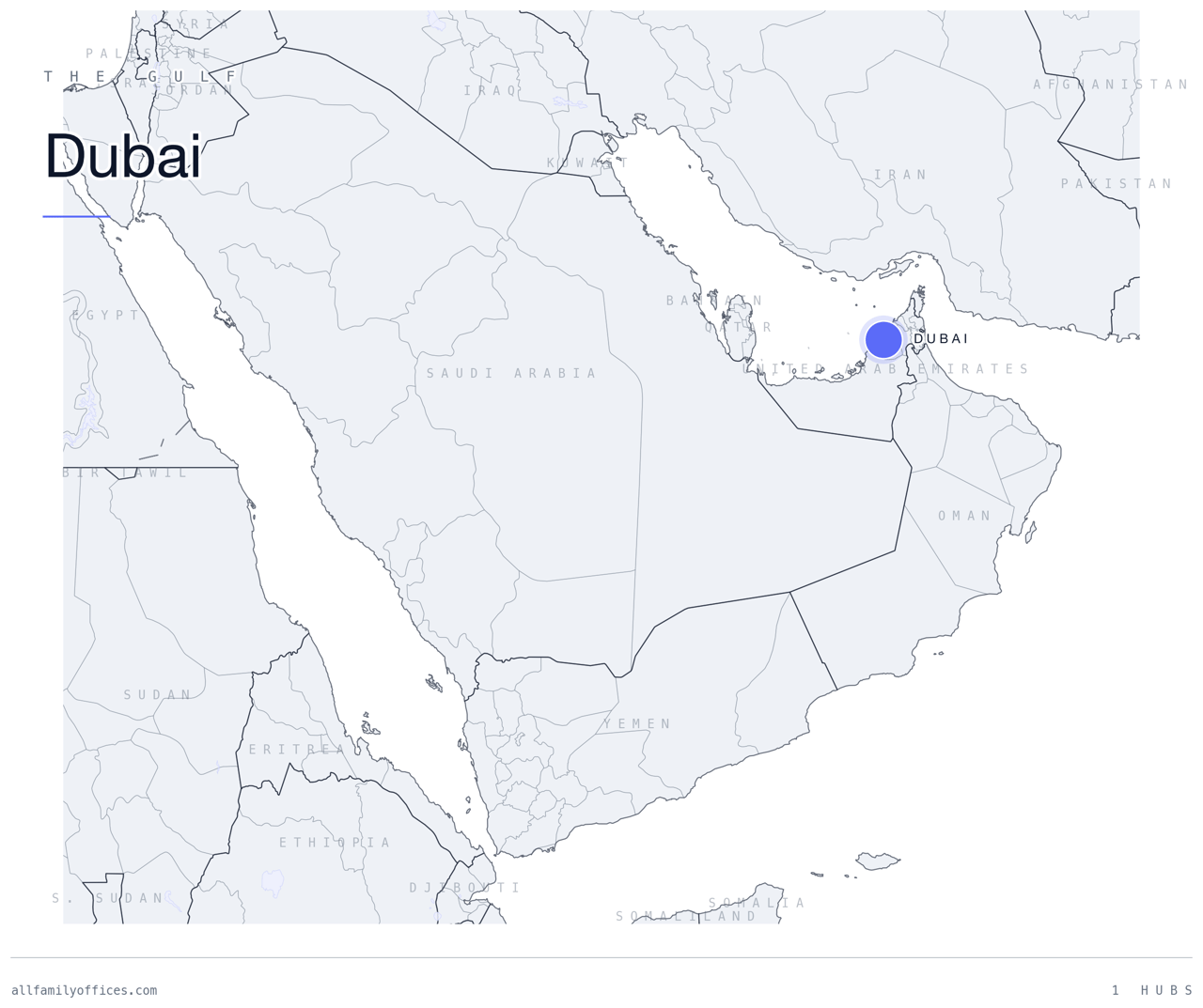
This list of family offices in Dubai covers the most prominent SFOs and multi-family offices (MFOs) active in the city and broader UAE. The AllFamilyOffices database lists 110+ family offices headquartered in Dubai, out of 340+ across the Middle East, with additional clusters in Abu Dhabi and Sharjah.
This concentration reflects decades of deliberate policy: zero personal income tax, no capital gains tax, no inheritance tax, golden visa programs offering 10-year residency, and full foreign ownership in designated free zones.
Four regulatory zones shape the city's family office ecosystem. The DIFC operates under a common law framework overseen by the Dubai Financial Services Authority (DFSA), where SFOs serving a single family no longer require separate DFSA registration. MFOs must obtain a DFSA license under stricter rules.
The Abu Dhabi Global Market (ADGM) provides a parallel common law structure in the capital. The DMCC and DWTC free zones offer lighter-touch licensing, with DWTC permitting partial non-family ownership.
Dubai's ultra-high-net-worth (UHNW) population now includes expatriate families from India, Europe, and the broader Gulf, alongside legacy ruling-family offices. Ray Dalio opened a family office branch in Abu Dhabi. Indian-origin conglomerates like LuLu Group and Burjeel Holdings run significant private wealth operations from the UAE.
Office types range from traditional SFOs and family business conglomerates to private investment vehicles, foundations (available in DIFC for as little as USD 350), and virtual family offices.
Family Office Comparison at a Glance
The table below compares the most prominent family offices operating in Dubai and the broader UAE. AUM figures are omitted because most offices do not publicly disclose them.
| Family Office | Type | Investment Focus | Notable Activity | Location |
|---|---|---|---|---|
| Seed Group | SFO | Technology, healthcare, tourism, real estate | 67 portfolio investments | Dubai |
| Daher Capital | SFO | Real estate, public equity, venture capital | Food industry wealth turned multi-asset platform | Dubai |
| Al-Huraimel Investments | SFO | Residential and commercial real estate, PE | Active in Dubai, Abu Dhabi, and Sharjah since 1988 | Sharjah |
| Private Office of Sheikh Al Nahyan | SFO | Real estate, PE, sustainable tech, healthcare, agro-tech | Al Nahyan ruling family of Abu Dhabi | Abu Dhabi |
| Amplefields Investments | SFO | Late-stage AI, transportation, fintech, healthtech | 10 portfolio investments in US and Israel | Middle East |
| Wami Capital | SFO | Not disclosed | Dubai-based SFO | Dubai |
| SKH Private Family Office | SFO | Not disclosed | Dubai-based SFO | Dubai |
| The Olayan Group | SFO | Enterprise applications, fintech, diversified | 30 portfolio investments | Saudi Arabia |
Seed Group stands out with the largest tracked portfolio by deal count. Among Dubai-based offices, real estate remains the most common allocation, but technology and private equity positions are rising fast.
Top Picks by Strategy
- Most Active Portfolio: Seed Group, with 67 investments spanning technology, healthcare, tourism, and real estate since 2004.
- Top Real Estate Allocator: Al-Huraimel Investments, developing residential and commercial properties in Dubai, Abu Dhabi, and Sharjah for over three decades.
- Leading Late-Stage Tech Investor: Amplefields Investments, targeting AI, transportation, fintech, and healthtech with deals in the US and Israel.
- Best for Sustainable Strategies: Private Office of Sheikh Mohamed Bin Ahmed Bin Hamdan Al Nahyan, combining private equity with sustainable technologies, healthcare, and agro-tech.
- Strongest Cross-Border Reach: Al-Nahdi Family Office, with 8 portfolio investments spanning Germany, China, and four additional countries.
- Most Diversified Platform: Daher Capital, covering real estate, public equity, and venture capital from its Dubai base.
- Newest Entrant to Watch: Alajlan Family Office, launched in 2022 with a focused thesis on enterprise applications and edtech, already holding 11 portfolio investments.
Top Family Offices in Dubai and the UAE in Detail
Seed Group
No Dubai-based family office matches Seed Group's deal volume. With 67 portfolio investments in enterprise applications, high tech, and over 29 additional sectors, Seed Group operates as one of the most active SFOs in the Middle East. Its capital deployment covers technology, healthcare, tourism, and real estate.
Founders seeking co-investment partners with broad sector exposure will find Seed Group's two-decade track record hard to match. Few single family offices combine this level of volume and range from one private wealth platform.
Daher Capital
Michel Daher built a food manufacturing and distribution empire before launching Daher Capital as a private investment vehicle in Dubai. The office now allocates capital to real estate, public equity, and venture capital. This multi-asset approach sets it apart from Dubai SFOs that remain concentrated in property.
Business owners looking to move commercial wealth into a structured portfolio will recognize Daher Capital's model. It offers a template for transitioning from operating businesses to formal wealth management.
Al-Huraimel Investments
One of the longest-running SFOs in the UAE, Al-Huraimel Investments has operated from Sharjah since 1988. H.E. Issa Khalfan Al-Huraimel and his sons founded the office, which focuses on residential and commercial real estate development in Dubai, Abu Dhabi, and Sharjah. It also holds private equity positions.
Families seeking a real estate-anchored office with deep local development expertise will find few competitors with comparable tenure in the Emirates.
Private Office of Sheikh Mohamed Bin Ahmed Bin Hamdan Al Nahyan
The Al Nahyan ruling family of Abu Dhabi backs this SFO, which invests in real estate, private equity, sustainable technologies, healthcare, and agro-tech. The sustainability angle distinguishes it from most Gulf family offices, which historically favored conventional asset classes.
Its blend of ruling-family capital and forward-looking sector focus places it at the intersection of traditional wealth preservation and next-generation priorities.
Amplefields Investments
Amplefields targets late-stage technology deals in AI, transportation, fintech, and healthtech, with 10 portfolio investments in the US and Israel. Launched in 2021, it has built cross-border reach that most Middle Eastern SFOs lack.
Tech entrepreneurs seeking growth-stage capital from a Gulf-based office with Western market fluency should note Amplefields' focused thesis and rapid deployment since launch.
LuLu Group and LuLu Financial Holdings
Yusuff Ali M.A. built LuLu Group into one of the Gulf's largest retail and hospitality empires, operating hypermarkets and malls from its Abu Dhabi base. LuLu Financial Holdings manages the family's broader wealth, including significant India-UAE investment and charitable ties.
The office represents the Indian-origin family business model that has become a defining feature of UAE private wealth, with operations bridging South Asian and Gulf markets.
The Olayan Group
The top-ranked Arab family business by regional rankings, The Olayan Group operates from Saudi Arabia with 30 portfolio investments in enterprise applications, fintech, and other sectors. While not Dubai-based, its regional influence makes it relevant to any serious assessment of Middle East family office capital.
UHNW families evaluating the broader Gulf investment landscape will encounter Olayan as a benchmark for scale and broad asset mix among Arab family conglomerates.
Wami Capital
Wami Capital operates as a Dubai-based SFO with limited public disclosure about its portfolio or thesis. Its presence on curated lists of active Dubai family offices signals participation in the city's private capital networks.
For fund managers and deal sponsors prospecting within DIFC and Dubai free zones, Wami Capital represents the type of discreet SFO that requires direct relationship-building to access.
Investment Trends Shaping Dubai's Family Office Market
Direct Investments and Co-Investment Networks
83% of Middle East family offices invest in private equity, and co-investment with sovereign wealth funds is growing. Saudi Arabia now offers family offices access to sovereign fund deal flow, while DIFC-based networks facilitate joint deals among SFOs.
Middle East SFOs participated in 1,039 early-stage rounds worth $33.1 billion and 863 late-stage rounds worth $108 billion over the past five years. Seed Group's 67-deal portfolio and Amplefields' 10 cross-border investments illustrate how Dubai offices deploy direct capital rather than relying solely on fund allocations.
Technology and AI Capital Flows
79% of younger Middle East investors see major opportunity in digital and tech sectors. Seed Group's 67 investments lean heavily toward enterprise applications and high tech. Amplefields channels capital into AI, fintech, and healthtech from its Dubai base.
Three to five years ago, discussing technology with Gulf family offices proved difficult. Today it is standard practice, driven by next-generation members entering investment roles and Dubai's positioning as a regional tech hub.
Sharia-Compliant and Sustainable Investing
91% of younger Gulf investors already allocate to Islamic investment strategies, and 88% plan to increase those positions. In parallel, 81% of younger investors factor sustainability into decisions, and 73% believe it drives better returns.
Dubai family offices increasingly blend halal investing principles with ESG criteria. The Private Office of Sheikh Al Nahyan's sustainable tech and agro-tech focus exemplifies this shift. The result is a distinct regional approach to values-based capital deployment.
Real Estate Beyond Traditional Holdings
Dubai family offices historically over-concentrated in property. That pattern is shifting. Daher Capital now splits capital among real estate, public equity, and venture capital rather than holding a property-heavy portfolio.
Regional wealth managers are adding digital assets and alternative investments to portfolios that were once 60% or more real estate. This shift reflects both risk management discipline and the pull of higher-return sectors like the tech deals Amplefields and Seed Group pursue.
Next-Generation Wealth Transfer
An estimated $1 trillion in managed assets will transfer between generations in the Middle East over the coming decade. 89% of next-generation investors hold their assets in the region.
One in five family offices reports that the younger generation is becoming much more involved in investment strategy. Saudi Arabia's Vision 2030 is creating $1 trillion or more in new investment projects, giving next-generation leaders fresh local outlets for capital deployment beyond the traditional real estate and trading businesses their families built.
How to Evaluate a Family Office in Dubai
Regulatory jurisdiction is the first filter. DIFC, ADGM, DMCC, and DWTC each impose different licensing rules, legal frameworks, and oversight standards. An SFO in DIFC operates under common law with DFSA oversight, while DMCC and DWTC free zones apply lighter-touch rules.
Verify any office's licensing status through the DFSA public register before engaging. Seed Group and Wami Capital both operate under Dubai's regulatory umbrella, but their structures and disclosure levels differ sharply.
Sharia compliance capability matters for many Gulf families. Assess whether the office integrates Islamic finance principles, including zakat obligations, halal investing screens, and the prohibition of riba (interest). 91% of younger regional investors already allocate to Islamic strategies, making this a baseline expectation in the Dubai market.
Succession planning readiness separates professional offices from informal arrangements. Only 24% of Middle East high-net-worth individuals have had succession plans historically. Nearly half of family offices in regional studies called building a robust plan a "major challenge." Probe for a formal family constitution, documented estate planning processes, and clear family governance frameworks.
Cross-border expertise is critical because Dubai offices like Amplefields and Al-Nahdi Family Office manage portfolios spanning multiple countries. Evaluate an office's capacity for multi-jurisdictional tax planning and compliance. Physical presence requirements vary by free zone, and some zones mandate onshore staffing and local data storage.
Watch for red flags specific to this market: over-concentration in a single asset class (especially real estate, which historically dominated UAE portfolios), absence of formal oversight structures, limited data transparency, and staff retention issues. Only 15% of family office staff in the region are women, which may signal broader organizational maturity questions worth exploring during due diligence.
Which Family Office Fits Your Needs?
UHNW families seeking broad wealth management should look first at offices with proven multi-sector platforms. Seed Group's 67 investments give it the widest coverage in Dubai, while MFO structures (requiring DFSA licensing) offer shared services and reduced fixed costs for families that do not need a fully dedicated team. The USD 50 million DIFC threshold for SFO licensing sets a practical floor for families considering their own office.
Business owners moving trade or industrial wealth into structured portfolios will find natural alignment with Daher Capital and Al-Huraimel Investments. Both grew from operating businesses into investment platforms, and both maintain strong real estate and private equity exposure rooted in Gulf commercial networks. Families relocating to Dubai through golden visa programs should prioritize offices with DIFC or ADGM foundation structuring expertise for asset protection and estate planning.
Next-generation wealth holders focused on technology and sustainability should evaluate Amplefields for its late-stage AI and fintech thesis, or the Private Office of Sheikh Al Nahyan for its sustainable technologies and agro-tech focus. With 89% of younger regional investors keeping assets in the Middle East, Dubai-based firms offer proximity to both local deal flow and the global networks these inheritors increasingly demand.
Methodology
This list of family offices in Dubai draws on the AllFamilyOffices database, top Arab family business rankings, the DIFC Family Wealth Centre, and portfolio data from public filings and registry sources. Office profiles were cross-referenced with professional directories and public registry records.
Selection criteria prioritized offices with verifiable Dubai or UAE presence and documented investment activity. Market statistics reflect 2024-2025 data from regional wealth research firms, global private banking reports, and private wealth migration studies. Offices were included based on portfolio evidence, regulatory registration, or credible third-party tracking, not self-reported claims.
Frequently Asked Questions
 Google AI Mode
Tells Google to show you more from AllFamilyOffices in AI, Search and Discover.