On This Page
Key Facts
- An estimated 127 single family offices (SFOs) operate in the Middle East, with Saudi Arabia contributing a major share of that total.
- Middle East SFOs have collectively deployed over $365 billion in more than 8,193 investment rounds.
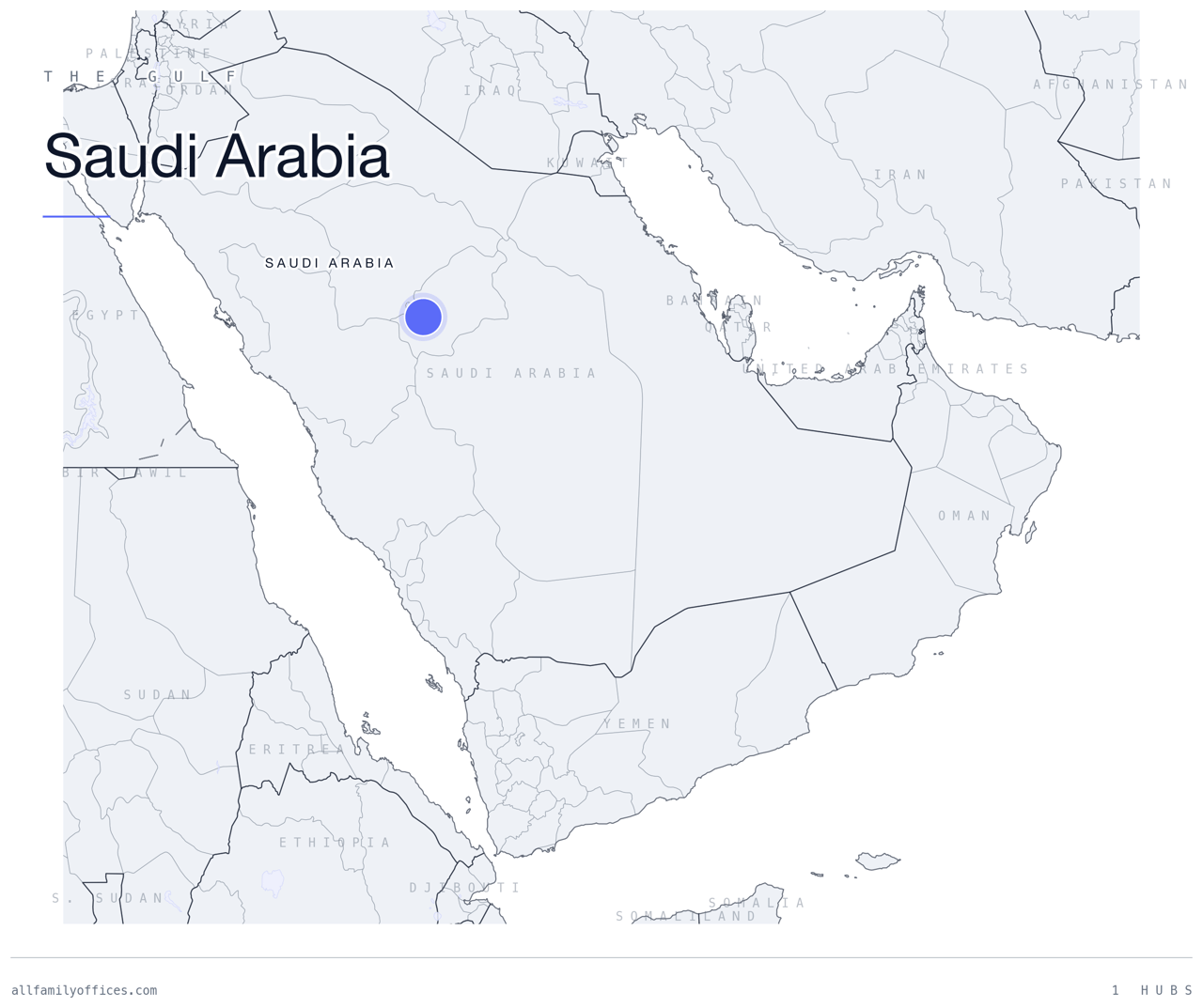
- Riyadh, Jeddah, and Al Khobar serve as the three primary hubs for Saudi family office activity.
- The vast majority of Saudi wealth platforms are SFOs tied to business dynasties. Multi-family office (MFO) structures remain rare.
- 83% of Middle East family offices invest in private equity. 58% of MENA family groups are active in venture capital.
- Saudi Arabia is home to over 350,000 millionaires, the highest count in the Middle East.
- The number of ultra-high-net-worth (UHNW) individuals in the region is projected to grow 24.6% between 2021 and 2026.
Family Office Landscape in Saudi Arabia
Saudi family offices trace their roots to oil wealth, trading empires, and industrial conglomerates built over seven decades. The Olayan Group, one of the oldest, dates to 1947. Most operate as single family offices or holding companies rather than formal wealth management entities. This structure reflects a culture where business families prefer direct control over assets and capital deployment decisions.
The Kingdom has over 350,000 millionaires and roughly 18,800 UHNW individuals in the broader Middle East, defined as those with net worth exceeding $30 million. Vision 2030 is channeling over $1 trillion into projects like NEOM, the Red Sea tourism corridor, Qiddiya, and Diriyah Gate. Saudi Special Economic Zones offer corporate tax rates of 0% for up to 20 years. The Regional Headquarters Program provides fast-track licensing with access to sovereign wealth fund co-investment deals.
Riyadh hosts the largest concentration of offices, including Kingdom Holding Company, AlTouq Group, and Morood Investment Company. Jeddah is home to Tamer Group, Bugshan Group, Khaled Juffali Company, and Ghassan Al-Sulaiman Development. Al Khobar anchors the Eastern Province cluster with industrial family groups like Al Turki Group and Al Zamil Group.
Jeddah's family offices are mostly single family offices of merchant families with roots in trade and property. Besides Tamer Group and Bugshan Group, they include ASFO (Al Saheal Family Office), co-founded by Yasser Al Saheal, which invests in public and private equities, bonds and real estate and has an office in London. Al-Murabaa, a single family office led by chief executive Yaser Saleh Bin Mahfouz, invests mainly in income-generating real estate in the UK, the US and Saudi Arabia, alongside Saudi and global equities and murabaha placements for surplus cash. Jeddah families who prefer a shared platform to an office of their own can use The Family Office Company BSC, a multi-family office founded in Bahrain in 2004 that also has an office in Riyadh and offers Shariah-compliant investments.
Islamic finance principles shape most mandates. 91% of younger Saudi investors allocate to Shariah-compliant strategies. Over two-thirds require succession planning frameworks that comply with Shariah law.
Family Office Comparison
The table below profiles 15 of the most notable family offices operating in Saudi Arabia. Because Saudi firms do not publicly disclose assets under management, the AUM column is omitted entirely.
| Family Office | Type | Investment Focus | Location |
|---|---|---|---|
| Kingdom Holding Company | SFO | Technology, media, global diversified | Riyadh |
| The Olayan Group | SFO | Global VC, fintech, biotech, enterprise SaaS | Saudi Arabia |
| Abdul Latif Jameel (JIMCO) | SFO | Mobility, healthcare, fintech | Saudi Arabia |
| Al Rajhi Holding Group | SFO | Diversified | Saudi Arabia |
| AlTouq Group | SFO | Real estate, PE, growth capital, distressed buyouts | Riyadh |
| Bugshan Group | SFO | Conglomerate, blockchain, real estate | Jeddah |
| Tamer Group | SFO | Healthcare, FMCG, IoT | Jeddah |
| Almajdouie Holding (Raed Ventures) | SFO | Seed/early-stage VC, fintech | Saudi Arabia |
| Alfanar Group (Alfanar Capital) | SFO | Tech-enabled platforms, regional startups | Saudi Arabia |
| Aljazira Capital | SFO | Financial allocation, international deals | Riyadh |
| Alkhabeer Capital | MFO | PE/VC structured products, syndicates | Saudi Arabia |
| Morood Investment Company | SFO | Capital markets, commercial real estate | Riyadh |
| Dallah Albaraka Group | SFO | Diversified, Islamic finance | Saudi Arabia |
| Al Muhaidib Group | SFO | Diversified | Saudi Arabia |
| Aljomaih Holding Company | SFO | Diversified | Saudi Arabia |
Kingdom Holding and The Olayan Group stand out for their global reach and venture capital activity. Almajdouie Holding is the clearest example of a family conglomerate launching a dedicated VC arm (Raed Ventures) to invest in MENA startups. Alkhabeer Capital is one of the few MFO-style operations in the Kingdom, offering PE and VC syndicates to multiple families.
Top Picks by Strategy
- Largest Global Deal Maker: Kingdom Holding Company, with a $250 million Snapchat stake and participation in the $44 billion Twitter buyout via 34.9 million shares
- Best for Venture Capital: Almajdouie Holding (Raed Ventures), a dedicated seed and early-stage fund targeting fintech and MENA startups
- Top Healthcare and Consumer Investor: Tamer Group, which co-invested $162 million in French IoT firm Sigfox alongside its core healthcare and FMCG portfolio
- Strongest Real Estate and PE Platform: AlTouq Group, active since 1970 in growth capital, mezzanine deals, and distressed buyouts in commercial and industrial property
- Leading Tech-Focused VC Arm: Alfanar Capital (Alrasheed family), backing tech-enabled platforms and regional startups
- Best for International Space and Deep Tech: Aljazira Capital, which led a $350 million consortium allocation in Axiom Space
- Most Diversified Conglomerate Office: Bugshan Group, spanning 20+ businesses from construction and automobiles to blockchain (ArabianChain, $820,000 allocation)
- Emerging Edtech and Enterprise Office: Alajlan Family Office, launched in 2022 with a focus on enterprise software and education technology
Top 15 Saudi Family Offices in Detail
Kingdom Holding Company
Prince Alwaleed Bin Talal's private wealth office holds the most visible international portfolio of any Saudi family. Kingdom Holding acquired a 2.3% stake in Snapchat for $250 million and committed 34.9 million shares (valued at $54.20 per share) to Elon Musk's 2022 Twitter buyout. The office also holds positions in Lyft and JD.com.
Riyadh-based and tied to the House of Saud, Kingdom Holding operates with a tech-heavy, media-forward mandate. This sets it apart from the Kingdom's traditional conglomerate offices.
The Olayan Group
The Olayan family's wealth platform has pursued global and regional venture capital for over seven decades, making it one of the oldest in Saudi Arabia. The office allocates to fintech, biotech, and enterprise SaaS, targeting growth-stage companies in both Western and MENA markets. For families or funds seeking co-investment alongside an established Saudi dynasty with deep cross-border networks, Olayan's track record as a patient, long-horizon allocator stands as a benchmark.
Abdul Latif Jameel (JIMCO)
JIMCO (Jameel Investment Management Co.) channels the Jameel family's capital into mobility, healthcare, and fintech, three sectors aligned with Vision 2030's economic goals. The family built its fortune through Toyota distribution in the Middle East. JIMCO bridges old-economy industrial wealth with new-economy venture activity, giving it a unique lens on Saudi market needs.
Al Rajhi Holding Group
The Al Rajhi family's holding group draws on banking wealth, with Al Rajhi Bank ranking among the world's largest Islamic banks. The group invests in diversified assets. Members Naif Al Rajhi and Bander Al Rajhi participated in the Vertex blockchain ICO, showing a willingness to explore digital asset classes alongside traditional holdings.
AlTouq Group
One of the most active private equity platforms among Saudi wealth managers, AlTouq Group has operated since 1970. The Riyadh-based SFO invests in commercial, residential, and industrial real estate, plus growth capital, mezzanine financing, and distressed buyouts. AlTouq recently expanded into retail, power supply, financial services, and IT, reflecting a deliberate shift from pure property plays toward technology-adjacent sectors.
Bugshan Group
Spanning over 20 business lines from advertising and construction to automobiles and cosmetics, the Jeddah-based Bugshan family runs one of the broadest portfolios in the Kingdom. Board member Ahmed Abdullah Bugshan invested $820,000 in ArabianChain, a public blockchain platform. This deal signals wider interest in digital assets among traditional Saudi conglomerates. The group's breadth makes it a de facto private wealth office managing capital from real estate, industrial operations, and consumer goods.
Tamer Group
Healthcare, beauty care, and fast-moving consumer goods form the core of Tamer Group's portfolio. The Jeddah-based family joined a consortium that invested $162 million in Sigfox, an IoT connectivity provider operating in 26 countries. That deal shows how Saudi healthcare-origin families extend into technology-driven sectors where health data and connected devices overlap.
Almajdouie Holding (Raed Ventures)
Raed Ventures launched in 2015 as Almajdouie Holding's dedicated venture capital arm for seed and early-stage startups. Raed invested $1.4 million in Trukker, a UAE-based truck logistics platform often called the "Uber of trucks." The VC arm targets fintech and MENA-region startups, making Almajdouie one of the few Saudi family conglomerates with a formalized venture mandate and deal-sourcing operation.
Aljazira Capital
Aljazira Capital led a consortium that invested $350 million in Axiom Space, the US firm building the first commercial space station. The Riyadh-based office also backed regional startups Floward and Tarabut. Aljazira bridges Saudi family capital with international deep-tech opportunities, an approach that appeals to allocators seeking frontier sectors like space technology.
Alfanar Group (Alfanar Capital)
The Alrasheed family's VC arm backs tech-enabled platforms and regional ventures through Alfanar Capital. The arm targets companies that can scale within the GCC's growing digital economy. Alfanar Capital offers a focused alternative to broader conglomerate firms, with a mandate built around technology rather than traditional industry.
Abuljadayel Family Office
Sultan Mohamed Abuljadayel's $130 million purchase of up to 50% of The Independent, the British newspaper, marks one of the largest single deals by a Saudi family in European media. The acquisition signals appetite among Saudi wealth holders for high-profile international assets. It also moves beyond the technology and real estate sectors that dominate most portfolios.
Alkhabeer Capital
Alkhabeer Capital manages wealth for multiple families through PE and VC structured products and syndicates, making it one of the few multi-family office structures in Saudi Arabia. For UHNW families that lack the scale or desire to run a standalone SFO, Alkhabeer provides pooled access to private market deals. Its syndicate model is rare in a market dominated by single-family structures.
Morood Investment Company
Morood blends public equity positions with private property holdings from its Riyadh base. The office invests in capital markets, alternative assets, and commercial real estate. This model suits families seeking liquidity alongside long-term real estate income, with Morood's focus on the Saudi capital positioning it well for the construction wave tied to Vision 2030 giga-projects.
Dallah Albaraka Group
Dallah Albaraka centers its entire mandate around Islamic finance and Shariah-compliant instruments. The group invests only in halal-approved assets, making it a reference point for families that require strict religious compliance. Its approach reflects the deep link between religious obligation and wealth oversight that defines much of Saudi family office culture.
Ghassan Al-Sulaiman Development
The Al-Sulaiman family built its wealth through the IKEA franchise in Saudi Arabia and now allocates to venture capital and diversified holdings. Franchise-origin wealth gives this Jeddah-based office practical expertise in retail operations, consumer behavior, and supply chain management. Saudi startups seeking both capital and operational mentorship will find strong alignment here.
Trends Shaping Saudi Family Capital
Vision 2030 Giga-Projects as a New Asset Class
Saudi wealth managers are allocating capital directly into Vision 2030 projects. NEOM, the Red Sea tourism corridor, Qiddiya entertainment city, and Diriyah Gate represent over $1 trillion in combined outlay. SEZ tax exemptions (0% for up to 20 years) and the RHQ Program's sovereign wealth fund co-investment access make these projects attractive to families seeking tax-efficient, government-backed exposure.
Next-Generation Shift Toward Technology and Venture Capital
79% of younger Middle East investors see major opportunities in digital and tech sectors. Saudi families respond by launching formal VC arms: JIMCO (Abdul Latif Jameel), Raed Ventures (Almajdouie), and Alfanar Capital (Alrasheed family) all emerged in the last decade. Early-stage deal flow in fintech, e-commerce, and logistics now competes with traditional real estate for family capital in the Kingdom.
Shariah-Compliant and Sustainable Investing Convergence
91% of younger Saudi investors already allocate to Islamic strategies. 88% plan to increase holdings in sustainable assets. This creates a dual filter: offices like Dallah Albaraka increasingly require deals to be both halal (no arms, alcohol, gambling, or interest-based finance) and ESG-aligned. 81% of younger investors factor sustainability into decisions, and 74% expect new business opportunities in sustainable sectors.
International Deal Activity
Saudi wealth platforms deploy capital globally with growing ambition. Kingdom Holding invested in Snapchat, Twitter, and Lyft. Aljazira Capital backed US-based Axiom Space for $350 million. Tamer Group co-invested in French IoT firm Sigfox. Abuljadayel acquired a UK newspaper stake for $130 million. These deals reflect Saudi families using international markets to diversify away from oil-dependent domestic assets.
Blockchain and Digital Assets
Multiple Saudi families participated in the Vertex blockchain ICO, including members of the Al Rajhi and Al Othaim families. Bugshan Group invested in ArabianChain. While deal sizes remain modest compared to tech mega-deals, digital asset allocation grows steadily. Next-generation family members view crypto and blockchain as aligned with the Kingdom's fintech ambitions.
How to Evaluate a Family Office in Saudi Arabia
Saudi family offices rarely disclose AUM, fee structures, or returns publicly. This opacity means standard Western evaluation methods do not apply directly. Start by reviewing an office's deal history: Kingdom Holding's Snapchat and Twitter positions are verifiable, while many smaller offices like Al Muhaidib Group or Aljomaih Holding leave minimal public traces. Regional databases and curated introductions are often the only path to reliable data.
Shariah compliance is a critical evaluation factor unique to this market. Over two-thirds of Saudi families require succession and portfolio frameworks that align with Islamic finance principles. Check whether an office prohibits riba (interest), follows halal exclusions, and incorporates zakat obligations. Dallah Albaraka Group states its Islamic mandate openly. Others may apply Shariah screens without formal disclosure.
Relationship-driven capital defines the Saudi market. GCC wealth holders invest based on personal trust, strategic alignment, and demonstrated local commitment. Proving market presence (registered entity, local pilot programs, regulatory engagement) matters more than a polished pitch deck. Startups or funds that say "we will set up after we raise" often signal that they lack genuine commitment to Saudi operations.
Succession planning remains a major challenge: only 24% of Middle East high-net-worth individuals had formal succession plans a few years ago. Evaluate how an office handles generational transitions. Firms with active next-generation involvement (like Almajdouie launching Raed Ventures or Al Rajhi family members investing in blockchain) tend to have clearer governance structures and more defined mandates for new capital.
Which Family Office Fits Your Needs?
Ultra-high-net-worth families looking for full-service wealth management will find limited MFO options in the Kingdom. Alkhabeer Capital is one of the few structured platforms offering PE and VC syndicates to multiple families. Most Saudi offices are SFOs serving a single dynasty, so families without an existing office may need to explore virtual family office models or Dubai-based MFOs with Saudi coverage.
Business owners preparing for liquidity events should look at offices with direct deal and venture capital mandates. Almajdouie Holding's Raed Ventures and Alfanar Capital both actively source early-stage deals and can serve as strategic partners, not just capital providers. The Olayan Group and JIMCO bring cross-border networks that help founders access markets beyond the GCC.
Next-generation wealth holders drawn to technology, sustainability, and digital assets will find alignment with the Kingdom's younger leaders. Aljazira Capital's $350 million Axiom Space deal and Al Rajhi family members' blockchain allocations reflect the generational shift underway. Institutional allocators seeking Saudi co-investment should explore the RHQ Program's sovereign wealth fund access and direct relationships with Kingdom Holding and AlTouq Group, both of which have established track records in large-scale consortium deals.
Methodology
This list of family offices in Saudi Arabia draws on publicly available data from regional investor databases, deal records, and industry reports published through 2025. Offices qualified based on verified Saudi operations, identifiable portfolio activity, or documented deal history. AUM figures were omitted because Saudi family offices do not publicly disclose asset values. Deal sizes, target companies, and sectors reflect confirmed transactions reported in financial media and investor directories. The list prioritizes offices with verifiable data and excludes names that appear only in paywalled databases without corroborating public information.
Frequently Asked Questions
 Google AI Mode
Tells Google to show you more from AllFamilyOffices in AI, Search and Discover.