On This Page
- Key Facts
- Regional Landscape for Multi Family Offices in the Middle East
- Family Office Comparison
- Top Picks by Strategy
- Top Family Offices in the Middle East in Detail
- Allocation Trends Shaping This Market
- How to Evaluate a Multi-Family Office in This Region
- Which Family Office Fits Your Needs?
- Methodology
- Frequently Asked Questions
Key Facts
- Deloitte Private estimates that 290 single family offices operated in the Middle East in 2024. In Campden Wealth and HSBC Global Private Banking's MENA Family Office Landscape Report 2024, 53% of the participating family offices (39 responses) were based in the UAE.
- The AllFamilyOffices database lists 160+ multi-family offices (MFOs) and 170+ single family offices (SFOs) in the Middle East (October 2026).
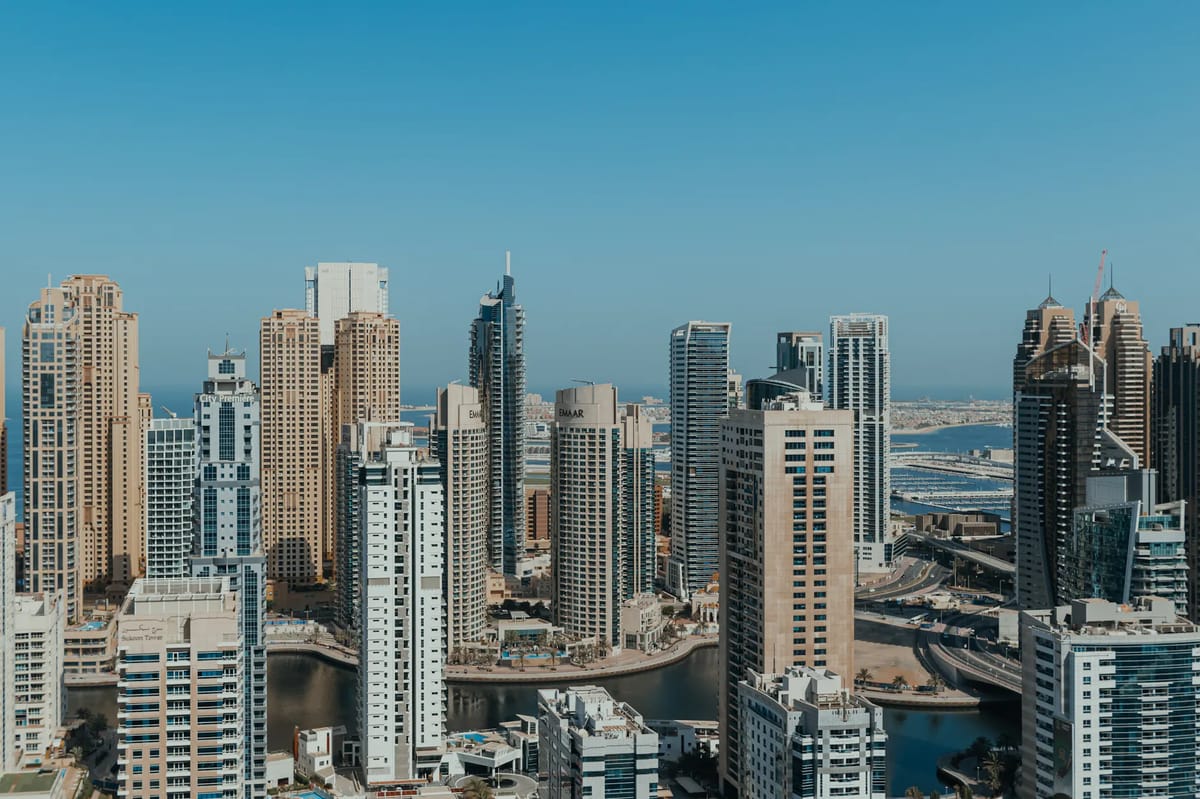
- Dubai and Abu Dhabi serve as primary hubs. The Dubai International Financial Centre (DIFC) and Abu Dhabi Global Market (ADGM) offer dedicated family office frameworks.
- In the UBS Global Family Office Report 2024, Middle Eastern family offices allocated 51% of their portfolios to alternative assets, with private equity at 27 to 28%, above the 22% global average.
- In Lombard Odier's 2025 survey of 300 high-net-worth individuals in five Gulf states, 55% of the families had established a family office.
- In KPMG and Agreus's Global Family Office Compensation Benchmark Report 2025, the largest group of the Middle Eastern family offices surveyed (29%) managed between $501 million and $1 billion in assets under management (AUM).
- Saudi Arabia's Vision 2030 initiative is rapidly positioning Riyadh as a rival financial center to Dubai.
Regional Landscape for Multi Family Offices in the Middle East
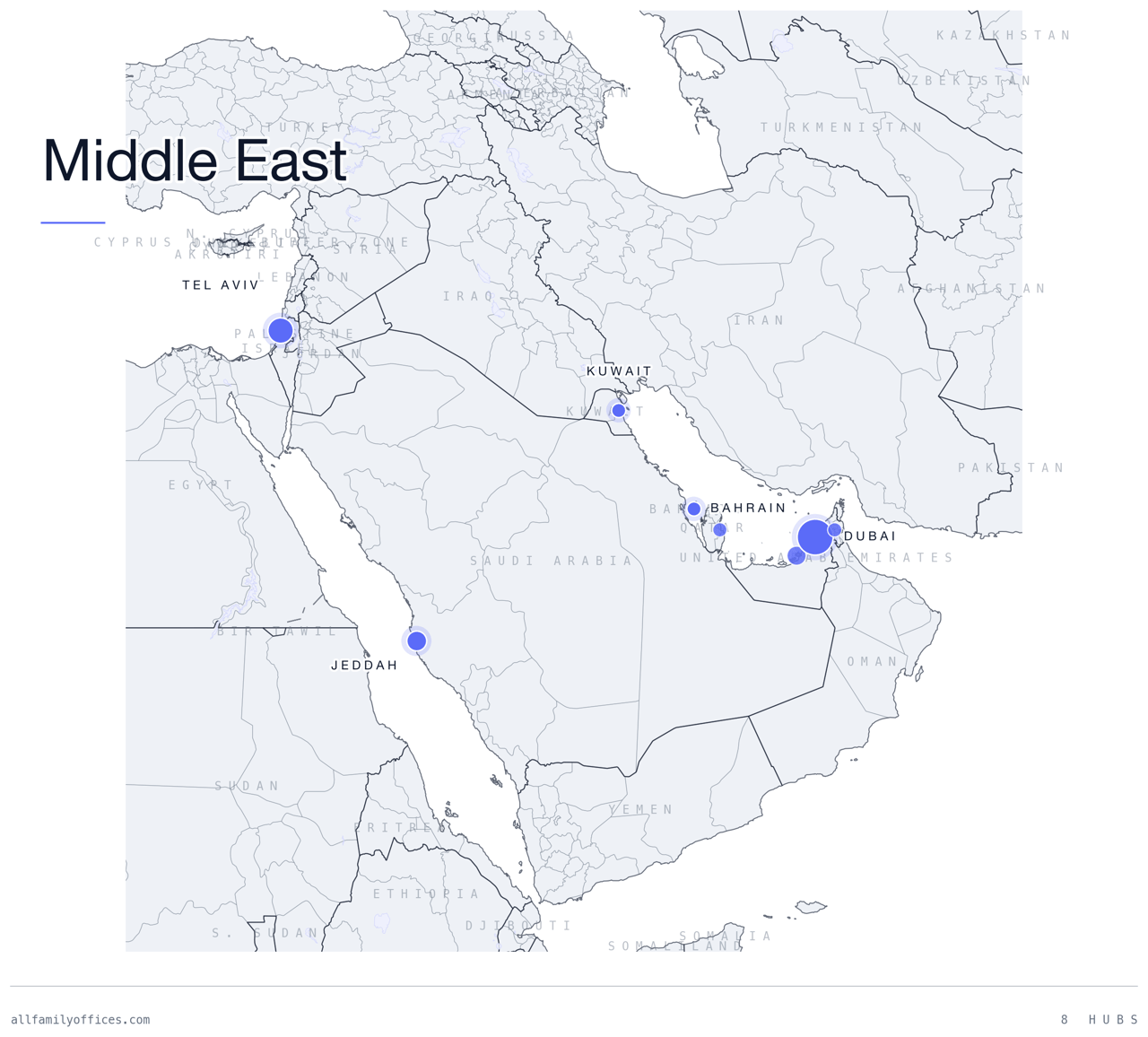
The Middle East hosts roughly 290 single family offices, a small but fast-growing share of the 8,030 that Deloitte Private estimated worldwide in 2024. The UAE leads: 53% of the family offices that took part in the survey for the MENA Family Office Landscape Report 2024 (Campden Wealth and HSBC Global Private Banking, 39 responses) were based there. Most UAE offices are concentrated in Dubai and Abu Dhabi. Saudi Arabia is emerging as the second major hub through its Vision 2030 economic program. Qatar, Kuwait, Bahrain, Israel, and Turkey each host clusters of established firms.
Multi-family offices in this region serve ultra-high-net-worth (UHNW) families who want institutional-grade wealth management without building a full in-house team. The entry point typically starts at $10 million in net worth. In KPMG and Agreus's 2025 survey, the largest group of regional offices (29%) managed between $501 million and $1 billion, and 7% managed $5.1 billion or more. This scale reflects both concentrated oil-derived wealth and a new wave of tech and real estate fortunes.
Two structural forces reshape this market. First, only 10% of the Middle Eastern family office CEOs in KPMG and Agreus's survey are family members, a sign of professionalization, although in Campden Wealth and HSBC's 2024 MENA survey family members held the chief executive role in 85% of offices. Second, 41% of the Middle Eastern family offices in KPMG and Agreus's 2025 survey have two or more locations, and 58% of those have one in Europe. The UAE's Golden Visa scheme, zero personal income tax, and the 2020 removal of the 49% foreign ownership cap have pulled both capital and talent into the region.
Family Office Comparison
The table below compares key multi-family offices and large single family offices operating in the region. AUM data appears where available, though most Middle Eastern family offices do not publicly disclose figures.
| Family Office | Type | AUM Estimate | Investment Focus | Services | Location |
|---|---|---|---|---|---|
| Royal Group LLC | SFO | $164 billion (estimate) | Real estate, healthcare, tech, venture capital | Investment management | Abu Dhabi |
| Crescent Group | SFO | — | Oil and gas, diversified businesses | Holding company | Sharjah |
| Abu Dhabi Capital Group | SFO | — | Equities, PE, hedge funds, real estate | Institutional allocation | Abu Dhabi |
| YBA Kanoo Group | SFO | — | Diversified portfolio, GCC alliances | Capital deployment, partnerships | Bahrain |
| UP Capital & Strategy | MFO | — | 10 sectors, 6 regions, M&A advisory | Strategy, debt advisory, charitable giving | Istanbul |
| Seed Group | SFO | — | AI, blockchain, fintech, hospitality | Technology joint ventures | Dubai |
| Zad | SFO | — | Global investments | Investment management | Riyadh |
| Alfardan Group | SFO | — | Property, automotive, hospitality, agriculture | Diversified operations | Doha |
| SEDCO Capital | MFO | — | Sharia-compliant investing, ESG | Investment management | Saudi Arabia |
| The Arch Capital | MFO | — | Financing, capital markets, wealth advisory | Full-service advisory | Jeddah |
| Kimfo Ventures | MFO | — | Real estate, high tech | Wealth preservation, development | Ra'anana, Israel |
Royal Group LLC's figure is a 2026 estimate; the table shows no figure for the other offices. The gap in disclosed figures reflects a regional culture of privacy rather than a lack of capital.
Top Picks by Strategy
- Largest Estimated AUM: Royal Group LLC, at $164 billion, spanning 60+ companies in Abu Dhabi
- Best for Sharia-Compliant Investing: SEDCO Capital, the leading advocate for merging Islamic finance principles with ESG standards in Saudi Arabia
- Top Venture Capital Track Record: Alajlan Family Office, whose portfolio includes Robinhood and Coursera, both now listed, alongside co-investments with YCombinator
- Strongest MFO Platform: UP Capital & Strategy, serving multiple families with M&A, debt advisory, and charitable giving services in 6 regions
- Leading Real Estate Allocator: Kimfo Ventures, with active development projects including Mantsur House and the Kikar HaMoshava business center in Israel
- Most Diversified Tech Portfolio: Seed Group, Sheikh Saeed Al Maktoum's office, with 66 global investments spanning AI, blockchain, fintech, and healthcare and offices in 12+ countries
- Best Family-Office-as-a-Service: Octagon, offering structured wealth management, tax planning, and family oversight without the overhead of a standalone SFO
Top Family Offices in the Middle East in Detail
Royal Group LLC
Abu Dhabi's Royal Group has an estimated $164 billion in assets. The conglomerate spans 60+ companies in real estate, healthcare, technology, financial services, and media. UHNW families seeking co-investment exposure to a diversified Gulf portfolio will find Royal Group's deal flow unmatched in scale within the region.
Crescent Group
The Jafar family's Sharjah-based holding company is anchored by Crescent Petroleum, one of the oldest private oil and gas companies in the Middle East. Crescent Enterprises, its diversified arm, extends the family's reach beyond energy. This office represents the classic Gulf model of hydrocarbon wealth evolving into a multi-sector platform. Its energy roots give it a natural edge in infrastructure and industrial deals that smaller firms cannot source independently.
Abu Dhabi Capital Group
ADCG runs an institutional-style family office. The portfolio spans equities, fixed income, private equity, hedge funds, and real estate. Its approach mirrors sovereign wealth fund strategy more closely than a traditional private wealth office. Families seeking a structured, institutional model will find ADCG's framework a useful benchmark for portfolio construction.
UP Capital & Strategy
Istanbul-based UP Capital manages wealth for multiple high-net-worth families. Led by Umut Emirler and David Price, the firm operates in 10 sectors and 6 regions. Portfolio companies include Geo Energy Holding, Canning Town, and Clarity Informatics. Beyond capital deployment, the office provides M&A advisory, financial engineering, and charitable giving coordination. That breadth of service is rare among regional wealth management firms.
Alajlan Family Office
Riyadh-based Alajlan invests across real estate and technology, with its venture activity focused on early-stage startups. Its portfolio includes Robinhood and Coursera, both now listed, and Plaid. Co-investment partners include YCombinator, Soma Capital, and Pioneer Fund. With over 30 years of investment experience, Alajlan targets pre-seed to pre-Series A companies in B2B SaaS, PropTech, and EduTech. Tech founders seeking smart capital from a Gulf-based family should note this office first.
SEDCO Capital
Saudi Arabia's SEDCO Capital occupies a unique position as the region's most prominent Sharia-compliant multi-family office. The firm pairs Islamic finance principles with ESG criteria. It avoids alcohol, gambling, and harmful sectors while seeking sustainable returns. In Campden Wealth and HSBC Global Private Banking's MENA Family Office Landscape Report 2024, 31% of the participating family offices said they partly observe Islamic investment principles. SEDCO has made it a core identity rather than an add-on filter. Families requiring halal mandates will find few MFOs with deeper expertise.
Seed Group
Sheikh Saeed bin Ahmed Al Maktoum's private office operates through Seed Group, which lists 66 global investments and has offices in more than 12 countries. The portfolio targets AI, machine learning, blockchain, fintech, healthcare, and hospitality. A joint venture with Vital Holding extended its reach into new verticals. Seed Group blends royal family access with a tech-forward strategy that few traditional Gulf offices match.
YBA Kanoo Group
One of the region's largest family-owned groups, Bahrain's YBA Kanoo invests through its Kanoo Global Investments arm. Dating to 1890, the group builds partnerships with global asset managers and entrepreneurs focused on GCC markets. Having successfully navigated over 130 years of regional economic shifts, Kanoo offers concrete evidence of intergenerational wealth transfer in action. Families evaluating long-term oversight will find this track record instructive.
Kimfo Ventures
The Kimche family's multi-family office in Ra'anana, Israel, splits its focus between wealth preservation, financial allocations, real estate, and high tech. Led by the father-son team of David and Aviad Kimche, the office has developed notable real estate projects including Mantsur House and the Kikar HaMoshava business center. Kimfo represents Israel's distinct MFO tradition, where tech-sector returns and active real estate development coexist in a single platform.
The Arch Capital
Jeddah-based Arch Capital launched in 2021 under Anas Alsairafi, a founding member of Al Bilad Bank. The MFO covers financing solutions, capital market advisory, wealth advisory, and asset management. As a newer entrant, it benefits from the rapid expansion of Riyadh and Jeddah as financial centers under Vision 2030. Families entering the Saudi market may find Arch Capital's local banking relationships and capital markets expertise a strong bridge into the kingdom's deal flow.
Octagon
Ekaterina Chernova founded Octagon as a family-office-as-a-service provider. The model gives wealthy families access to family office capabilities without building an in-house team. This suits families whose assets are large enough to warrant structured management but not large enough to justify the $2 to $5 million annual cost of a standalone SFO. Octagon addresses a growing segment of the Middle East market where families want professional oversight without permanent overhead.
Allocation Trends Shaping This Market
Private Equity Overtaking Real Estate
In the UBS Global Family Office Report 2024, Middle Eastern family offices allocated 27 to 28% of their portfolios to private equity, compared to the 22% global average. Real estate, historically the dominant asset class, made up 15% of their strategic allocation, still above the 10% global average. The 2009 Dubai property crash accelerated this shift. Offices like Royal Group and ADCG now spread risk into PE funds, direct deals, and co-investment vehicles. Regional sovereign wealth funds (PIF, ADIA, Mubadala) set the pattern that family offices follow, though with more selective exposure given smaller capital bases.
Sharia-Compliant and ESG Convergence
In Campden Wealth and HSBC's 2024 MENA survey, 31% of family offices said they observe Islamic investment principles at least partially. Both Sharia and ESG frameworks exclude alcohol, gambling, and environmentally harmful sectors, creating natural overlap. SEDCO Capital and the Dubai Islamic Economy Development Centre push offices to adopt ethical mandates. Next-generation leaders educated in Western countries drive this convergence. They view Islamic finance and sustainability as complementary rather than competing filters.
Venture Capital and Direct Deal Activity
Gulf family offices increasingly invest directly in startups rather than through fund structures. Alajlan Family Office co-invested with YCombinator in multiple deals. The Al Ghurair family backs agritech startups focused on UAE food security. The Al Nowais family channels capital into renewable energy through AMEA Power. In the UBS Global Family Office Report 2024 (2023 data), direct investments made up 10% of the region's strategic allocation, with private debt at 2% and infrastructure at 1%.
International Capital Inflows and Talent Migration
International family offices arriving in the UAE typically begin with conservative real estate purchases before expanding into fintech and other sectors. These newcomers bring talent and institutional expertise that raises the bar for local firms. In response, Middle Eastern offices hire investment bankers, former consulting partners, and credentialed analysts. KPMG and Agreus's 2025 compensation survey found that 93% of the family office professionals it surveyed in the region received a performance bonus. CEO salaries most commonly fell between $330,000 and $396,000.
How to Evaluate a Multi-Family Office in This Region
The most critical factor for selecting an MFO here is regulatory jurisdiction. Offices registered in DIFC or ADGM operate under dedicated frameworks with asset protection and access to international markets. Offices outside these zones may lack equivalent legal safeguards. Verify the exact registration and regulatory status of any office before engaging. For example, UP Capital & Strategy operates from Istanbul under Turkish regulation, while Arch Capital sits within Saudi Arabia's evolving framework.
Sharia compliance is a make-or-break consideration for many Gulf families. Only 31% of the family offices in Campden Wealth and HSBC's 2024 MENA survey observe Islamic investment principles, and only partially. Families requiring halal mandates should confirm whether the MFO offers genuine Sharia-compliant products or merely labels conventional products as compliant. SEDCO Capital provides the strongest benchmark for a fully integrated Sharia-ESG approach in this market.
Fee transparency remains a persistent challenge in the Middle East specifically because regional offices tend toward privacy. Some operate with conflicts of interest tied to private banks or fund managers. Ask any prospective office to break down management fees, performance fees, and product commissions in writing. Compare these against the 1-2% management fee range common among the MFOs profiled here. Independent firms with fiduciary certifications and upfront fee disclosure offer the most reliable standard.
Access and relationship dynamics differ from Western markets. Cold outreach rarely works with Gulf family offices. Warm introductions through mutual contacts are the standard engagement model. Alajlan Family Office, for instance, co-invests with partners it has existing relationships with. Building rapport before making financial asks is a cultural expectation in this region, not optional etiquette.
Succession planning capability separates the best MFOs from average ones. Almost 70% of MENA family offices have already transitioned to second or third-generation leadership, according to Campden Wealth and HSBC's 2024 MENA survey. Yet 36% name next-generation members who are not yet qualified to take control as a challenge to succession planning. MFOs offering structured next-generation education, mentorship programs, and family charter development address a gap that pure investment managers like ADCG or Zad cannot fill. YBA Kanoo Group's 130+ years of successful generational transfer offer a concrete model for what effective long-term planning looks like.
Which Family Office Fits Your Needs?
UHNW families with $100 million or more in liquid assets who want a full-service platform should evaluate UP Capital & Strategy. Its multi-sector, multi-region MFO model covers M&A advisory, debt strategy, and charitable giving for multiple families. Families preferring a single-family-office-level experience without the $2 to $5 million annual overhead of building a dedicated team could also consider Octagon's service model.
Business owners planning a liquidity event face a specific challenge in the Gulf: managing sudden wealth in a zero-tax environment with almost too many options. The Arch Capital in Jeddah provides capital markets expertise useful for Saudi-based exits. ADCG's institutional-style approach suits families transitioning from operating companies to structured portfolios. Both offer local market knowledge that international firms often lack.
Next-generation wealth holders seeking venture capital exposure and startup co-investment should look at Alajlan Family Office's track record of backing pre-seed to pre-Series A companies. Families prioritizing values-aligned capital deployment will find SEDCO Capital's Sharia-compliant ESG framework the most developed option in the region. For families who need structured oversight but lack the scale for a full setup, Octagon's family-office-as-a-service model offers a lower-commitment entry point with professional management built in.
Methodology
This article draws on data from the UBS Global Family Office Report 2024, Campden Wealth and HSBC's MENA Family Office Landscape Report 2024, KPMG and Agreus's Global Family Office Compensation Benchmark Report 2025, Lombard Odier's 2025 Gulf survey, and leading industry research series on private wealth. Individual office profiles come from publicly available sources, company disclosures, and web-enriched data verified as of early 2026. AUM figures appear only where offices or credible third-party sources disclose them. Offices without verified AUM data are profiled based on allocation focus, services, and deal history rather than estimated figures. Office counts come from the AllFamilyOffices database (October 2026).
Frequently Asked Questions
How many multi family offices operate in the Middle East?
The AllFamilyOffices database lists 160+ multi-family offices in the Middle East (October 2026). Deloitte Private estimates 290 single family offices region-wide in 2024. In Campden Wealth and HSBC's 2024 MENA survey (39 responses), 53% of participating family offices were based in the UAE, followed by Saudi Arabia (16%) and Lebanon (11%). In total, the AllFamilyOffices database lists 340+ family offices in the region.
What is the difference between a single family office and a multi-family office in this region?
A single family office (SFO) serves one family exclusively, offering total control and privacy but requiring significant resources. Royal Group LLC and Crescent Group are examples of large Gulf SFOs. A multi-family office (MFO) pools expertise for several families, reducing costs while still providing institutional-grade services. UP Capital & Strategy and SEDCO Capital are prominent MFOs. The region also has virtual family offices (VFOs) and family-office-as-a-service models like Octagon, which offer flexibility without fixed overhead.
Where are most family offices in the Middle East based?
Dubai and Abu Dhabi host the largest concentration, supported by DIFC and ADGM regulatory frameworks. Riyadh and Jeddah grow rapidly under Vision 2030. Qatar's Doha hosts major SFOs including Alfardan Group and Mohamed Bin Hamad Holding. Kuwait City, Bahrain, Tel Aviv, and Istanbul each maintain smaller but established clusters. In KPMG and Agreus's 2025 survey, 41% of Middle Eastern family offices had two or more locations, most often in Europe.
What is the minimum net worth to use a family office in this market?
Entry points start at roughly $10 million in net worth for the most accessible MFOs. Larger firms like UP Capital & Strategy typically serve families with substantially more. The largest group of Middle Eastern family offices in KPMG and Agreus's 2025 survey (29%) managed between $501 million and $1 billion. This suggests most clients bring portfolios well above the $10 million floor. Families below this threshold may consider a virtual family office or advisory-only arrangement.
How do Middle Eastern family offices invest differently from global peers?
In the UBS Global Family Office Report 2024, Middle Eastern offices allocated 28% to private equity versus the 22% global average. Real estate remains higher at 15% compared to 10% worldwide. Fixed-income allocation is the lowest globally, partly because Sharia-compliant offices avoid interest-bearing products. Alternative assets make up 51% of the average portfolio, with funds of funds at 18% and hedge funds at 5%. Direct investments represent 10%, reflecting growing appetite for co-investment alongside sovereign wealth funds and venture funds.
Are family offices in the Middle East open to working with international families?
Yes. The UAE's Golden Visa scheme, zero personal income tax, and recent foreign ownership reforms have attracted international families and their offices. International arrivals typically start with real estate before branching into fintech and other sectors. Several DIFC-based advisors serve families establishing new offices in the region, handling legal setup, compliance, and multi-asset reporting. Global private banks also support cross-border families entering this market.
 Google AI Mode
Tells Google to show you more from AllFamilyOffices in AI, Search and Discover.