On This Page
Key Facts
- Deloitte Private estimated 2,290 single family offices in Asia Pacific in 2024. Singapore and Hong Kong together are home to about 15% of the world's single family offices, according to McKinsey (2024).
- In Singapore, more than 2,000 single family offices (SFOs) held tax incentives from the Monetary Authority of Singapore (MAS) at the end of 2024, up more than 40% from 1,400 a year earlier.
- 74% of Asian families served by a family office use the SFO model, according to Julius Baer's Family Barometer 2025. Multi-family offices (MFOs) are growing as a cost-efficient alternative.
- Private markets make up 24% of the average portfolio of Asia-Pacific family offices, according to BNP Paribas Wealth Management and Campden Wealth's Asia-Pacific Family Office Report 2025.
- McKinsey projects US$5.8 trillion in intergenerational wealth transfer in Asia Pacific between 2023 and 2030.
- 78% of the Asia-Pacific single family offices in Campden Wealth and AlTi Tiedemann Global's Family Office Operational Excellence Report 2025 were founded in the last 15 years, nearly double the rate in Europe and North America.
- Around 70% of Asia-Pacific family offices followed a balanced strategy in 2025, up from 53% in 2024, according to BNP Paribas and Campden Wealth. This reflects a defensive but long-term posture.
The Asia Pacific Wealth Landscape
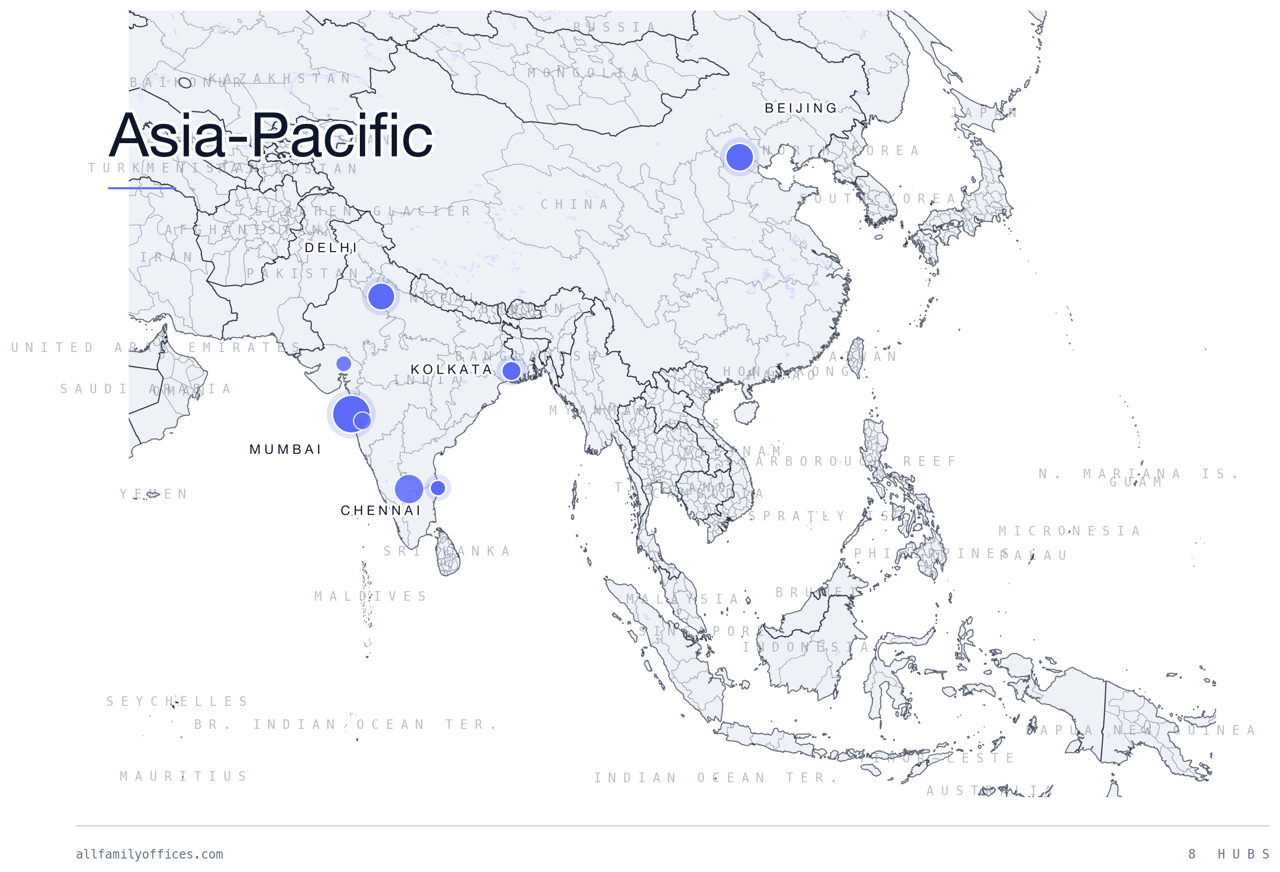
Asia Pacific is the fastest-growing wealth region in the world. Multi family offices in Asia Pacific are shaping how capital flows through its markets. Singapore has more than 2,000 SFOs with MAS tax incentives and serves as a gateway to Southeast Asian wealth pools. Hong Kong is home to an estimated 3,384 SFOs, according to a 2026 Deloitte study commissioned by InvestHK, and functions as the primary offshore channel for Chinese family capital.
The MFO model is gaining ground as families seek cost-sharing, broader service access, and regulated wealth management. MFOs in Singapore must hold a license under the Securities and Futures Act. This provides legal safeguards for each family served. SFOs, by contrast, manage only one family's assets and are exempt from licensing.
This regulatory split makes the MFO structure relevant for ultra-high-net-worth (UHNW) families who want institutional-grade platforms without building one from scratch. First-generation wealth creation drives the region's growth, with 80% of Asia-Pacific families in a 2025 Campden Wealth and AlTi Tiedemann Global study still owning an operating business.
Many founders are now preparing for succession. This fuels demand for MFOs that combine capital management with estate planning, family governance, and wealth preservation. Malaysia's Forest City Special Financial Zone in Johor, whose incentives were announced in 2024, offers SFO vehicles a 0% concessionary tax rate for up to 20 years: an initial 10 years plus a 10-year extension. Dubai and Abu Dhabi also draw Chinese families exploring alternatives, creating a multi-hub model where families operate in several jurisdictions at once.
Family Office Comparison
The table below compares leading multi-family offices operating in the region, sorted by assets under management (AUM) where available. Most MFOs in this market do not publicly disclose AUM, so the column shows only figures the firms publish.
| Family Office | Type | AUM Estimate | Investment Focus | Services | Location |
|---|---|---|---|---|---|
| Taurus Wealth Advisors | MFO | ~US$2 billion (AUM/advice) | Private equity, risk management, estate planning | Full-service wealth management for UHNW families | Singapore, Dubai |
| AP Family Office | MFO | A$1 billion+ (AUM) | Agricultural real assets, real estate PE, structured credit, high-growth tech | Tax/estate planning, custody, trusteeship, foundation management | Sydney, Hong Kong, Singapore |
| Raffles Family Office | MFO | — | Advisory, digital assets, crypto | Wealth management, digital asset platform | Hong Kong, Singapore |
| Blauwpark Partners | MFO | — | Alternative allocations, private equity | Advisory | Singapore |
| Prime Asia Asset Management | MFO | — | Consulting, family oversight | Wealth planning, tax planning, oversight support | Singapore |
| Maitri Asset Management | MFO | — | Responsible investing, ESG strategies | Impact-focused wealth management | Singapore |
| RheinGold Family Office | MFO | — | Portfolio management, succession, charitable giving | Succession planning, private aviation, structured giving | Singapore |
| One Rock Investments | MFO | — | Independent advisory, legacy management | Succession planning, advisory | Singapore |
Only Taurus Wealth Advisors and AP Family Office name the currency of their asset figures, so the table shows figures for these two firms only. RheinGold Family Office ($1.5 billion) and Prime Asia Asset Management (1.0 billion+) show undated assets-under-management counters on their websites without naming the currency, and the remaining firms do not publish comparable figures. This is common in the region, where opacity on financial data remains a defining trait of the sector.
Top Picks by Strategy
- Largest Published AUM in This Guide: Taurus Wealth Advisors, with about US$2 billion in assets under management or advice and offices in Singapore and Dubai
- Best for Real Asset Allocation: AP Family Office, which reports more than A$1 billion in assets under management across agricultural real assets, real estate, structured credit and high-growth technology from its Sydney base
- Leading Digital Asset Platform: Raffles Family Office, which built a crypto wealth management platform with Huobi Technology for UHNW families holding digital assets
- Top ESG and Impact MFO: Maitri Asset Management, the first MFO in Asia to earn B Corp certification, directing 25% of profits to the Ishk Tolaram Foundation
- Strongest Succession and Charitable Focus: RheinGold Family Office, combining portfolio management with structured giving and private aviation services
- Best for Private Equity Access: Blauwpark Partners, with a dedicated focus on alternative capital deployment and private equity fund selection led by former institutional allocators
- Most Versatile Tax and Planning Platform: Prime Asia Asset Management, offering consulting alongside wealth, tax, and oversight planning from Singapore
Leading Firms in Detail
Taurus Wealth Advisors
Taurus Wealth Advisors reports about US$2 billion in assets under management or advice, the largest figure published by any MFO in this guide. Founded in Singapore in 2008, the firm also has an office in Dubai, giving UHNW families direct access to deal flow and regulatory frameworks in two financial centres.
Its services cover private equity, risk management, estate planning, and tax advisory. Families with cross-border holdings benefit from a single advisory partner that coordinates wealth structuring in both Asian and Middle Eastern markets. Few MFOs in the region match this geographic reach.
AP Family Office
AP Family Office reports more than A$1 billion in assets under management, invested through four strategies. The firm is based in Sydney with regional offices in Hong Kong and Singapore. The four strategies cover agricultural real assets, real estate private equity, structured credit and fixed income, and AI infrastructure and high-growth technology.
AP also provides tax and estate planning, custody, trusteeship, and foundation management. Families seeking exposure to Australian real estate and agricultural land alongside Asian market access will find AP's model distinctive.
Raffles Family Office
Raffles Family Office sits at the intersection of traditional wealth management and digital assets. Operating from Hong Kong and Singapore, the firm partnered with Huobi Technology in 2022 to launch a crypto platform for UHNW families. The platform offers wallet consolidation, succession planning counsel, and integrated fiat-crypto dashboards.
This makes Raffles the MFO in this guide most focused on families with exposure to digital assets. Its dual-hub structure also serves families needing advisory on both sides of the Hong Kong-Singapore corridor.
Maitri Asset Management
Maitri Asset Management earned the distinction of being the first multi-family office in Asia to receive B Corp certification. Built on the Tolaram family's platform, the firm channels 25% of its profits to the Ishk Tolaram Foundation. Its focus centers on responsible investing and ESG strategies.
With 44% of Asia-Pacific family offices engaged in responsible investing in BNP Paribas and Campden Wealth's 2025 survey, Maitri offers a proven model for families seeking to embed values-based capital deployment into their wealth management.
Blauwpark Partners
Private equity fund selection and direct co-investment define Blauwpark Partners. The Singapore-based firm's team includes former institutional investors, investment bankers, family office executives, and venture capital investors from Europe and Asia. It focuses on alternative allocations and private equity.
This makes it a natural fit for families building a private markets portfolio with institutional-grade due diligence. Its lean, specialist model contrasts with the full-service MFOs on this list. It appeals to families that already have estate and tax planning handled elsewhere.
RheinGold Family Office
RheinGold Family Office packages portfolio management with lifestyle and legacy services rarely combined in a single MFO. Co-founded by Yolanda Dai and Steve Holdener, the Singapore-based firm offers succession planning, structured charitable giving, and private aviation.
Families managing complex multigenerational transitions will find RheinGold's bundled service model distinctive. Singapore's Philanthropy Tax Incentive Scheme, launched in January 2024, amplifies the appeal of its structured giving approach for families integrating charitable work into their oversight framework.
Prime Asia Asset Management
Prime Asia Asset Management fills a gap that pure capital-focused MFOs leave open: structured family oversight. The Singapore-based firm, founded in 2016 and licensed by the Monetary Authority of Singapore, provides consulting, wealth planning, tax planning, and family advisory services.
Second-generation leaders transitioning from embedded family business operations are the core audience. Prime Asia's focus on family charters and formal structures is a key differentiator for families professionalizing their wealth for the first time.
One Rock Investments
One Rock Investments centers its practice on independent advisory with no proprietary product conflicts. Founded by Michel Della Libera, who leads it as CEO, the Singapore-based MFO focuses on succession planning and legacy management.
Families who prioritize unbiased counsel and long-term management over proprietary deal flow will find One Rock's model relevant.
Trends Shaping This Market
Defensive Rotation into Cash and Balanced Strategies
Asia Pacific family offices shifted toward liquidity and balance in 2025. In BNP Paribas Wealth Management and Campden Wealth's Asia-Pacific Family Office Report 2025, around 70% followed a balanced strategy, up from 53% in 2024, and most expected cash to be the most rewarding asset class over the next 12 months.
Taurus Wealth Advisors and AP Family Office, with their broad multi-asset platforms, are well positioned to execute these balanced allocations for UHNW clients. Average expected returns settled at roughly 6%, reflecting tempered expectations amid geopolitical uncertainty.
Geographic De-Risking Away from US Exposure
In the same survey, the share of family offices planning to cut US holdings exceeded the share planning to add to them by 24 percentage points, and geographic diversification to reduce geopolitical risk was the top 2025 objective, cited by 47%. Families are rotating toward intra-Asian markets and alternative jurisdictions.
The multi-hub model amplifies this trend. Firms like Taurus (Singapore, Dubai) and AP Family Office (Sydney, Hong Kong, Singapore) help families spread both political and regulatory risk in multiple jurisdictions simultaneously.
New Energy and Healthcare Dominate Thematic Allocations
In a 2022 Cerulli Associates survey of Asian family offices, three-quarters favored new energy themes, and healthcare and real estate each drew 70%. Nearly two-thirds chose commodity exposure such as gold.
Private equity and digital disruption themes drew 60%, and some family offices in Singapore and Hong Kong also wanted exposure to cryptocurrency.
Co-Investment and Private-Label Fund Structures
Many Asia-Pacific family offices hold direct investments alongside funds. Private markets make up 24% of the average portfolio in the BNP Paribas and Campden Wealth survey. Co-investment activity is rising as families pool capital through private-label fund structures.
This collaborative model lets smaller offices access institutional-grade deals while sharing due diligence costs. Blauwpark Partners, with its specialist private equity focus and institutional allocator pedigree, facilitates exactly this kind of pooled capital deployment.
How to Choose the Right Wealth Platform
Regulatory status should be the first filter. MFOs in Singapore must hold a license under the Securities and Futures Act. This imposes compliance standards that SFOs are exempt from. Verify that any MFO holds the correct license with the Monetary Authority of Singapore before engaging.
Cross-border capability matters more in Asia Pacific than in any other region. In a 2025 Campden Wealth and AlTi Tiedemann Global study, 67% of Asia-Pacific family offices had family members living outside the office's home jurisdiction. An MFO must show expertise in multi-jurisdictional tax planning, estate structuring, and regulatory compliance. The Singapore-Dubai model of Taurus Wealth Advisors and AP Family Office's Sydney-Hong Kong-Singapore footprint represent the operational reach that complex cross-border families need.
Fee transparency remains a challenge in this market. Cost ranks as a top concern, yet most MFOs do not publish standard fee schedules. Ask for a full breakdown of management fees, performance fees, and custody charges before committing. Some families reduce costs through private-label fund structures that pool resources with other families.
Succession planning readiness separates strong MFOs from weak ones. Only about a third of Asia-Pacific families appear to have a succession plan, according to BNP Paribas and Campden Wealth, despite the US$5.8 trillion wealth transfer McKinsey projects by 2030. Evaluate whether the MFO offers structured tools such as family charters, constitutions, and next-generation programs. RheinGold and One Rock both emphasize this capability.
Cultural alignment is often underestimated. Many Asia Pacific families are still led by first-generation wealth creators with strong ties to operating businesses. A wealth platform that understands embedded family office models and the transition from business ownership to professional management will deliver more relevant advice than one built for inherited Western wealth.
Which Family Office Fits Your Needs?
UHNW families with operations in multiple countries should prioritize Taurus Wealth Advisors or AP Family Office. Both maintain offices in more than one jurisdiction and offer full-service platforms covering estate and tax planning. The Singapore and Dubai presence of Taurus suits families split between Asia and the Middle East.
Business owners preparing for a liquidity event or generational transition will benefit from MFOs that lead with succession planning. Prime Asia Asset Management and One Rock Investments both center their advisory models on family oversight frameworks. They fit second-generation leaders who need to formalize structures that first-generation founders built informally.
Families with strong convictions about responsible investing or charitable giving should explore Maitri Asset Management's B Corp-certified platform or RheinGold's structured giving services. Singapore's Philanthropy Tax Incentive Scheme adds a financial incentive for families routing charitable activities through the city-state.
Next-generation wealth holders with exposure to digital assets and crypto face a narrow field. Raffles Family Office is the only MFO in this guide with a dedicated digital asset platform, built through its 2022 partnership with Huobi Technology. For families seeking private equity access without full-service overhead, Blauwpark Partners offers specialist alternative advisory led by former institutional allocators.
Methodology
This analysis of multi family offices in Asia Pacific draws on publicly available data from industry reports, regulatory filings, and confirmed office disclosures as of early 2026. Office profiles include only firms identified through verified sources. AUM figures appear only where publicly confirmed. The coverage spans MFOs and SFOs operating in Singapore, Hong Kong, Sydney, and adjacent hubs. Trend data comes from surveys published between 2022 and 2025, chiefly BNP Paribas Wealth Management and Campden Wealth's Asia-Pacific Family Office Report 2025. Selection criteria included confirmed operational presence in the region, service breadth, and relevance to UHNW families seeking multi-family office engagement.
Frequently Asked Questions
How many family offices are there in Asia Pacific?
Deloitte Private estimated 2,290 single family offices in Asia Pacific in 2024, and the AllFamilyOffices database lists 330+ multi-family offices in Asia-Pacific (October 2026). Local counts run higher: Singapore had more than 2,000 SFOs with MAS tax incentives at the end of 2024, up from 400 at the end of 2020, and Deloitte estimates that Hong Kong had 3,384 SFOs at the end of 2025. Together, the two cities are home to about 15% of the world's single family offices, according to McKinsey. The total continues to grow: 78% of the Asia-Pacific SFOs in a 2025 Campden Wealth and AlTi Tiedemann Global study were founded in the last 15 years.
Why are Asia's family offices moving to multi-hub models?
Rising allocations to alternative investments like private equity, real estate, and direct deals create longer time horizons. These require oversight in multiple jurisdictions. In a 2025 Campden Wealth and AlTi Tiedemann Global study, 67% of Asia-Pacific family offices had family members living outside the office's home jurisdiction. Singapore remains the center for compliance and oversight. Hong Kong serves mainland Chinese capital, and Dubai attracts families seeking further geographic spread.
What is the difference between an SFO and an MFO in Singapore?
A single family office (SFO) manages assets for one family only and is exempt from licensing under the Securities and Futures Act. A multi-family office manages assets for two or more families and must hold a capital markets services license from the Monetary Authority of Singapore. SFOs can access Section 13O and 13U tax incentive schemes. MFOs offer cost efficiencies and broader service access but face stricter regulatory requirements.
What are the largest multi-family wealth platforms in Asia Pacific?
Among the firms in this guide, Taurus Wealth Advisors publishes the largest asset figure, about US$2 billion in assets under management or advice, and AP Family Office reports more than A$1 billion in assets under management. Most MFOs in the region, including Raffles Family Office, Blauwpark Partners, and Maitri Asset Management, do not disclose managed assets, so no complete ranking exists.
What is the minimum net worth to join a multi-family office in Asia?
Most MFOs in Asia Pacific do not publish fixed minimums. Published minimums vary by firm: RheinGold Family Office, for example, says it typically serves clients with investable assets from US$5 million. Smaller families may consider virtual family office models or advisory-only engagements. Some MFOs use private-label fund structures that allow smaller families to pool capital and access institutional strategies.
What tax incentives exist for family offices in Singapore?
Singapore offers Section 13O and 13U fund tax incentive schemes, a newer Section 13OA scheme for Singapore limited partnership funds that took effect in 2025, and the Variable Capital Company (VCC) framework for pooled allocations. The Philanthropy Tax Incentive Scheme, launched in January 2024, encourages SFOs managing funds under Section 13O, 13OA or 13U to conduct overseas charitable activities through Singapore. The Global Investor Programme also lets family office principals with at least S$200 million in net investible assets apply for permanent residence by setting up a Singapore single family office with at least S$200 million in assets under management.
 Google AI Mode
Tells Google to show you more from AllFamilyOffices in AI, Search and Discover.