
On This Page
- Key Facts About Multi Family Offices in Canada
- The Canadian MFO Landscape
- Family Office Comparison at a Glance
- Top Picks by Strategy
- Top Canadian Multi-Family Offices in Detail
- Investment Trends Shaping Canadian MFOs
- How to Evaluate a Multi-Family Office in Canada
- Which Family Office Fits Your Needs?
- Methodology
- Frequently Asked Questions
Key Facts About Multi Family Offices in Canada
- A list compiled by Canadian Family Offices in 2023 included 81 multi-family offices (MFOs), and nearly 80 MFOs took part in its 2025 survey, The Multi-Family Office Landscape in Canada 2025.
- Deloitte Private expects the assets under management of single family offices worldwide to reach US$5.4 trillion by 2030, a 73% increase over the US$3.1 trillion of 2024.
- In Canadian Family Offices' 2025 survey, 84% of Canadian MFOs said non-Canadian assets make up more than 30% of their client portfolios. Over 40% plan to cut US allocations in the next 12 months.
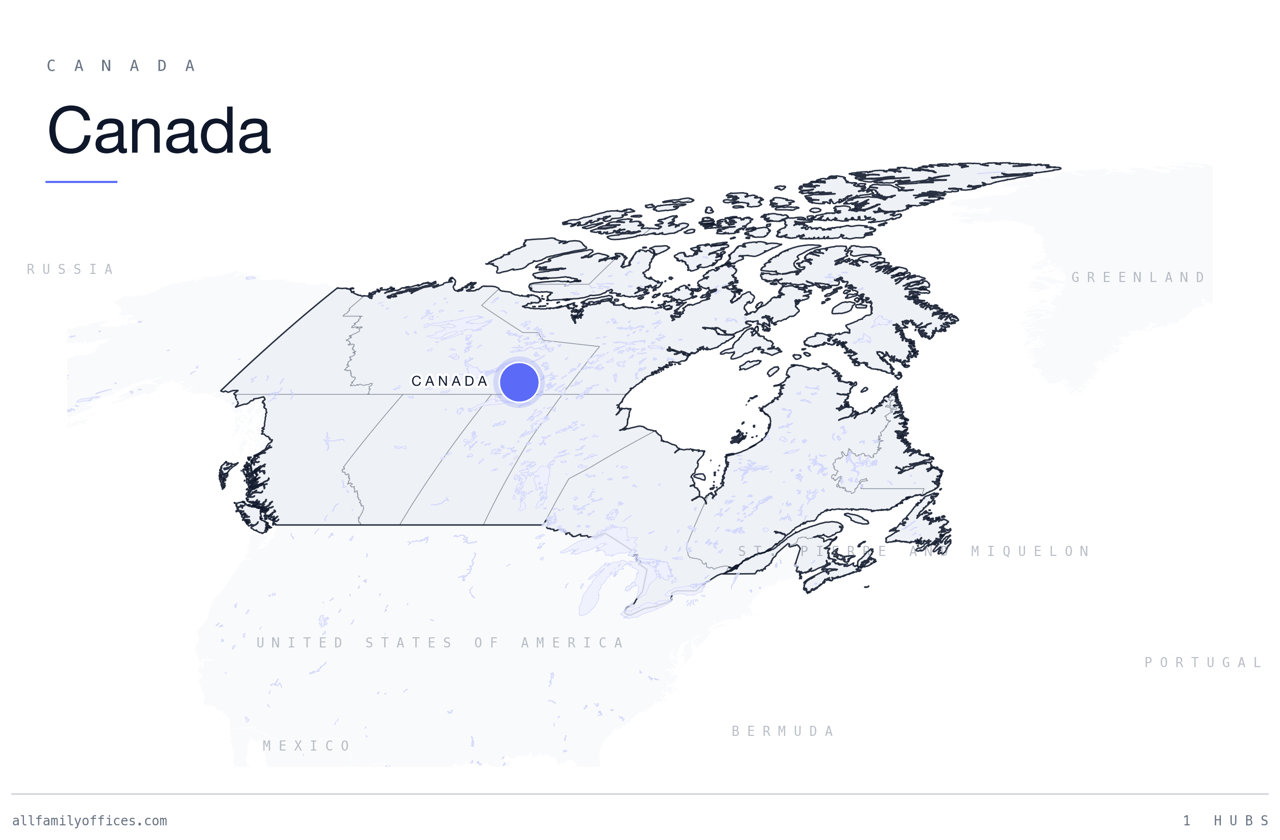
- Toronto serves as the primary hub for MFO activity, with other firms based in Calgary, Oakville, Vancouver, and Montreal.
- Private equity draws recommendations from 84% of Canadian MFOs. Infrastructure follows at more than 75%, with private credit at nearly two-thirds.
- Canadian tax policy ranks as the top concern for 42% of MFOs surveyed in 2025, holding that position for the second year running.
- Our Family Office Inc. reports $4.1 billion in assets under advisement. It remains one of the few Canadian MFOs to disclose a specific figure.
The Canadian MFO Landscape
Canada's multi-family office industry remains young compared to the US and Europe, yet it is growing fast. A list compiled by Canadian Family Offices in 2023 included 81 MFOs. Single-family office (SFO) counts stay murky, with estimates ranging from a few dozen to several hundred.
Younger ultra-high-net-worth (UHNW) families and large-scale wealth transfers between generations push families toward structured advisory models. Toronto is the clear centre of gravity, hosting bank-affiliated offices like TD Wealth Family Office and independents such as Tacita Capital.
Oakville and Calgary anchor Northland Wealth Management's two locations. KPMG Family Office has advisors in Vancouver, Edmonton and Montreal as well as Toronto. This geographic spread gives families outside Ontario meaningful local options.
The Canadian MFO market spans several distinct models. Independent firms like Northland and Tacita follow strict fiduciary standards with zero commissions. Bank-affiliated platforms from TD and RBC tap institutional resources and private banking. Consulting-firm practices at KPMG and MNP bring tax, legal, and oversight expertise. Our Family Office Inc. pioneered a trademarked "Shared Family Office" structure. With 84% of Canadian MFOs reporting that non-Canadian assets make up more than 30% of client portfolios, cross-border tax and regulatory complexity defines wealth management in this market.
Family Office Comparison at a Glance
The table below compares nine of the most prominent multi-family offices operating in Canada, sorted by reported assets where available.
| Family Office | Type | AUM Estimate | Investment Focus | Core Services | Location |
|---|---|---|---|---|---|
| Our Family Office Inc. | Shared (MFO) | $4.1B AUA | Tax-efficient global strategies | Tax, charitable giving, investment, risk | Toronto |
| Northwood Family Office (part of Corient) | MFO | — | Integrated planning and capital deployment | Planning, investment, administration, family engagement | Canada |
| Northland Wealth Management | Independent MFO | — | PE, VC, real estate, hedge funds | Investment, tax/estate, oversight, next-gen prep | Oakville, Calgary |
| Tacita Capital | Independent MFO | — | Tax-optimized diversified portfolios | Portfolio management, open architecture | Toronto |
| TD Wealth Family Office | Bank-affiliated | — | Diversified institutional strategies | Private banking, wealth planning, family governance, charitable giving | Canada-wide |
| Harbourfront Wealth Management | MFO | — | Multi-discipline wealth administration | 10+ services incl. concierge, trust, succession | Canada-wide |
| KPMG Family Office | Consulting-firm | — | Outsourced/supported family office | Tax, law, M&A, oversight, charitable giving | Toronto, Vancouver, Edmonton, Montreal |
| MNP Family Office Services | Accounting-firm MFO | — | Wealth preservation and tax management | Family structure, succession, tax simplification | Canada-wide |
| RBC Wealth Management | Bank-affiliated | — | North American advisory and reporting | Advisory, reporting, wealth planning | Canada-wide |
Our Family Office is the only firm in this table that publishes an asset figure for its family office business alone. Bank-owned platforms and larger wealth firms report assets only for their whole wealth business, and most other firms do not publish AUM data, a norm in Canada's privacy-focused market. Independent MFOs cluster in Ontario, while consulting-firm and bank-affiliated models offer broader national reach.
Top Picks by Strategy
- Largest Published Family Office AUA in This Guide: Our Family Office Inc., with $4.1 billion in assets under advisement and a limited client base of 45 families, offering deep integration of tax, investment, and charitable giving services.
- Top Independent MFO: Northland Wealth Management, built on a fully conflict-free fiduciary model with zero commissions and access to institutional-quality alternative allocations.
- Strongest Tax Optimization: Tacita Capital, designed from the ground up around after-tax returns, using open architecture and third-party managers to reduce tax drag.
- Most Complete Service Menu: Harbourfront Wealth Management, covering more than 10 disciplines from trust and beneficiary services to concierge and lifestyle management.
- Leading Bank-Affiliated Platform: TD Wealth Family Office, combining private banking, credit solutions, and behavioral finance with the institutional resources of a major Canadian bank.
- Best Multi-Discipline Advisory: KPMG Family Office, merging tax law, M&A due diligence, and family oversight under a single firm with family office advisors in Toronto, Vancouver, Edmonton and Montreal.
- Most Accessible Entry Point: MNP Family Office Services, offering succession planning to families of varying sizes without traditional UHNW minimums.
Top Canadian Multi-Family Offices in Detail
Our Family Office Inc.
Canada's first integrated Shared Family Office manages $4.1 billion in assets under advisement for a deliberately limited group of 45 families. The trademarked model lets UHNW families share back-office operations and research while receiving fully customized tax, estate, and charitable giving strategies.
Tim Cestnick, a Globe and Mail tax columnist, co-founded the firm. It has won an industry award every year since 2021, including the 2025 Global Multi-Family Office Team of the Year and Boutique Firm of the Year at the 2026 STEP Private Client Awards. Families seeking a single point of coordination for tax, capital deployment, and charitable giving will find this model eliminates the fragmented advisor problem.
Northwood Family Office (part of Corient)
Northwood Family Office is part of Corient, CI Financial's wealth management firm: CI Financial acquired Northwood in 2022, Northwood became part of the Canadian launch of Corient in 2026, and its website now redirects to Corient. Its team integrates planning, portfolio management, and wealth administration into a single client relationship.
Northwood places equal weight on helping multigenerational families align on values, communication, and decision-making. Families managing complex estates with multiple branches or foundations benefit from this bridge between financial strategy and family dynamics.
Northland Wealth Management
Fiduciary independence defines Northland's model. The firm follows the CFA Code of Ethics, earns zero commissions and zero referral fees, and operates as a family-owned business from Oakville, Ontario and Calgary, Alberta.
Northland provides access to private equity, venture capital, real estate, and hedge fund allocations used by Canada's largest pensions and endowments. Consolidated reporting aggregates every holding from every custodian into a single view. Families who want conflict-free advice with institutional-quality alternatives and full fee transparency should benchmark other advisors against Northland's disclosure standards. The firm also runs dedicated next-generation preparation programs.
Tacita Capital
Tax-conscious investing is not a feature at Tacita; it is the entire architecture. This Toronto-based private wealth office structures every portfolio to minimize tax drag and maximize after-tax returns. The firm uses a diversified mix of traditional, alternative, and private investments.
Open architecture means Tacita selects third-party managers from a global universe rather than relying on proprietary products. Michael Nairne co-founded the firm, and the active founding family invests alongside clients. Garnet Anderson, a frequent BNN Bloomberg commentator, provides the firm's public market analysis. Affluent and ultra-affluent Canadian families focused on preserving capital through tax efficiency will find Tacita a strong fit.
TD Wealth Family Office
Institutional scale gives TD Wealth a distinct advantage in private banking, credit solutions, and portfolio management. The office draws on TD Bank's full resources while maintaining a "blank canvas" approach, tailoring each engagement to the family's specific needs.
Anna Dayan leads the Family Office team, which includes specialists in behavioral finance, estate planning, and charitable advisory. Families requiring integrated private banking alongside wealth planning, or those with complex credit and liquidity needs, gain from the bank's balance sheet and deal-sourcing ability. TD also offers multigenerational planning services.
Harbourfront Wealth Management
Few Canadian MFOs match Harbourfront's breadth of service. The firm delivers more than 10 distinct disciplines, ranging from accounting and tax planning to concierge and lifestyle management.
This makes Harbourfront one of the few Canadian wealth management firms offering both financial and personal administration under a single roof. Business owners navigating a sale or liquidity event can access business advisory, succession planning, and cross-border wealth planning at the same time. Families who want a single provider for everything from trust services to risk management will find fewer coordination gaps here.
KPMG Family Office
Multi-discipline advisory capacity distinguishes KPMG from pure-play wealth managers. The firm combines tax and law expertise (including KPMG Law LLP in Quebec), M&A and due diligence capabilities, and family oversight consulting.
With family office advisors in Toronto, Vancouver, Edmonton and Montreal, and family office leaders for British Columbia, the Greater Toronto Area, Western Canada and Québec, KPMG offers national reach. Programs like QuantumShift and FamilyShift bring together business owners and next-generation leaders. Families with active operating businesses who need coordinated deal advisory alongside estate planning benefit most from this model.
Investment Trends Shaping Canadian MFOs
Geographic Shift Away from US Assets
In Canadian Family Offices' 2025 survey, over 40% of Canadian MFOs said they intend to cut US allocations in the next 12 months. More than 40% plan to increase positions in developed markets like Europe and Japan.
Nearly 20% are adding emerging market exposure, a trend that favors firms like Northland and Our Family Office with established global mandates.
Private Markets Lead Alternative Allocations
Some 84% of Canadian MFOs recommend private equity to clients. Infrastructure (such as toll roads, utilities and energy projects) follows at more than 75%, with private credit at nearly two-thirds. Venture capital was recommended by 44%, down marginally from the prior year.
Northland's direct access to PE and VC co-investment deals gives its clients institutional-quality alternative exposure that most Canadian families cannot source on their own.
Real Estate Holds the Top Alternative Spot
Real estate remains the single most held alternative asset among Canadian MFOs. Domestic market knowledge gives Canadian offices an edge in evaluating local property. Cross-border holdings in US and European markets provide additional risk spreading.
For Toronto-based firms like Tacita Capital, local real estate expertise complements their tax-optimized portfolio approach. Direct investment in Canadian commercial property remains a core allocation for many MFO clients.
AI Adoption and Rising Digital Security Risk
Generative AI is gaining traction in family offices. In the RBC and Campden Wealth North America Family Office Report 2025, 29% of North American family offices said they use it as an aid in investment reporting and 30% for text-based research, and adoption of automated reporting systems rose to 69% from 46% the year before.
AI and cybersecurity issues rose from near the bottom of the list to the second most common concern among Canadian MFOs in Canadian Family Offices' 2025 survey. This risk is especially acute for offices like Harbourfront and Our Family Office that manage personal lifestyle services alongside financial data.
Canadian Tax Policy Shapes Portfolio Structure
Tax policy remains the top concern for 42% of surveyed MFOs, holding that rank for two consecutive years. Capital gains rules, trust law changes, and CRA oversight influence how offices structure holding companies and investment vehicles.
This environment explains why Tacita Capital and Our Family Office built their models around tax-efficient investing. Families choosing between Canadian MFOs should weigh each firm's tax planning depth, even after the federal government cancelled the proposed increase in the capital gains inclusion rate in March 2025.
How to Evaluate a Multi-Family Office in Canada
Independence is the first factor to assess. Canadian MFOs range from fully independent firms like Northland and Tacita, which earn zero commissions, to bank-affiliated platforms like TD and RBC. Bank platforms offer institutional resources but may favor proprietary products. Ask whether the office follows a fiduciary standard and has adopted the CFA Code of Ethics.
Cross-border capability is essential for most Canadian families. With 84% of Canadian MFOs reporting that non-Canadian assets make up more than 30% of client portfolios, your office must handle US and international tax reporting, foreign currency hedging, and multi-jurisdictional estate planning. Verify experience with CRA compliance and provincial securities commission requirements.
Fee structure deserves close scrutiny in the Canadian market. Northland explicitly advertises zero referral fees and zero commissions. Consulting-firm models like KPMG charge advisory fees that reflect their legal and M&A capabilities. Request a full fee schedule and confirm whether the office receives any third-party compensation.
Consolidated reporting separates strong Canadian MFOs from weaker ones. Families with holdings at multiple custodians and in private allocations need a single aggregated view. Northland and Our Family Office both highlight this capability. Confirm that reporting covers private holdings, not just liquid accounts.
Open architecture matters for portfolio construction in Canada's concentrated fund market. Independent firms like Tacita access the full universe of public and private managers. Bank-affiliated offices may default to in-house funds. Ask what percentage of invested capital sits in proprietary versus third-party vehicles. Co-investment access, as Northland offers, gives families more control over deal selection.
Which Family Office Fits Your Needs?
UHNW families seeking full integration of tax, capital deployment, and estate planning should consider Our Family Office or Northwood Family Office, which is part of Corient. Our Family Office's limited client base of 45 families means high personalization. Northwood's family engagement model suits families navigating multigenerational dynamics.
Business owners approaching a sale or succession event benefit from KPMG's M&A and due diligence advisory or Harbourfront's combined business succession and wealth management offering. These firms handle the deal process and the post-liquidity wealth plan in parallel. Families with active operating companies in multiple provinces will find KPMG's presence in several provinces useful for local regulatory knowledge.
Next-generation wealth holders focused on long-term capital preservation can look to Northland for conflict-free advice with institutional-quality alternatives. Tacita suits those who want portfolios built around minimizing tax drag. Families wanting the backing of a major bank alongside integrated private banking should explore TD Wealth or RBC Wealth Management. Mid-market families entering the MFO world for the first time may find MNP's model, which serves a broader wealth range and focuses on succession planning, the most practical starting point.
Methodology
This guide to multi family offices Canada draws on Canadian Family Offices' 2025 survey of nearly 80 multi-family offices, the RBC and Campden Wealth North America Family Office Report 2025, global family office projections from major consultancies, and individual office disclosures from public websites and media profiles. Selection criteria included each office's role serving multiple families with integrated advisory services in the Canadian market. Evaluation weighed independence, service breadth, geographic reach, published specializations, and available asset data. Most Canadian MFOs do not disclose AUM figures, so comparisons rely on service scope and structural traits rather than asset size alone. Data comes from 2024 and 2025 sources, with updates through October 2026.
Frequently Asked Questions
How many multi family offices are there in Canada?
The AllFamilyOffices database lists 100+ multi-family offices in Canada (October 2026). A list compiled by Canadian Family Offices in 2023 included 81 MFOs, and nearly 80 took part in its 2025 survey of the Canadian MFO landscape. The true number is likely higher, as many smaller firms operate without public profiles. SFO counts remain murkier, with estimates ranging from a few dozen to hundreds. The industry is still young compared to the US and European markets.
What is the difference between a single family office and a multi-family office in Canada?
A single family office (SFO) serves one family and needs enough wealth to justify its own staff and operating costs. A multi-family office (MFO) serves multiple families, offering economies of scale and broader expertise. Canada also features unique models: Our Family Office's trademarked Shared Family Office structure and consulting-firm practices at KPMG and MNP. MFOs provide built-in succession planning if a key advisor departs, reducing key-person risk.
Where are most Canadian family offices located?
Toronto is the primary hub, hosting bank-affiliated offices (TD, RBC), independents (Tacita Capital), and consulting-firm practices (KPMG). Oakville and Calgary house Northland Wealth's two offices. KPMG has family office advisors in Vancouver, Edmonton, and Montreal. Quebec-based families can access KPMG Law LLP's dedicated family office co-leadership.
What minimum wealth do you need for a Canadian multi-family office?
Thresholds vary by office model. Traditional MFOs typically serve UHNW families, while SFOs need enough wealth to justify standalone operating costs. Consulting-firm models like MNP serve a broader range of family sizes. Our Family Office, which serves a limited group of 45 families, says it is best suited to families with more than $20 million in liquid assets. The MFO model's core advantage is making family office services accessible at lower thresholds than an SFO through shared operations.
What do Canadian family offices invest in?
Real estate is the top alternative holding among Canadian MFOs, according to Canadian Family Offices' 2025 survey. Private equity draws recommendations from 84%, infrastructure from more than 75%, and private credit from nearly two-thirds. Venture capital was recommended by 44%, down marginally from the prior year. Canadian MFOs allocate less to alternatives than global peers: alternatives make up less than 40% of holdings in 83% of their client portfolios, while BlackRock's 2025 family office survey puts alternatives at 42% of portfolios globally and the UBS Global Family Office Report 2025 puts them at 54% for US family offices. A growing number shift capital from US assets to European, Japanese, and emerging market positions.
How are Canadian family offices regulated?
No specific "family office" regulatory category exists in Canada. Provincial securities commissions, such as the Ontario Securities Commission (OSC), provide primary oversight. MFOs may register as portfolio managers or exempt market dealers depending on their service model. The CRA oversees tax structures including holding companies and family trusts. Many independent MFOs voluntarily adopt the CFA Code of Ethics and operate under a fiduciary standard, though this is not legally required for all office types.
 Google AI Mode
Tells Google to show you more from AllFamilyOffices in AI, Search and Discover.