On This Page
- Key Facts: Europe's Multi-Family Office Market
- Multi Family Offices in Europe: Landscape Overview
- Family Office Comparison at a Glance
- Top Picks by Strategy
- Leading European Offices in Detail
- Investment Trends Shaping European Family Offices
- How to Evaluate a Multi-Family Office in Europe
- Which Family Office Fits Your Needs?
- Methodology
- Frequently Asked Questions
Key Facts: Europe's Multi-Family Office Market
- Europe was home to 23% of the billionaires on Forbes' 2022 World Billionaires List, and its billionaire count had risen 80% since 2016, according to Campden Wealth's European Family Office Report 2022.
- Iconiq Capital, a US multi-family office with a London office, reports about $117.5B in regulatory assets under management firm-wide in its SEC Form ADV.
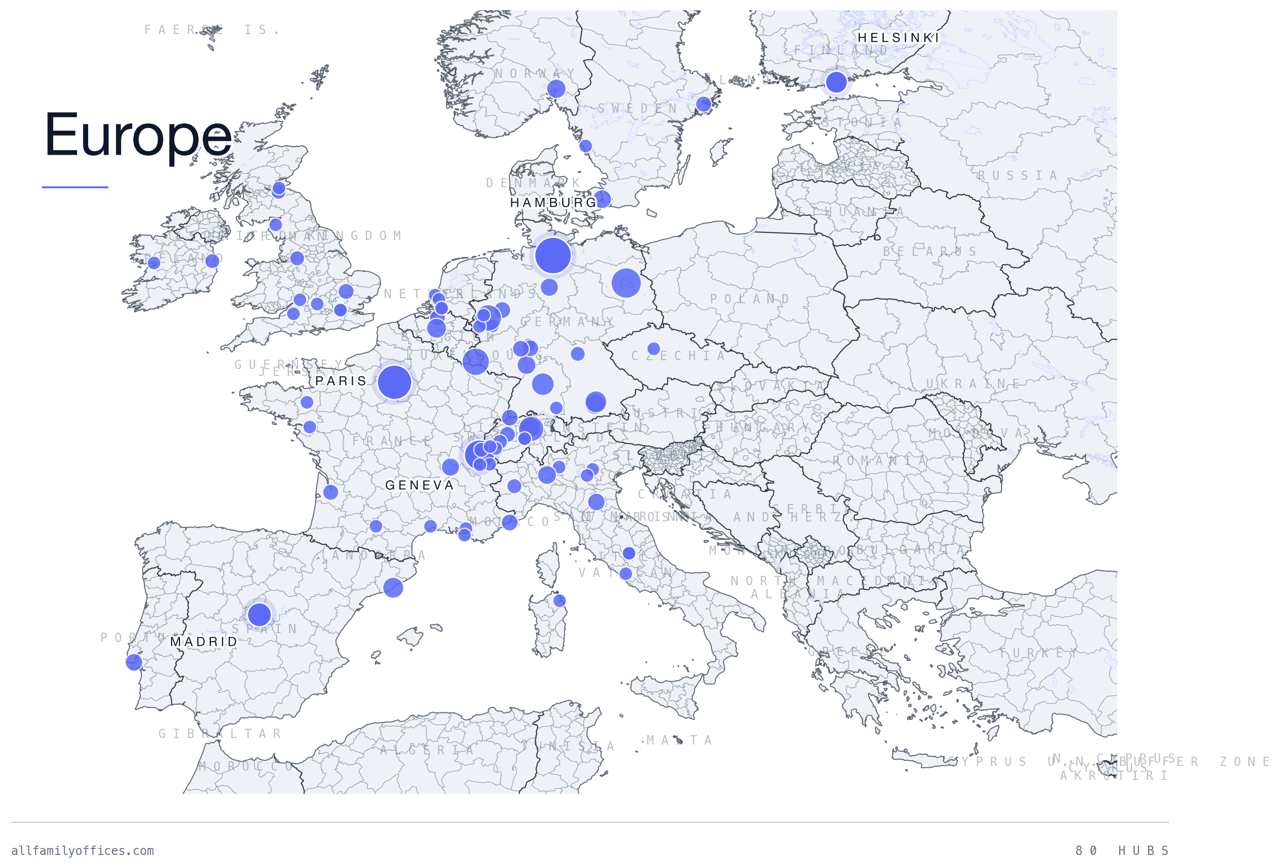
- Major MFO hubs span Switzerland (Zurich, Geneva, Zug), Germany (Frankfurt and nearby Bad Homburg, Munich, Hamburg), the United Kingdom (London), and the Nordics (Oslo, Copenhagen).
- In Campden Wealth's European Family Office Report 2022, 49% of the family offices surveyed were increasing their exposure to equities to counter inflation, 33% to real estate and 33% to commodities, and 28% had shortened the duration of their bond portfolios.
- MFO structures serve multiple ultra-high-net-worth (UHNW) families through shared systems for asset management, wealth planning, and consolidated reporting.
- Hot sectors for European MFO deal flow include fintech, digital security, healthtech, clean-tech, SaaS, and industrial robotics.
- Risk management was the top governance priority for the next 12 to 24 months for 68% of the family offices in Campden Wealth's European Family Office Report 2022.
Multi Family Offices in Europe: Landscape Overview
A multi-family office (MFO) pools resources for several UHNW families under one roof. It offers shared investment teams, reporting, and advisory services. This model stands apart from the single family office (SFO), which serves one family alone.
In Europe, the MFO concept traces back centuries. Renaissance-era dynasties like the Medici created private offices to manage finances and fund the arts. Their approach laid the groundwork for modern wealth management.
Switzerland anchors Europe's MFO market. Zurich, Geneva, and Zug host dozens of offices with global mandates, drawing on the country's neutral jurisdiction and deep capital markets expertise. Germany's MFOs cluster in Frankfurt and nearby Bad Homburg, Munich, and Hamburg. They reflect the Mittelstand tradition of industrial family capital flowing into new ventures. London serves as the continent's tech-focused gateway, attracting VC-oriented firms like Iconiq Capital, which opened a dedicated office there to source growth-stage deals.
The Nordics contribute a distinct model of globally active family investors. Denmark topped IMD's World Competitiveness Ranking in 2022. Offices like KIRKBI (Billund) and A.P. Møller Holding (Copenhagen) deploy patient capital. The 80% rise in European billionaires between 2016 and 2022 that Campden Wealth reported fuels demand for MFO platforms. Rising wealth creation generates more families needing cross-border structuring, co-investment access, and family governance frameworks that no single advisor can provide.
Family Office Comparison at a Glance
The table below compares leading family offices operating in Europe, mixing MFOs with select SFOs for context. AUM figures appear only where verified data exists.
| Family Office | Type | AUM Estimate | Investment Focus | Services | Location |
|---|---|---|---|---|---|
| Iconiq Capital | MFO | $117.5B (firm-wide) | Growth-stage tech, VC | Growth capital, deal sourcing | London / US |
| Lighthouse Canton | MFO | $5B+ (firm-wide) | Diversified | Asset management | Singapore / London |
| J Stern and Co | MFO | $2.8B+ (after pending merger) | Diversified | Wealth management, portfolio management | London |
| Franz Haniel & Cie | Family holding (SFO) | — | Business services (majority stakes), multi-asset portfolio (FHC Capital) | Family equity, PE-style investing | Duisburg, Germany |
| Oslo Family Office | MFO | — | Strategy, investments | Co-investment, advisory | Oslo / Zürich |
| 1788 Capital Trust | MFO | — | Medtech, fintech, blockchain | Asset management, wealth planning | Geneva, Switzerland |
| Winterberg Group | MFO | — | Transport, IoT, health, digital security | Growth capital, buyouts | Zug, Switzerland |
| BLN Capital | SFO | — | Early-stage tech, gaming | Seed/pre-seed investing | Berlin, Germany |
| SKion | SFO | — | Industrial goods, renewables, medtech | Direct industrial investment | Bad Homburg, Germany |
| KIRKBI | SFO | — | Diversified | Long-term holdings | Denmark |
| Armada Investment AG | SFO | — | Fintech, logistics, agtech, edtech | Venture fund, family office | Zurich, Switzerland |
Iconiq Capital leads by reported AUM; its figure is the firm-wide regulatory AUM in its SEC Form ADV (October 2026), which includes its investment funds. Lighthouse Canton, headquartered in Singapore with an office in London, reports more than $5 billion in assets under management and advisory firm-wide (31 October 2025). J Stern and Co expects to manage more than $2.8 billion once it combines its Swiss business with Geneva's bvo capital, a merger announced in July 2026 and subject to FINMA approval. Offices like Franz Haniel & Cie and SKion deploy large but undisclosed pools of industrial family capital. The geographic spread reflects Europe's polycentric wealth structure, with no single city dominating the way New York does in the US market.
Top Picks by Strategy
- Largest AUM: Iconiq Capital (about $117.5B firm-wide, SEC Form ADV) brings Silicon Valley network effects to European growth-stage tech through its London outpost.
- Leading Heritage Family Holding: Franz Haniel & Cie combines 270 years of family ownership with majority stakes in market-leading European business services companies and a multi-asset portfolio (FHC Capital).
- Top for Early-Stage Tech: BLN Capital, built by the Kolibri Games founders in Berlin, targets seed and pre-seed deals in gaming and technology in Europe and the US.
- Best for Cross-Border Co-Investment: Oslo Family Office operates from both Oslo and Zürich, connecting Norwegian owner families with deal flow from the broader European market.
- Most Diversified Platform: J Stern and Co offers a broad multi-asset mandate suited to families seeking institutional-grade allocation.
- Deepest Thematic Focus: 1788 Capital Trust in Geneva covers medtech, industrial automation, fintech, blockchain, and energy efficiency under one MFO roof.
Leading European Offices in Detail
Iconiq Capital
Silicon Valley's most prominent MFO now has a direct line into European venture capital. Iconiq reports about $117.5 billion in regulatory assets under management in its SEC Form ADV, a firm-wide figure that includes its investment funds, and counts Mark Zuckerberg among its client base. The firm opened a London office to source growth-stage tech deals, giving European founders access to a network spanning both continents.
Tech entrepreneurs with $50M+ liquidity events seeking smart capital with US distribution advantages will find Iconiq's model hard to match. The office focuses on companies past the early revenue stage. It deploys patient growth capital rather than spray-and-pray seed checks.
J Stern and Co
A genuinely diversified mandate sets J Stern and Co apart from most European wealth managers. The firm provides portfolio management for multiple UHNW families seeking broad exposure to equities, fixed income, and alternatives.
Families with $100M+ in liquid wealth often want one MFO for allocation, risk, and reporting. J Stern serves as a strong benchmark for that profile.
Franz Haniel & Cie
Franz Haniel & Cie draws on 270 years of experience with transformation. Based in Duisburg, Germany, this "family equity company" primarily takes majority stakes in market-leading European business services companies such as CWS (hygiene, workwear, cleanrooms, fire safety); its other majority holdings include BekaertDeslee, Emma, das kinderzimmer, ROVEMA and TAKKT. It also builds a globally oriented multi-asset portfolio, FHC Capital, and aims to achieve economic success while driving ecological and social progress.
Families who want sustainability built into long-term ownership rather than added as a marketing overlay will find Haniel's heritage a strong proof point. Haniel is not an MFO: it is the family's wholly owned holding company, shown here alongside the MFOs as an example of an active, long-term family investor.
Oslo Family Office
More than 20 Norwegian owner families rely on Oslo Family Office for strategy, advisory, and operational support. Its dual-city model sets it apart. The office expanded to Zürich to build a co-investment platform linking Norwegian and broader European families.
The office helps multi-generational families align on succession planning and shared ownership frameworks, prioritizing long-term value creation alongside capital deployment.
1788 Capital Trust
One of Europe's most sector-focused MFO platforms operates from Geneva. 1788 Capital Trust covers medical technologies, industrial automation, food chain sustainability, fintech, blockchain, and energy efficiency. This thematic depth lets client families build concentrated positions in high-conviction sectors.
Families with a strong view on healthtech or clean energy but limited internal deal sourcing capacity will find 1788's rare mix of sector expertise and full-service advisory hard to replicate. The office also handles wealth planning and consolidated reporting.
Winterberg Group
Two distinct strategies run under one MFO at Winterberg Group in Zug: growth capital for early-stage companies and buyouts of mature businesses. The office focuses on transport and mobility, Internet of Things, health and fitness, and digital security.
This dual approach lets client families hold both high-growth venture bets and stable cash-flowing assets within a single platform. Winterberg targets seed and Series A rounds for its growth portfolio, with geographic reach spanning the US, Europe, and South Africa.
BLN Capital
The founding team behind Kolibri Games, one of Germany's most successful mobile gaming studios, built BLN Capital to channel entrepreneurial wealth into early-stage technology. This Berlin-based firm invests at seed and pre-seed stages in gaming and tech, with deal flow in Europe and the US.
Founders building in gaming, consumer tech, or adjacent verticals gain not just capital but operational insight from a team that scaled a studio to exit. BLN Capital is not an MFO but the founders' own investment firm, one of a new generation of European family offices built by tech entrepreneurs to back other tech entrepreneurs.
Investment Trends Shaping European Family Offices
Direct Allocations and Co-Investment Networks
European MFOs increasingly bypass fund structures to invest directly in companies. Oslo Family Office opened its Zürich branch to facilitate co-investments between Norwegian families and European deal partners. Dense co-investment networks now connect offices in Zurich, London, and Munich. These networks let smaller firms participate in deals that would otherwise exceed their individual ticket sizes.
Sustainability as a Core Mandate
Several European MFOs and family investors have embedded sustainability into their theses rather than treating it as a screening overlay. Franz Haniel & Cie names the promotion of ecologically sustainable solutions as a growth driver for its portfolio companies. Stinson GmbH in Offenbach focuses solely on sustainable allocations, and Aprima in Mannheim targets sustainability and digitization. Paris Agreement commitments and rising energy costs have made climate-aligned portfolios a structural feature of European family capital.
Tech Sector Dominance in Deal Flow
Fintech, digital security, healthtech, and SaaS account for a large share of European MFO activity. Iconiq Capital's London expansion reflects the pull of the UK's tech ecosystem. In Germany, Reimann Investors (fintech, SaaS) and Extorel (semiconductors, clean-tech) channel industrial family wealth into venture-stage technology. Berlin's BLN Capital and Munich's FORUM Family Office add early-stage depth to this corridor.
Private Equity Allocation Surge
Geopolitical uncertainty and inflationary pressures push European family offices to increase private equity and real asset exposure. In Campden Wealth's European Family Office Report 2022, 49% of offices were raising their equity exposure, 33% were adding real estate and 33% commodities. Bond portfolios are shrinking in duration as offices seek returns that outpace inflation.
Next-Generation Wealth Transfer
Succession planning and oversight structures now rank among the top concerns for European family offices. Multi-generational ownership demands clarity on decision rights, shared values, and dispute resolution. MFOs like Oslo Family Office stand apart from private banks by offering dedicated advisory on these frameworks. They help families maintain cohesion as ownership groups grow with each generation.
How to Evaluate a Multi-Family Office in Europe
European MFOs operate within a regulatory patchwork unmatched by any other region. A Swiss-based MFO like Winterberg Group faces different compliance rules than one in Luxembourg, the UK, or Germany. AIFMD II is reshaping how European capital vehicles must be structured. Some offices may soon face fund-manager classification. Families should verify that their chosen MFO holds jurisdiction-specific expertise matching the family's domicile and asset locations.
Investment model matters as much as domicile. Some European MFOs invest directly in companies (Winterberg Group, EMH Partners), while others allocate mainly through fund structures. A third group, like 1788 Capital Trust, blends both approaches. Request a clear breakdown of direct versus fund exposure and understand how each model affects fees, liquidity, and reporting.
Minimum thresholds vary enormously in this market. SKion invests in companies with EUR 50M to EUR 500M in revenue. BLN Capital invests at seed stage with no revenue requirement. FORUM Family Office sits between, seeking businesses with at least EUR 5M in revenue or EUR 1M in EBIT. Matching the MFO's sweet spot to your family's profile avoids wasted due diligence on both sides.
Fee structures deserve close scrutiny. European MFOs use asset-based fees, retainer models, or performance-linked arrangements. Some combine all three. Request full breakdowns covering custody, advisory, transaction, and performance layers. Compare total cost against a standalone SFO, which can exceed EUR 2M annually in operating expenses before staff salaries.
Cultural fit may be the hardest criterion to assess, yet it shapes long-term success. European family offices invest through trust, reputation, and shared values. Unlike transactional private banking, an MFO partnership typically spans decades. Consider whether the office's generational outlook, ethical boundaries, and communication style match your family's own.
Which Family Office Fits Your Needs?
UHNW families seeking broad, institutional-grade wealth management should start with J Stern and Co, which offers a diversified multi-asset mandate with full reporting and risk management systems.
Tech founders face a different decision. Iconiq Capital offers growth-stage capital with a US-Europe bridge, making it the strongest choice for founders who want Silicon Valley network effects alongside European market access. For earlier-stage entrepreneurs in gaming or consumer tech, BLN Capital brings operational credibility from the Kolibri Games team.
Families rooted in industrial businesses can look to Franz Haniel & Cie, the Haniel family's own holding company, as a model for a heritage and sustainability-driven mandate. Those prioritizing thematic sector exposure should explore 1788 Capital Trust's medtech and fintech focus in Geneva. Nordic owner families navigating cross-border wealth have a clear option in Oslo Family Office, which serves over 20 Norwegian families and runs European co-investments from Zürich. Families for whom estate planning, succession, and advisory services matter as much as returns should weight MFOs that offer these as core functions rather than add-ons.
Methodology
This guide profiles multi family offices in Europe, plus several single family offices and family holdings shown for comparison, using publicly available data from industry databases, office websites, and published records. Office selection prioritized MFOs with verified European operations, disclosed mandates, and identifiable client or portfolio activity. AUM figures appear only where confirmed by public filings or official disclosures. The analysis excluded offices without verifiable data from the comparison table and profiles. Data reflects conditions as of early 2026. Families should conduct independent due diligence before engaging any office listed here.
Frequently Asked Questions
How many MFOs operate in Europe?
No single registry tracks all European MFOs. The AllFamilyOffices database lists 1,300+ multi-family offices in Europe (October 2026). The true number is likely higher, as many offices operate privately without public disclosure. Europe's 23% share of the billionaires on Forbes' 2022 list and its 80% billionaire growth between 2016 and 2022, both reported by Campden Wealth, suggest steady expansion in this market.
What separates an SFO from an MFO?
A single family office manages wealth for one family alone. SKion, for example, serves the Klatten family with a focused industrial mandate. An MFO serves multiple families through shared systems. Oslo Family Office supports several owner families with pooled teams. MFOs reduce per-family overhead and offer co-investment access that standalone SFOs rarely achieve.
Where are Europe's leading MFOs headquartered?
Switzerland leads with clusters in Zurich, Geneva, Zug, and Pfaeffikon. Germany ranks second, with activity concentrated in Frankfurt and nearby Bad Homburg, Munich, and Hamburg. London serves as the UK's primary hub, especially for tech-focused and VC-oriented offices. Oslo and Copenhagen host globally active Nordic family investors. Austria and France round out the market with smaller but growing ecosystems.
What net worth do you need to join a European MFO?
Minimums vary by office and strategy. Some MFOs accept families with EUR 10M to EUR 50M in liquid assets. Others set higher thresholds. On the deal side, FORUM Family Office targets portfolio companies with at least EUR 5M in revenue, and SKion looks for companies with EUR 50M to EUR 500M. Families should clarify both the client minimum for advisory services and co-investment minimums for deal participation.
How do European MFOs handle cross-border regulatory issues?
European MFOs routinely manage wealth held in multiple jurisdictions. Offices in Switzerland, Luxembourg, and the UK bring deep expertise in cross-border structuring, trust administration, and regulatory compliance. AIFMD II adds new requirements that may classify some MFOs as fund managers, increasing reporting obligations. Families with assets in three or more European countries should verify their MFO has jurisdiction-specific legal and tax capacity.
What returns do European MFOs target?
European MFOs generally prioritize capital preservation and long-term growth over short-term performance. Private equity, direct allocations, and real estate form the core of most return-seeking portfolios. Winterberg Group pursues growth capital returns at seed and Series A stages, while J Stern and Co targets steady, diversified returns. Risk management was the top governance priority for 68% of the family offices in Campden Wealth's European Family Office Report 2022.
 Google AI Mode
Tells Google to show you more from AllFamilyOffices in AI, Search and Discover.