On This Page
- Key Facts About Italian Multi-Family Offices
- Multi Family Offices Italy: Landscape Overview
- Family Office Comparison at a Glance
- Top Picks by Strategy
- Top Family Offices in Detail
- Investment Trends Shaping Italian Family Offices
- How to Evaluate an Italian Multi-Family Office
- Which Family Office Fits Your Needs?
- Methodology
- Frequently Asked Questions
Key Facts About Italian Multi-Family Offices
- The AllFamilyOffices database lists 85+ family offices in Italy (October 2026), including 55+ multi-family offices (MFOs) and 25+ single family offices (SFOs) serving the country's industrial dynasties.
- Few Italian offices publish their assets: Banor SIM reports more than €14 billion in assets under supervision across its group, Tosetti Value €5 billion in financial assets, and CFO SIM more than €2 billion under management.
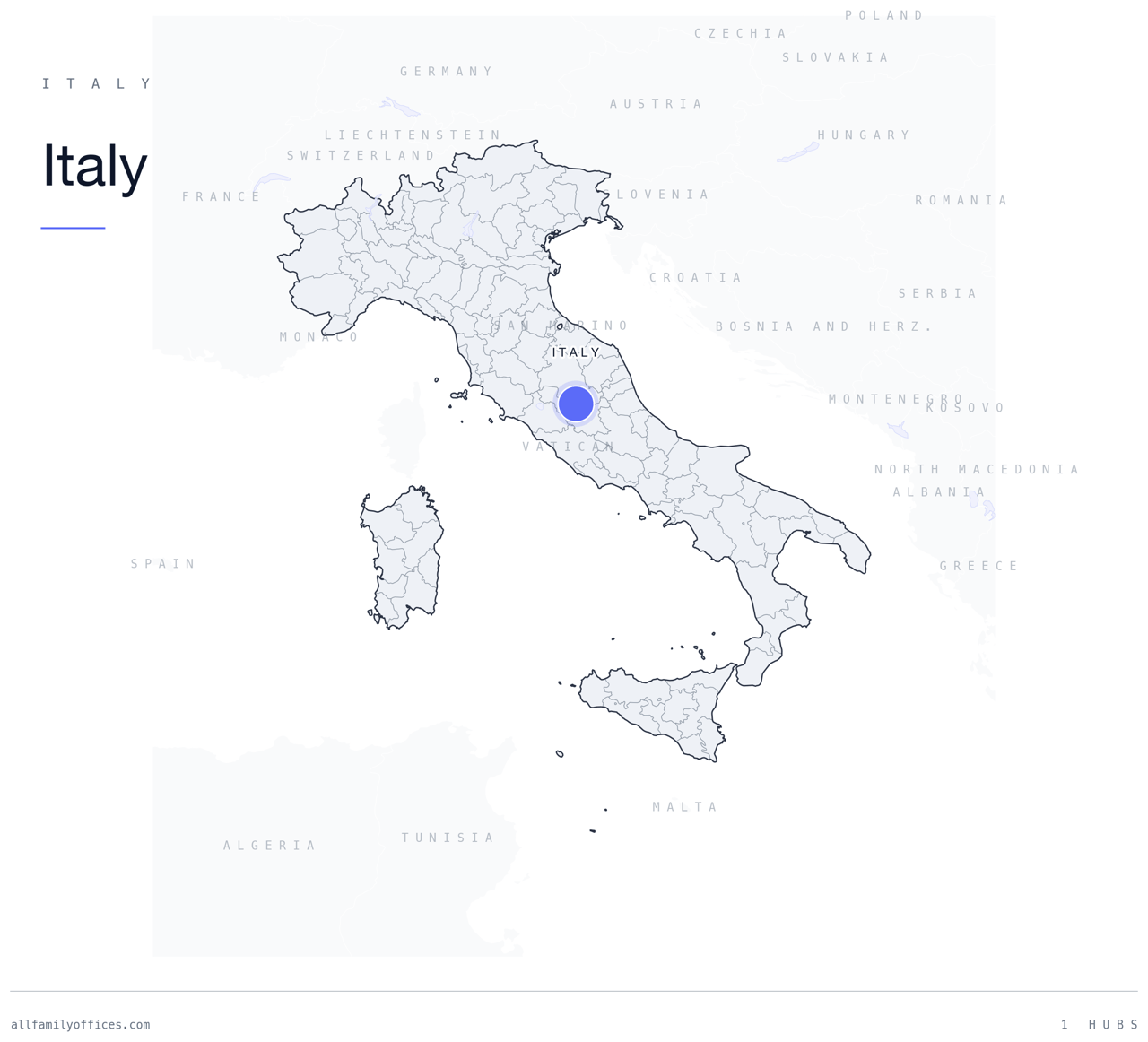
- Milan is the dominant hub. Turin, Rome, Venice, and Vicenza serve as secondary centers.
- Italy's 15,500+ family-controlled companies with annual revenues above €20 million (AUB Observatory, 2023–2024 data) fuel a steady pipeline of new clients for wealth management firms.
- Generational wealth transfer is the primary growth driver.
Multi Family Offices Italy: Landscape Overview
Italy's multi-family office sector has grown from a handful of pioneers in the late 1990s; the AllFamilyOffices database now lists 55+ MFOs. These firms serve ultra-high-net-worth (UHNW) families with combined financial, tax, and legal advisory, often under a single roof. The market sits within a broader ecosystem of family offices (85+ in the AllFamilyOffices database) that manage wealth rooted in textiles, fashion, automotive, and other Made in Italy industries.
Milan functions as the clear center of gravity, hosting most of the country's MFOs and SFOs. Turin holds a special place as home to Tosetti Value, one of Europe's earliest independent MFOs. Northern regions (Lombardy, Veneto, Piedmont) account for the vast majority of offices, reflecting where Italy's 15,500+ family-controlled companies with revenues above €20 million cluster. Rome, Venice, Vicenza, and Padua serve as smaller but active hubs.
A distinct feature of the Italian market is the SIM (Società di Intermediazione Mobiliare) licensing framework. Many leading MFOs, including Tosetti Value SIM, Banor SIM, CFO SIM, and Secofind SIM, operate under this regulated structure. SIM licensing signals formal compliance oversight, setting these firms apart from unregulated advisory boutiques. On the SFO side, industrial dynasties like the Del Vecchio, Berlusconi, and Marzotto families run dedicated offices. These SFOs increasingly co-invest alongside institutional capital.
Family Office Comparison at a Glance
The table below compares Italy's leading family offices by type, scale, and focus area. A figure appears only where the firm publishes one (October 2026); the figures measure different things, so the table is not a strict ranking, and a dash means no published figure.
| Family Office | Type | AUM Estimate | Investment Focus | Key Services | Location |
|---|---|---|---|---|---|
| Banca Finnat | MFO | €22B+ (group client assets) | Diversified | — | Rome |
| Banor SIM | MFO | €14B+ (assets under supervision) | Independent advisory | Independent family office advice, manager coordination | Milan |
| Tosetti Value SIM | MFO | €5B (financial assets) | Asset supervision, family oversight | Art program, Emblème digital cataloguing, research | Turin |
| CFO SIM | MFO | €2B+ (managed assets) | 360° wealth management | Account aggregation, illiquid investments, next-gen education | Milan |
| Ceresio Investors | MFO | — | Diversified | Investment management | Milan |
| Kairos Partners | MFO | — | Diversified | Portfolio management | Milan |
| E.U.F.O.R.I.A. | MFO | — | European family office services | — | Milan |
| De Agostini | MFO | — | Diversified | — | Milan |
| CIV | MFO | — | Responsible finance, ESG | M&A, corporate oversight, social impact | Milan |
| Canal & Serraglia | MFO | — | Wealth advisory, distressed assets | Trusteeship, foundation management, corporate finance | Venice |
| PFC Family Office | SFO | — | Impact investing, sustainability | Family oversight, charitable giving | Milan |
| LMDV Capital | SFO | — | Luxury hospitality, consumer brands | Direct investments | Milan |
| H14 | SFO | — | Venture capital, private equity | Cross-sector direct deals | Milan |
Banca Finnat, a Rome bank, reports the largest group total, and Banor SIM the largest figure among the independent firms that publish one. Smaller offices like CIV and Canal & Serraglia compete on specialization. The SFO entries (PFC, LMDV, H14) reflect Italy's industrial family wealth flowing into dedicated investment vehicles.
Top Picks by Strategy
- Independent Advisory at Scale: Banor SIM reports more than €14 billion in assets under supervision across its group, and its family office division gives independent advice. It coordinates multiple external managers for cost optimization.
- Pioneer MFO: Tosetti Value advises on €5 billion in financial assets for 100 clients and has operated since 1997, making it one of Europe's oldest independent multi-family offices.
- Best for Direct Investments: LMDV Capital, Leonardo Maria Del Vecchio's Milan single family office, invests directly in hospitality, consumer brands and other Made in Italy companies, including Acqua & Terme Fiuggi and Leone Film Group.
- Top Impact Investor: PFC Family Office, the Marzotto family's office, runs a dedicated impact strategy. The portfolio combines listed equities, green bonds, and private equity co-investments (investing alongside other funds or families).
- Strongest 360° Platform: CFO SIM bundles illiquid investments, account aggregation, next-gen education, and charitable giving into a single MFO with more than €2 billion under management.
- Most Active in Venture Capital: H14 has backed Qualifyze and The Icon League, plus a minority stake in a Rome-based private university.
- Best for Responsible Finance: CIV blends ESG-focused allocation with corporate finance and M&A advisory. Former JPMorgan banker Alessandro Nitti leads the firm.
Top Family Offices in Detail
Tosetti Value SIM
Italy's benchmark for independent multi-family office services, Tosetti Value advises on €5 billion in financial assets for 100 clients. The firm's scope extends well beyond portfolio oversight. It runs a dedicated art program, a research center tracking global macro trends, and Emblème, a digital platform for cataloguing passion assets like collections and real estate. Families seeking wealth preservation combined with cultural stewardship will find no closer match in the Italian market. Tosetti Value also gives clients access to a global advisory network through its international partnerships.
Banor SIM
Banor SIM, an independent Milan firm founded in the early 2000s, reports more than €14 billion in assets under supervision across its group. Its family office division gives independent advice and centers on coordinating relationships with external managers, optimizing portfolio strategy and costs; the wider group also manages its own Banor Sicav funds. UHNW families who want independent advice and a single point of contact for their entire portfolio will find Banor's family office model a natural fit. Milan's position as Italy's financial capital anchors the firm at the center of the country's wealth ecosystem.
CFO SIM
Italian families with complex needs often require one firm covering liquid markets, illiquid assets, tax, and succession planning. CFO SIM delivers that 360-degree model with more than €2 billion under management. The firm offers access to private equity, venture capital, club deals (pooled investments with other families), and real estate alongside account aggregation and reporting. It also runs dedicated next-gen education programs and charitable giving coordination. Business owners preparing for generational transfer find CFO SIM's integrated approach especially practical. Capital deployment and corporate finance sit under the same roof.
CIV (Compagnia per l'Innovazione e per i Valori)
Responsible finance defines CIV's identity. This Milan-based MFO channels capital into sustainability-focused investments while offering corporate finance and M&A advisory. Alessandro Nitti built the firm after senior roles at JPMorgan and Banca Intesa. CIV treats social and environmental impact not as an add-on but as a core filter applied to every allocation decision. Next-gen wealth holders driven by ESG values will find CIV's model aligned with their priorities.
Ceresio Investors
Ceresio Investors, the group of the Foglia family's Lugano bank Banca del Ceresio and Milan-based Ceresio SIM, describes itself as a family office structured as a bank. The firm runs a multi-asset approach for wealthy families seeking exposure beyond a single sector or geography. For families who want institutional-grade portfolio management without the overhead of a dedicated SFO, Ceresio offers the capacity and operational depth that smaller boutiques cannot match.
Kairos Partners
Kairos Partners SGR, founded in Milan in 1999 and part of the ANIMA group since 2024, combines asset management with wealth management. The firm offers diversified wealth management with a flexible mandate rather than a narrow sector focus. Families looking for a well-capitalized private wealth office place Kairos on their shortlist alongside Ceresio and E.U.F.O.R.I.A.
PFC Family Office
The Marzotto family's SFO has become Italy's most visible example of impact investing in practice. PFC's portfolio spans listed equities, green and transition bonds, and private equity co-investments, all filtered through sustainability criteria.
The family's journey from textile manufacturing (the Marzotto Group) through fashion (Valentino, Hugo Boss) to full impact alignment offers a case study in how industrial wealth can pivot toward social goals. PFC also adopted a family constitution and shifted to participative decision-making.
LMDV Capital
Leonardo Maria Del Vecchio, heir to the EssilorLuxottica fortune, runs his own single family office. LMDV Capital, headquartered in Milan, invests directly in hospitality, consumer brands and other Made in Italy companies. Holdings include Acqua & Terme Fiuggi and a 19.45% stake in Leone Film Group.
Families and entrepreneurs in luxury or consumer sectors can study LMDV's model as a template for hands-on, thesis-driven investing.
H14
The Berlusconi family office (run by Barbara, Eleonora, and Luigi Berlusconi) focuses on venture capital and private equity. Recent deals include Qualifyze, a German pharma software company, and The Icon League, a Berlin-based esports venture. H14 also took a minority stake in a Rome-based private university. Its cross-border deal flow and appetite for early-stage risk make it one of Italy's most active SFOs in the startup space.
Canal & Serraglia
Venice-based Canal & Serraglia offers a profile distinct from the Milan-dominated market. This MFO combines traditional wealth advisory with corporate finance, distressed asset scouting, trusteeship, and foundation management. Its service list covers estate planning, risk management, and manager evaluation alongside tax structuring. Families in North East Italy, or those with complex holdings including distressed assets, gain a local advisor with deep regional knowledge.
Investment Trends Shaping Italian Family Offices
Direct Investments and Co-Investment Growth
Private equity and direct investments are central to Italian family offices. Club deals, where multiple families pool capital for a single transaction, are gaining ground among Milan-based MFOs like CFO SIM. LMDV Capital's direct holdings show how SFOs bypass fund structures for hands-on ownership.
Next-Gen Wealth Transfer and Oversight Reform
Generational transfer pushes next-gen family members toward wealth management roles as a first step. Family offices increasingly advise on family councils and formal oversight structures, and many provide financial education for younger family members.
Impact Investing and ESG Adoption
Younger family members' concern for the environment is reshaping family asset allocation. PFC Family Office's impact portfolio is the most visible Italian example of an ESG-aligned strategy run by a single family office. CIV's responsible finance model adds corporate finance and M&A to the equation. This combination serves families that want sustainability embedded in business transactions, not just public market portfolios.
Startup and Venture Capital Activity
Italian SFOs are active early-stage investors. H14 is among the most active, with backing for Qualifyze and The Icon League. Hot sectors include tech startups, pharma software, and esports. The younger generation's global outlook, shaped by international education and work experience, pulls deal sourcing beyond Italy's borders.
How to Evaluate an Italian Multi-Family Office
Regulatory status is the first checkpoint. Many leading Italian MFOs operate under SIM licensing, a framework unique to Italy that imposes capital requirements and compliance standards. Tosetti Value SIM, Banor SIM, CFO SIM, and Secofind SIM all carry this designation. An office without SIM or SGR (Società di Gestione del Risparmio) status may still be competent, but the licensing gap raises questions about oversight.
Independence from product providers matters more in Italy than in markets with fewer conflicts. The Italian wealth sector includes both fully independent MFOs and bank-affiliated advisors. Banor's family office division gives independent advice, while the wider group also manages its own Banor Sicav funds; ask how any such products are kept separate from the advice. Ask whether the office earns revenue from advisory fees alone or also collects distribution fees from fund managers.
Service breadth separates Italian MFOs from single-mandate advisors. With 15,500+ family-controlled companies above €20 million in revenue facing generational transfer, offices that combine portfolio management with family governance, succession planning, and corporate finance (as CFO SIM does) address needs that pure asset managers cannot. In practice, check whether the office has experience drafting family constitutions or running next-gen education programs.
Cross-border capability is growing in importance for Italian families. Younger members hold increasingly global portfolios and may own assets in multiple jurisdictions. Offices with international advisory networks can coordinate tax and estate planning in several countries at once. Next-gen members tend to be far more international than earlier generations.
Cultural fit deserves attention in a market where MFOs serve restricted client numbers. Italian offices prioritize discretion and personal rapport over high client volume. A first meeting should reveal whether the firm's communication style and values align with the family's expectations.
Which Family Office Fits Your Needs?
UHNW families seeking full-service, independent wealth management at scale should explore Banor SIM or Tosetti Value. Both offer independent family office advice. Tosetti Value adds art advisory and digital asset cataloguing for families with complex holdings. Ceresio Investors and Kairos Partners suit families prioritizing diversified, institutional-grade portfolios.
Business owners approaching a generational transition need more than investment returns. CFO SIM's integrated model covers succession planning, next-gen education, and corporate finance alongside capital deployment. Canal & Serraglia in Venice provides a comparable range for North East Italian families, adding distressed asset expertise and foundation management. These firms treat the family business and the family's capital as connected problems, not separate mandates.
Next-gen wealth holders with ESG priorities can look to PFC Family Office for an established impact model. CIV offers an alternative that blends responsible finance with M&A and corporate advisory. Families drawn to direct deal-making in luxury and consumer sectors will find LMDV Capital's track record instructive. Those interested in venture capital and cross-border startup investments should study H14's recent portfolio.
Methodology
This guide draws on data from industry databases, wealth research reports, regulatory filings, and the AIDAF/SDA Bocconi Family Business Observatory. The selection criteria included AUM, service range, investment focus, and regulatory status. Asset figures are the firms' own published totals as of October 2026, labelled with what they measure; figures not publicly disclosed are omitted rather than estimated. The scope covers both MFOs and SFOs with notable investment activity, with emphasis on offices holding SIM or SGR licenses. Office counts come from the AllFamilyOffices database; all other data points come from published sources.
Frequently Asked Questions
How many multi-family offices are there in Italy?
The AllFamilyOffices database lists 55+ multi-family offices in Italy (October 2026), and 85+ family offices in all when SFOs are included. The sector has grown since pioneers such as Tosetti Value opened in 1997, fueled by Italy's 15,500+ family-controlled companies with annual revenues above €20 million.
What is the difference between a single family office and multi-family office in Italy?
A single family office (SFO) serves one family exclusively. LMDV Capital manages wealth for the Del Vecchio family, and H14 serves the Berlusconi family. A multi-family office (MFO) serves multiple client families under a shared platform. The AllFamilyOffices database lists 25+ SFOs and 55+ MFOs in Italy. Many Italian MFOs operate under SIM licensing, adding a regulatory layer that SFOs typically do not carry.
Where are most Italian family offices located?
Milan dominates and serves as the country's financial capital. Turin hosts Tosetti Value, one of Europe's earliest independent MFOs. Rome's notable firms include Banca Finnat and Kallisto Partners. Venice, Vicenza, and Padua serve as secondary hubs in North East Italy. Northern regions (Lombardy, Veneto, Piedmont) concentrate the vast majority of offices.
What do Italian family offices typically invest in?
Private equity and direct investments are central, and club deals are gaining ground. Hot sectors include tech startups, luxury hospitality, green bonds, and real estate. SFOs such as H14 have been especially active in early-stage investing. Impact investing and ESG-aligned strategies are growing, driven by next-gen preferences.
What is the minimum wealth requirement for an Italian multi-family office?
No standard minimum exists in the Italian market. Italian MFOs serve a restricted number of UHNW families and prefer long-term relationships over high client volume. Typical clients are entrepreneurial families. The largest firms, such as Banor SIM (more than €14 billion in assets under supervision across its group), generally serve families with substantial fortunes.
How are multi family offices Italy regulated?
Many Italian MFOs hold SIM (Società di Intermediazione Mobiliare) licenses. These impose capital requirements, reporting standards, and conduct rules. Examples include Tosetti Value SIM, Banor SIM, CFO SIM, and Secofind SIM. Some offices are structured as SGR (Società di Gestione del Risparmio) entities. SIM licensing provides investor protection and separates regulated MFOs from unregulated advisory firms.
 Google AI Mode
Tells Google to show you more from AllFamilyOffices in AI, Search and Discover.