
On This Page
- Key Facts About Family Offices in Latin America
- Landscape Overview: How Latin America's Wealth Platforms Differ
- Family Office Comparison at a Glance
- Top Picks by Strategy
- Top Family Offices in Latin America in Detail
- Investment Trends Shaping This Market
- How to Evaluate a Family Office in Latin America
- Which Family Office Fits Your Needs?
- Methodology
- Frequently Asked Questions
Key Facts About Family Offices in Latin America
- The AllFamilyOffices database lists 120+ multi-family offices (MFOs) and 40+ single family offices (SFOs) in Latin America (October 2026), from Mexico to Argentina.
- Promecap, based in Mexico City, reports more than $3.5 billion in assets under management (AUM), including its own capital, the only AUM figure shown in this guide.
- Latin American venture funding reached $4.1 billion in 2025, up from $3.6 billion in 2024, according to industry data. Globally, family offices are responsible for 31% of investments in start-ups, according to PwC's Global Family Office Deals Study 2024.
- Mexico dominates the landscape with dynasty offices controlled by the Slim, Garza, Servitje, Baillères, and Garza Sada families.
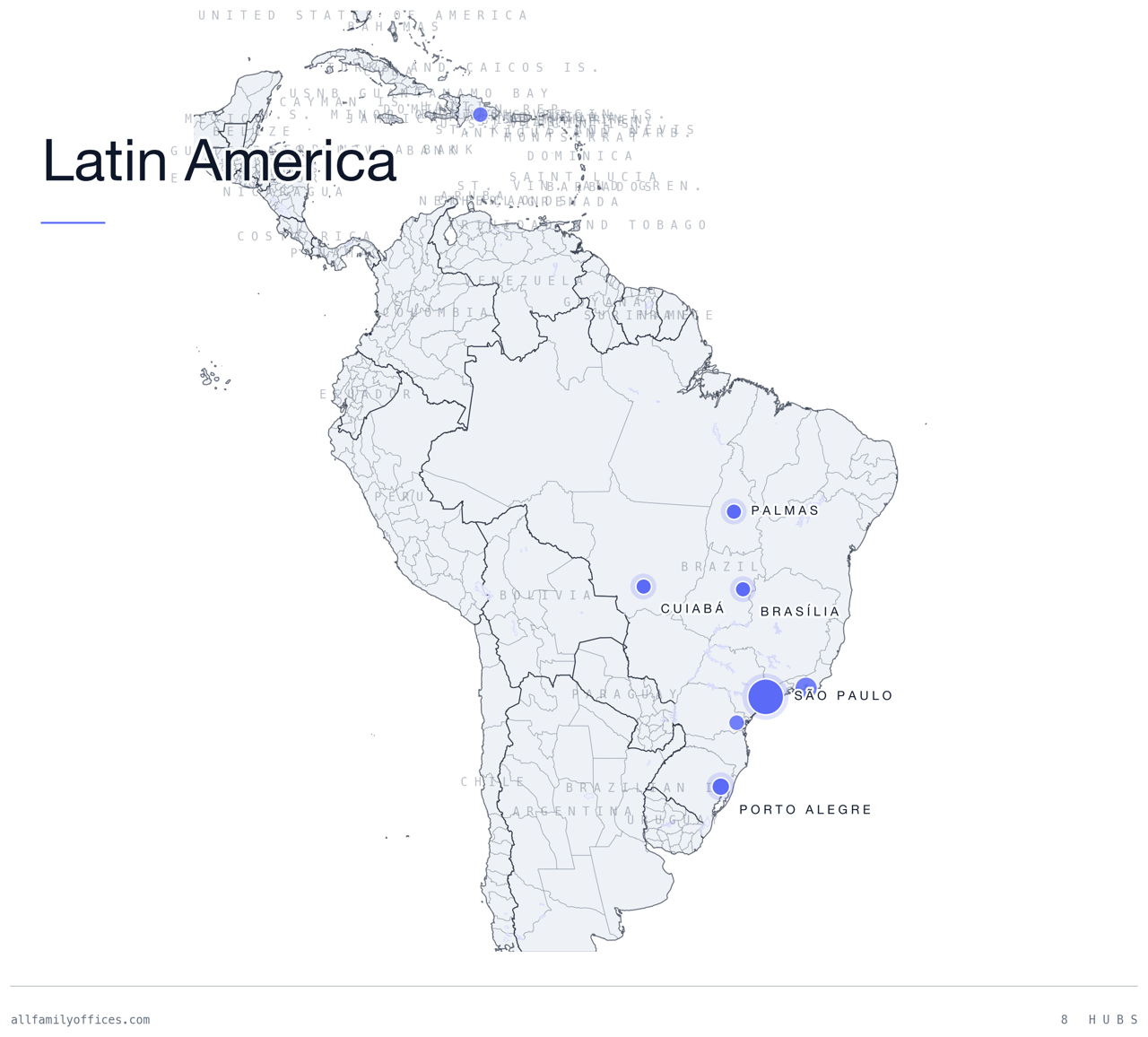
- Miami, São Paulo, and Mexico City serve as the three primary hubs for cross-border wealth structuring and family office operations.
- At Wright Capital, a São Paulo multi-family office serving ultra-high-net-worth (UHNW) families, client impact allocations have grown from the 1% minimum the firm set at its founding to close to 4%.
- In a March 2023 survey of 65 high-net-worth Latin American families by The ImPact, 80% reported holding impact investments, together an estimated $1.2 billion.
Landscape Overview: How Latin America's Wealth Platforms Differ
Latin America's family office ecosystem differs sharply from those in the U.S. or Europe. Most LATAM offices function as operator-financier hybrids. Families control industrial conglomerates and deploy capital through direct deals rather than passive allocations. This model produces offices that think like operators first and investors second, with deep sector expertise in energy, food, mining, and retail.
The AllFamilyOffices database lists 120+ MFOs and 40+ SFOs in the region. Mexico leads in dynasty-scale SFOs; the Slim family alone signed a $1.99 billion drilling contract with Pemex in September 2025. Brazil leads in MFO depth, with firms like Turim and Wright Capital offering full-service wealth platforms. Central America contributes conglomerate families such as the Kriete, Poma, Motta, and Bosch-Gutiérrez groups, each controlling multi-sector empires built over generations.
Cross-border activity is reshaping the market. A Miami-based regional wealth association became the first organization to formally represent Latin American family offices in the United States. Families use Miami, New York, and Houston as hubs to strengthen oversight, design tax-efficient vehicles, and access institutional capital. Nearshoring demand in Mexico, energy transition spending, and fintech growth are pulling new wealth into formalized multi-family office structures.
Family Office Comparison at a Glance
The table below compares the leading family offices in Latin America. It mixes SFOs and MFOs to reflect the region's full spectrum of wealth management models.
| Family Office | Type | AUM Estimate | Investment Focus | Key Services | Location |
|---|---|---|---|---|---|
| Slim Family (Grupo Carso) | SFO | Undisclosed | Energy, telecom, infrastructure | Direct operations, EPC | Mexico City |
| Garza Family (FEMSA / OXXO) | SFO | Undisclosed | Retail, bottling, fintech | Corporate restructuring | Monterrey, Mexico |
| Baillères Family (Grupo Bal) | SFO | Undisclosed | Mining (silver, gold), insurance | Industrial operations | Mexico City |
| Kriete Family (Abra Group) | SFO | Undisclosed | Aviation, network connectivity | Fleet expansion, IPO | Central America |
| Motta Family (Inversiones Bahía) | SFO | Undisclosed | Aviation, banking, insurance | Diversified holding | Panama City |
| Bosch-Gutiérrez Family (CMI) | SFO | Undisclosed | Food, renewables (800+ MW) | Energy development | Guatemala City |
| Turim | MFO | Undisclosed | Global assets, impact/ESG | Full-service wealth planning | Rio de Janeiro / São Paulo |
| Promecap | MFO | $3.5B+ (AUM) | Private equity, equities, debt | PE-focused MFO | Mexico City |
| Wright Capital | MFO | Undisclosed | Impact investing, funds of funds | Wealth management for 40+ families | São Paulo |
| Adduntia | MFO | Undisclosed | Tax planning, succession | Private banking, external CFO | Buenos Aires |
| Eurocapital | MFO | Undisclosed | Impact investing (5 countries) | Multi-country advisory | Chile |
| Acacia (Grupo Romero) | SFO | Undisclosed | Cross-border bridging | LATAM-U.S. integration | Miami |
Promecap stands out as the only office with publicly confirmed AUM. Most LATAM dynasty offices keep financial details private, consistent with the region's preference for discretion over public reporting.
Top Picks by Strategy
- Largest Published AUM in This Guide: Promecap, with more than $3.5 billion in assets under management, including its own capital, and a private equity core built since 1997
- Leading MFO for Impact: Wright Capital serves 40+ Brazilian families through dedicated funds of funds ($30-40 million each), with client impact allocations now close to 4%
- Top Renewables Operator: Bosch-Gutiérrez Family (CMI) controls 800+ MW of renewable capacity in six countries and acquired Del Real Foods in October 2024 for U.S. market entry
- Best for Cross-Border Structuring: Acacia, the Helguero-Romero branch of Peru's Grupo Romero, bridges Latin American legacy enterprises with the U.S. family office ecosystem from Miami
- Premier Full-Service MFO: Turim won a leading industry award for Latin America's best family-office services in 2025, offering oversight, next-gen education, and charitable giving planning
- Most Diversified Conglomerate: Motta Family (Inversiones Bahía) spans aviation through Copa Holdings, banking via Banco General, and insurance through ASSA
- Strongest Energy Play: Slim Family (Grupo Carso) secured a $1.99 billion Pemex drilling contract and agreed to buy a further 30.1% of Talos Mexico for $49.7 million plus $33 million due on first production from the Zama field
Top Family Offices in Latin America in Detail
Slim Family (Grupo Carso / Control Empresarial)
No other Latin American private wealth office deploys capital at the speed and scale of the Slim group. Through Grupo Carso and Control Empresarial, the family operates as a principal developer in energy, telecom, and systems projects rather than a passive investor. In December 2024, Slim-controlled Zamajal agreed to buy a further 30.1% of Talos Mexico for $49.7 million at closing, plus $33 million due on first commercial production from the Zama field. The deal closed in March 2026, giving Zamajal 80% of Talos Mexico.
By September 2025, Grupo Carso signed a $1.99 billion contract with Pemex to drill up to 32 wells at the Ixachi field. Fund managers pitching to this office need operator-level detail: contracting structures, uptime plans, and downside cash projections.
Garza Family (FEMSA / Coca-Cola FEMSA / OXXO)
FEMSA's portfolio simplification strategy makes this Monterrey dynasty one of the clearest examples of corporate surgery in the region. The family completed a logistics divestiture and finalized its Heineken exit in 2025, sharpening focus on retail, Coke bottling, and proximity payments.
FEMSA posted second-quarter 2025 revenue up 6.3% year over year. The OXXO convenience chain, with thousands of stores, positions this office at the intersection of retail and fintech. Physical distribution now doubles as a financial origination channel.
Bosch-Gutiérrez Family (CMI / Corporación Multi Inversiones)
CMI runs a dual flywheel in food and renewables that few wealth platforms in the region can match. The energy arm exceeds 800 MW of renewable capacity in six countries, with Caribbean solar expansion through the Mata de Palma project in the Dominican Republic.
On the food side, CMI acquired Del Real Foods in October 2024 to enter the U.S. Hispanic foods market. Families or funds looking at structured green capex with contracted offtake will find CMI a natural co-investment partner.
Motta Family (Inversiones Bahía)
Panama's most diversified family wealth platform holds anchor positions in Copa Holdings (aviation), Banco General (banking), and ASSA (insurance). Alberto C. Motta Cardoze founded Inversiones Bahía together with his sons Stanley and Alberto Jr.
This office deploys patient control capital with Central American scale. It prefers regulatory-heavy sectors where long-term positioning matters more than short-term returns.
Kriete Family (Avianca / Abra Group)
The Kriete family's bet on Latin American aviation reached a new phase in October 2025. Abra Group (combining Avianca and GOL) announced a fleet plan adding 50 more A320neo narrowbodies and up to seven A330neo widebodies, and in December 2025 it confidentially submitted a draft registration statement for a proposed initial public offering. In March 2026 it said seven Airbus A330-900s would join its fleet.
This is a network-and-cost thesis: slot strategy and fleet economics drive value, not vanity routes.
Turim
Turim is the strongest full-service multi-family office platform in Latin America, with offices in Rio de Janeiro, São Paulo, and London. A leading industry publication named it the region's best for family-office services in 2025.
The firm had about 110 employees in 2024 and offers global asset management, impact and ESG investing, wealth planning, charitable giving, next-gen education, and family oversight. As a member of the Wigmore Association (a global club of leading MFOs), Turim connects Brazilian families to institutional-grade deal flow beyond the region.
Promecap
Promecap reports more than $3.5 billion in assets under management, including its own capital, the only AUM figure shown in this guide. Originally launched as a private equity fund in 1997, the firm shifted to a multi-family office model in 2008.
Based in Mexico City's Bosques de las Lomas district, it invests in private equity, public equities, and debt. Like Turim, Promecap holds membership in the Wigmore Association, giving it access to cross-border co-investment networks.
Wright Capital
Fernanda Camargo built Wright Capital around a simple rule: every client family must allocate at least 1% to impact. By 2024, impact allocations among her 40+ Brazilian client families had climbed to close to 4%.
Wright operates three in-house funds of funds ($30-40 million each), pooling capital and due diligence to cut transaction costs for smaller managers like Vox Capital, MOV Investimentos, and Positive Ventures. The next fund of funds will target nature-based solutions, regenerative agriculture, and climate tech.
Adduntia
Buenos Aires-based Adduntia fills a gap in Argentina's thin MFO market. The firm combines private banking, external CFO services, tax planning, capital deployment, and succession planning under one roof.
For families navigating Argentina's volatile currency environment, Adduntia's cross-border tax structuring offers practical value that generic wealth advisors cannot match.
Eurocapital
Pablo Alonso's MFO serves 32 clients in Chile, Argentina, Peru, Uruguay, and Spain, with a growing tilt toward impact investing. Seven of those 32 clients now invest in private impact funds, deploying tickets of $500,000 to $1 million.
Alonso channels capital through vehicles like Santiago-based Fondo de Inversión Social (FIS) and Sonen Capital's Latin America Impact Fund.
Investment Trends Shaping This Market
Operator-Led Energy Deals in Mexico
Mexican dynasty offices act as principal developers rather than passive LPs in energy. The Slim family's $1.99 billion Ixachi contract and Zamajal's stake in the Zama field illustrate a service-plus-capital model aligned with national energy priorities. Expect more hybrid structures in gas and midstream as Mexico's regulatory framework favors operators with drilling capability.
Corporate Surgery to Unlock Value
Monterrey-based families use heavy restructuring to surface trapped value. ALFA's spin-off of Controladora Alpek (CTALPEK), listed April 7, 2025, gave shareholders one CTALPEK share per ALFA share. Post-spin, Sigma reported second-quarter 2025 EBITDA of $305 million.
This template of listing, index eligibility, and free-float optimization is likely to spread among LATAM conglomerate families seeking to unlock subsidiary value.
Impact Investing Moves from Experiment to Standard
In The ImPact's March 2023 survey of 65 high-net-worth Latin American families, 80% reported holding impact investments, though these were small relative to their total assets. Wright Capital's clients now allocate close to 4% to impact, up from the 1% minimum the firm set a decade ago. Networks like Latimpacto (200+ members), The ImPact, and CREO recruit actively in the region.
In Mexico, the Sánchez-Navarro family launched CO_ Capital as an impact debt fund. Brazil's Russo family created Meraki Impact as a dedicated impact vehicle. These launches signal that impact is becoming a standard sleeve, not an experiment.
Cross-Border Structuring via U.S. Hubs
Latin American families use Miami, New York, and Houston to design shareholder agreements and plan efficient fund repatriation. A Miami-based regional wealth association, founded by Lourdes Castillo and chaired on the family office side by Daniel Leon of Acacia (Grupo Romero), formally represents these offices in the U.S.
Auxadi, a Madrid-headquartered firm with a U.S. office in Coral Gables near Miami, supports this migration with accounting, tax, and corporate legal services for clients in over 50 countries.
Nearshoring and Critical Minerals
Mexico's USMCA positioning drives demand in manufacturing, electronics, aerospace, and automotive. Argentina, Bolivia, and Chile hold about 64 million of the world's roughly 150 million tons of measured and indicated lithium resources, and Chile alone mined about 23% of the world's copper in 2025, according to the U.S. Geological Survey.
Family offices with operational expertise target logistics hubs, industrial parks, and midstream mineral processing. The Bosch-Gutiérrez and Slim groups are best positioned to capture these capital flows given their existing energy and industrial footprints.
How to Evaluate a Family Office in Latin America
Start by assessing operator fluency. LATAM family offices built their wealth running conglomerates, not picking stocks. An MFO serving this market must understand maintenance cycles, offtake agreements, and downside cash modeling. Promecap's private equity roots and Turim's direct execution model are benchmarks for this capability.
Cross-border structuring expertise is a must. Families moving wealth between LATAM jurisdictions and the U.S. need advisors who can design shareholder agreements and manage FX repatriation. Adduntia's external CFO service and Acacia's LATAM-U.S. bridging model show what strong cross-border support looks like in practice.
Verify succession planning depth. Ask whether the MFO has guided multi-generational wealth transfers, not just portfolio allocations. Turim's next-gen education and family structure programs set a high bar here.
Check network access. Globally, 83% of family office start-up investments are executed as club deals, according to PwC's Global Family Office Deals Study 2024. Membership in the Wigmore Association (Turim, Promecap) or Latimpacto signals access to proprietary deal flow. Offices without peer networks often miss the best family-to-family transactions.
Demand dated evidence. Red flags include IRR projections without KPIs, TAM slides without operator detail, and heroic commodity assumptions. LATAM family offices expect pitches grounded in quarterly data, specific filings, and realistic downside scenarios.
Which Family Office Fits Your Needs?
UHNW families seeking a full-service wealth management platform with estate planning and charitable giving should explore Turim or Adduntia. Turim's team, about 110 people in 2024, and its Euromoney award signal institutional depth. Adduntia offers a leaner model suited to families navigating Argentina's regulatory complexity. Both provide succession planning, a critical need in a region where first-generation founders are transferring control.
Business owners with industrial operations will find the strongest co-investment fit among the dynasty SFOs. The Slim, Garza, and Bosch-Gutiérrez families operate as principals, not allocators, and prefer counterparties who bring operator fluency. Latimpacto and peer networks facilitate introductions, and PwC's Global Family Office Deals Study 2024 found that 83% of family office start-up investments worldwide were club deals.
Next-generation wealth holders drawn to impact investing should consider Wright Capital or Eurocapital. Wright's fund-of-funds model pools capital from 40+ families, lowering the barrier to investing in smaller impact managers. Eurocapital's five-country reach offers geographic spread for families with wealth goals tied to climate, education, or financial inclusion.
Methodology
This guide on multi family offices in Latin America draws from publicly available filings, deal announcements, industry databases, and award records as of early 2026. Office profiles reflect only data confirmed through corporate disclosures, press releases, or recognized industry sources. AUM figures appear only where publicly reported; most LATAM dynasty offices keep financial details private. The analysis prioritizes offices with verifiable 2024-2025 deal activity, service model clarity, or recognized industry awards. Offices were selected based on deal volume, geographic reach, service breadth, and sector influence rather than AUM alone. This reflects a market where operational control often matters more than reported capital under management.
Frequently Asked Questions
How many multi-family offices operate in Latin America?
The AllFamilyOffices database lists 120+ multi-family offices in Latin America (October 2026), led by Brazil, followed by Mexico and Chile. The number continues to grow as newly wealthy families move beyond single family office structures into shared platforms. Leading MFOs include Turim in Brazil, Promecap in Mexico, and Adduntia in Argentina.
What is the difference between an SFO and an MFO in Latin America?
A single family office manages wealth for one dynasty, often controlling industrial conglomerates. The Slim family's Grupo Carso is a prime example. A multi-family office serves multiple UHNW families with pooled vehicles and shared services. Wright Capital, serving 40+ Brazilian families through combined funds of funds, represents the MFO model. LATAM also features operator-financier hybrids that blend both approaches.
Where are most family offices in Latin America based?
Mexico City leads for dynasty SFOs, followed by Monterrey. São Paulo and Rio de Janeiro are Brazil's main MFO hubs. Miami serves as the primary U.S. gateway for cross-border structuring. Panama City, Buenos Aires, Santiago, and Guatemala City each host notable offices tied to local conglomerate families.
What is the minimum allocation for a Latin American family office?
Few firms publish deal sizes. At Eurocapital, clients investing in private impact funds commit tickets of $500,000 to $1 million, while Wright Capital pools client capital through funds of funds of roughly $30 million to $40 million each. Exact minimum wealth for forming a family office in the region varies widely and is rarely disclosed.
How are Latin American family offices different from those in Europe or the U.S.?
LATAM family offices are primarily operator-financiers. They control real businesses (energy, food, aviation, mining) and invest as principals, not passive allocators. Co-investment and family-to-family deals that bypass private equity are common; worldwide, 83% of family office start-up investments are executed as club deals, according to PwC's Global Family Office Deals Study 2024. Cross-border tax structuring between LATAM jurisdictions and the U.S. is a central concern, unlike in domestic-focused U.S. or European offices.
What role does impact investing play among LATAM family offices?
Impact is moving from niche to norm. In The ImPact's 2023 survey of 65 high-net-worth Latin American families, 80% reported holding impact investments, and Wright Capital's clients have raised their impact allocations from a 1% minimum to close to 4%. Wright Capital requires a minimum 1% impact commitment from all client families. Key focus areas include nature-based solutions, regenerative agriculture, financial inclusion, and climate tech. Latimpacto (200+ members) and CREO expand the pipeline of investable opportunities in the region.
 Google AI Mode
Tells Google to show you more from AllFamilyOffices in AI, Search and Discover.