On This Page
- Key Facts About Multi Family Offices in Australia
- Multi Family Offices Australia: Landscape Overview
- Family Office Comparison at a Glance
- Top Picks by Strategy
- Top Family Offices in Australia in Detail
- Investment Trends Shaping Australian Family Offices
- How to Evaluate a Multi-Family Office in Australia
- Which Family Office Fits Your Needs?
- Methodology
- Frequently Asked Questions
Key Facts About Multi Family Offices in Australia
- KPMG's Australian Family Office Compensation Benchmark Report 2025 estimates that Australia has more than 2,150 family offices, up from its 2023 estimate of around 2,000.
- Most Australian multi-family offices (MFOs) require a minimum of $10 million in investable assets. A single family office (SFO) typically requires $50 million or more.
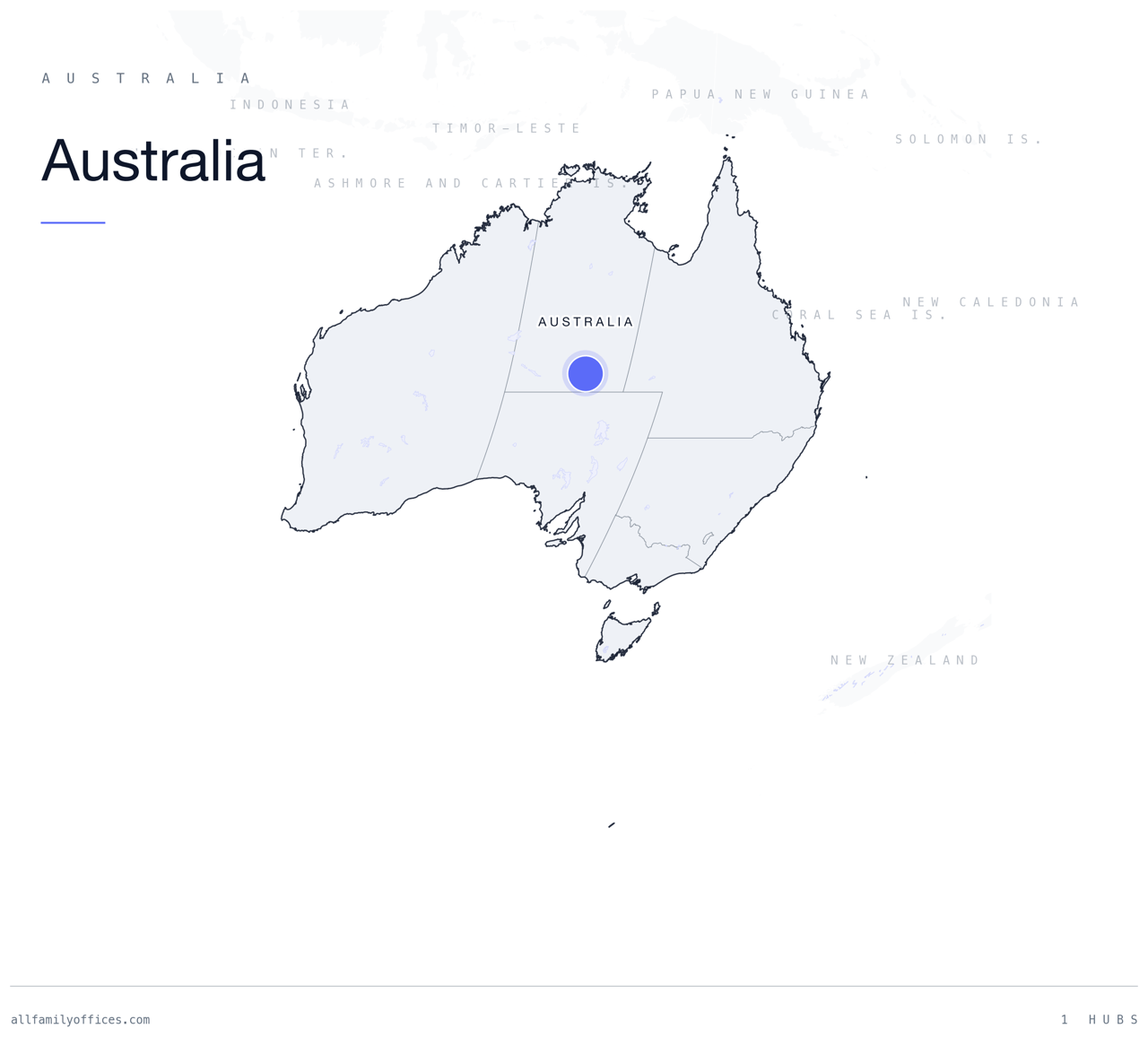
- Sydney is Australia's largest family office hub, with 32% of the family office assets reported in industry data from September 2026, ahead of Perth (27%) and Melbourne (21%). Sydney has 224 centi-millionaires (people with US$100 million or more in liquid investable wealth) and 22 billionaires, according to industry estimates from 2025.
- Annual MFO fees typically range from $150,000 to $500,000, roughly one-quarter the cost of running a dedicated SFO at $800,000 to $2 million.
- Key themes include direct investments in private equity, real estate, ESG-aligned strategies, and superannuation structuring under evolving Division 296 rules.
Multi Family Offices Australia: Landscape Overview
A multi-family office in Australia provides shared wealth management, tax planning, and advisory services to several unrelated ultra-high-net-worth (UHNW) families. The model fills a critical gap for families with $10 million to $50 million in assets. These families gain access to institutional-grade services without the $800,000-plus annual cost of a standalone SFO.
More than 1.6 million Australians have a net worth of US$1 million or more, according to UBS's Global Wealth Report 2026. That wealth base and a wave of intergenerational wealth transfers are pushing more families toward this structure. Sydney, Perth and Melbourne hold most of the family office assets reported in industry data from September 2026 (32%, 27% and 21%), and Sydney and Melbourne have the deepest pools of financial firms and advisory talent. Perth serves families tied to mining and resources wealth, while Brisbane supports regional business interests.
Families outside the largest cities often face fewer local MFO options. Service scope and remote capability become important selection factors in these regions.
The Australian MFO market operates under distinct regulatory conditions. Any office providing financial services to non-related parties must hold an Australian Financial Services Licence (AFSL) under ASIC oversight or act as an authorised representative of a licensee. Superannuation integration adds complexity that has no equivalent in US or European family offices, including self-managed super funds (SMSFs) and Division 296 tax changes.
Asian UHNW families are also setting up Australian MFO structures for succession planning and education-driven migration. Foreign Investment Review Board (FIRB) compliance shapes these cross-border arrangements.
Family Office Comparison at a Glance
The table below compares Australia's leading MFOs alongside two prominent SFOs for scale context. Asset estimates from October 2026 come first, largest first; they are given in dollars, without a named currency. AP Family Office reports its own figure in Australian dollars. Offices shown without a figure follow.
| Family Office | Type | AUM Estimate | Investment Focus | Key Services | Location |
|---|---|---|---|---|---|
| EWM Group | MFO | $10B (estimate) | Integrated wealth and asset management | Advisory, governance, philanthropy, risk management | Brisbane |
| Stonebridge Family Office | MFO | About $1B (estimate) | High-net-worth advisory | Multi-family office services | Sydney |
| AP Family Office | MFO | A$1B+ | Real estate, agriculture, equity, credit | Tax planning, estate planning, foundation management | Sydney |
| Candor Family Office | MFO | — | Personalised UHNW investment | 360° advisory, wealth retention | Perth |
| Tattarang | SFO | — | Renewables, critical minerals, agri-food, health tech | Direct investments, portfolio management | Perth |
| Bangarra Group | SFO | — | UK golf courses and land (Crown Golf) | Private family office of the Chapman family | Sydney |
| Mutual Trust | MFO | — | Diversified wealth management, agribusiness | Full-service family office, trustee services, governance | Melbourne |
| Morrows | MFO | — | Integrated multi-family office services | Tax, super, portfolio, family coaching, concierge | Australia |
| BOYCE Family Office | MFO | — | Corporate advisory, succession | Business accounting, tax structuring, consulting | Melbourne |
| William Buck Family Office | MFO | — | Wealth preservation, governance | Estate planning, next-gen oversight | Melbourne |
EWM Group has the largest asset estimate in this guide, at $10 billion. AP Family Office reports more than A$1 billion in assets under management. Tattarang and Bangarra are single family offices, shown for comparison.
Top Picks by Strategy
- Largest MFO Asset Estimate: EWM Group, headquartered in Brisbane, has the largest asset estimate among the multi-family offices in this guide, at $10 billion.
- Strongest Asia-Pacific Reach: AP Family Office operates from Sydney with regional offices in Hong Kong and Singapore, and reports more than A$1 billion in assets under management.
- Top Pick for Integrated Services: Morrows delivers a broad range of services under one roof, from taxation and superannuation to estate planning, philanthropy and family succession.
- Leading Regional MFO: Candor Family Office is Western Australia's longest-running MFO, with over two decades of service to UHNW clients in the resources-rich west.
- Best for Business Families: BOYCE Family Office focuses on corporate advisory, inter-generational succession, and business accounting; its family group has business interests across Australia, the UK and other countries.
- Strongest Family Oversight Platform: Mutual Trust's rising generation programs, family constitution frameworks, and indigenous trust capabilities set the benchmark for family governance in Australia.
- Published Entry Point: William Buck Family Office designs its bespoke service for clients with assets above $10 million, a useful marker for emerging wealth.
- Scale Benchmark (SFO Context): Tattarang, which describes itself as one of Australia's largest private investment groups, invests for the Forrest family, with holdings in renewable energy, critical minerals, and agri-food.
Top Family Offices in Australia in Detail
Mutual Trust
Mutual Trust serves some of Australia's wealthiest families. The Melbourne-based firm employs more than 200 professionals from five city offices. Its 2017 merger with The Myer Family Company combined two of Australia's most storied family wealth traditions.
Mutual Trust's proprietary "Gemstone" framework guides families through five facets of wealth purpose, from financial growth to charitable giving. As a founding member of a global family office network, the firm gives clients access to international co-investment intelligence. Its rising generation program prepares inheritors through structured education and mentorship. UHNW families seeking deep oversight comparable to a standalone SFO will find it here at a fraction of the cost.
AP Family Office
Few Australian MFOs match AP Family Office's regional footprint. The firm operates from Sydney with offices in Hong Kong and Singapore and reports more than A$1 billion in assets under management. Its allocation strategy spans real estate, agriculture, equity markets, and credit lending, with managed schemes licensed in Australia.
AP operates as a corporate authorised representative of Osmium Asset Management, which holds the Australian Financial Services Licence (AFSL 280595), and acts as both advisor and fund manager. Families with business ties in the Asia-Pacific corridor benefit from its cross-border tax planning and asset structuring. The firm also provides foundation management, making it a strong fit for families blending wealth growth with structured charitable giving.
EWM Group
Brisbane's EWM Group oversees an estimated $10 billion. The firm serves individuals, families, business owners, inheritors, and philanthropists through an integrated model. Its services include financial oversight, strategic charitable giving, risk management, and lifestyle support.
EWM fills a gap in the Queensland market, where MFO options are thinner than in Sydney or Melbourne. Families with complex portfolios who want a single point of coordination for both capital deployment and family structure will find EWM's breadth hard to match outside the two largest cities.
Morrows
Morrows packs a wide range of services into a single relationship. It covers taxation, accounting, superannuation, portfolio construction, and capital deployment guidance. It also handles family coaching, asset protection, estate planning, charitable strategies, legal advice, concierge services, and full estate administration.
The firm targets families who want one point of contact for every dimension of their financial life. Its emphasis on family coaching sets it apart. Morrows actively works on family dynamics, helping moderate generational tensions around control and autonomy. Families overwhelmed by coordinating multiple advisors get the clearest value from this model.
Candor Family Office
Western Australia's longest-running MFO has served UHNW clients in Perth for over two decades. Candor focuses on first and second-generation wealth creators, many of whom built fortunes in mining, resources, or property.
Its full-scope service model covers portfolio management, lifestyle coordination, and wealth retention in a single relationship. UHNW individuals in Perth or regional Western Australia can avoid relying on Sydney or Melbourne firms. Candor understands resource-sector wealth cycles and the specific tax structuring these clients require.
BOYCE Family Office
Business families facing generational transition are the core audience for BOYCE. The firm specialises in corporate advisory, business accounting, taxation structuring, and inter-generational succession planning. Its family group has business interests and investments across Australia, the UK and other countries, and it serves families whose enterprises span multiple jurisdictions.
BOYCE belongs to the Family Capital 100 global network of family business specialists. This gives clients access to international best practices for sustaining both human and financial capital. The Boyce family's first business began over 150 years ago in Australian publishing. Families approaching a business sale or restructuring gain the most from BOYCE's focused expertise.
William Buck Family Office
William Buck designs its family office service for clients with assets above $10 million. The firm serves families that fall below the typical SFO minimum but still need coordinated wealth preservation and estate planning.
William Buck places strong emphasis on next-generation readiness, helping families prepare inheritors before major wealth transfers. The family office draws on William Buck's broader accounting and advisory practice, which has offices across Australia and New Zealand. Families at earlier stages of wealth building, or those moving from a virtual family office to a more structured model, will find it a practical starting point.
Tattarang
The Forrest family's SFO describes itself as one of Australia's largest private investment groups. Its portfolio includes a major stake in Fortescue, Squadron Energy, RM Williams, Wyloo, Harvest Road Group, Austal, and Bega Cheese.
The firm's focus on renewable energy, critical minerals, and agri-food reflects a distinctive thesis: real assets with long-term structural tailwinds. Tattarang is not an MFO, but its direct approach and sector allocation influence how Australian family offices think about portfolio construction. The firm shows what becomes possible when wealth concentration reaches the scale where a dedicated SFO makes economic sense.
Investment Trends Shaping Australian Family Offices
Direct Ownership and Co-Investment Between Family Offices
Australian family offices are shifting capital away from managed funds toward direct ownership of companies and assets. Co-investment (pooling capital alongside other families or funds) is gaining traction as a way to access larger deals without concentrating risk. Global family office networks facilitate deal flow for Australian MFOs, connecting them with non-competing firms in Germany, the US, Mexico, and Brazil.
ESG, Impact Investing, and Charitable Capital
Private ancillary funds distributed $914 million in 2023-24, according to the Australian Taxation Office's taxation statistics. This figure signals the scale of structured giving among wealthy families. Younger family members are driving demand for ESG integration, pushing MFOs to embed sustainability criteria into portfolio construction. Renewable energy, sustainable agriculture, and climate mitigation have emerged as the leading sectors for impact-oriented capital in the Australian market.
Superannuation Structuring and Division 296 Implications
Division 296, passed by Parliament in March 2026, adds a 15% tax on the earnings attributable to super balances above $3 million from 1 July 2026, and a further 10% on the portion above $10 million. This change is forcing MFOs to restructure high-balance superannuation strategies for their clients. Payday super, which since 1 July 2026 requires employers to pay super at the same time as wages, adds further complexity for business-owning families.
MFOs with in-house super expertise, like Morrows and Mutual Trust, are best positioned to navigate these shifts alongside broader estate planning.
Cross-Border Capital Flows and Asia-Pacific Connectivity
Asian UHNW families are setting up Australian family office structures. They are drawn by the country's stable legal system, education options, and lifestyle appeal. FIRB compliance remains a critical hurdle for foreign investors acquiring Australian assets.
AP Family Office's tri-city presence (Sydney, Hong Kong, Singapore) and Mutual Trust's global network membership position these firms as natural entry points for families with cross-border wealth structures.
How to Evaluate a Multi-Family Office in Australia
Start with AFSL verification. Any Australian MFO providing financial services to non-related parties must hold an Australian Financial Services Licence or act as an authorised representative of a licensee.
In practice, independence matters more in Australia than in larger markets because the MFO sector is still maturing. Some firms distribute in-house products, creating conflicts of interest. Mutual Trust says it provides independent advice, while AP Family Office also offers its own fund products. Ask any prospective MFO directly whether they earn commissions or rebates from products they recommend.
Superannuation capability is a uniquely Australian differentiator. An MFO that cannot handle SMSF structuring, Division 296 planning, and binding death benefit nominations in-house will force you to coordinate with external specialists. Morrows and Mutual Trust integrate super into their core service model. William Buck's $10 million entry threshold provides a useful benchmark for families evaluating whether they can access MFO-grade service at their current wealth level.
Test fee transparency early. Australian MFO fees typically run 0.5% to 2% of AUM, or $150,000 to $500,000 annually. Compare this against the $800,000-plus cost of an SFO before deciding which model fits. Red flags include opaque billing, no written oversight framework, and absence of succession planning for the office itself (key person risk). Families planning a business sale should engage an MFO 12 to 18 months before the liquidity event for optimal tax structuring.
Which Family Office Fits Your Needs?
UHNW families managing $50 million or more should explore Mutual Trust first. Its oversight frameworks, rising generation programs, and trustee services replicate the depth of a private office within a shared-cost model. Families with Asia-Pacific business ties gain the most from AP Family Office, which handles cross-border tax planning and asset structuring through its Sydney, Hong Kong, and Singapore offices.
Business owners approaching a sale or generational handover need specialist succession planning. BOYCE Family Office builds its entire model around corporate advisory and inter-generational transition, and its family group has business interests across Australia, the UK and other countries. For those earlier in their wealth journey, William Buck accepts clients from $10 million and focuses on preparing the next generation.
Families in Perth or regional Western Australia should consider Candor Family Office. It is Western Australia's longest-established multi-family office, with deep knowledge of resource-sector wealth. In Queensland, EWM Group, which is estimated at $10 billion, provides integrated services that rival Sydney and Melbourne firms. Morrows suits families who want every service, from super compliance to concierge, managed through a single relationship.
Methodology
This guide to multi family offices australia draws on market research reports, wealth databases, industry lists, and direct disclosures from individual offices. Selection criteria included verified MFO or notable SFO status, public information on services or AUM, and active operations in Australia as of early 2026.
The evaluation considered service breadth, disclosed AUM, geographic reach, and area of focus. AUM figures are estimates from October 2026 or the firms' own published figures and may not capture private or unreported assets. Where AUM data was unavailable, the assessment relied on service scope and market reputation. Select SFOs provide scale context for the broader Australian family office market.
Frequently Asked Questions
How many multi-family offices operate in Australia?
KPMG's Australian Family Office Compensation Benchmark Report 2025 estimates that Australia has more than 2,150 family offices in total, up from its 2023 estimate of around 2,000. Dedicated MFOs represent a smaller subset of that figure. MFO numbers are rising as families with $10 million to $50 million in assets seek shared-cost alternatives to standalone offices. The AllFamilyOffices database lists 55+ multi-family offices in Australia (October 2026).
What is the difference between a single family office and a multi-family office in Australia?
An SFO serves one family exclusively. It typically requires $50 million or more in assets to justify dedicated staff, with annual operating costs of $800,000 to $2 million. An MFO shares services among several unrelated families, charging $150,000 to $500,000 per year and accepting clients from $10 million. MFOs are gaining ground as families recognise the value of pooled resources and broader expertise.
What is the minimum wealth requirement for an Australian multi-family office?
Most Australian MFOs set their minimum at $10 million in investable assets. William Buck Family Office explicitly starts at this threshold. Some firms serve families in the $5 million to $15 million range through lighter-touch or virtual models, with annual fees of $80,000 to $200,000. Families above $50 million can choose between an MFO and a dedicated SFO. The cost savings of the shared model remain compelling even at higher wealth levels.
Do Australian family offices need an AFSL licence?
Any family office providing financial services to parties outside the immediate family must hold an Australian Financial Services Licence under ASIC regulations or act as an authorised representative of a licensee. SFOs serving only family members may qualify for exemptions. Verify a prospective MFO's AFSL status through ASIC's public register before engaging.
Which Australian cities are the main hubs for family offices?
Sydney leads, with 32% of the family office assets reported in industry data from September 2026, followed by Perth (27%) and Melbourne (21%). Sydney has 22 billionaires and 224 individuals holding US$100 million or more in liquid investable wealth, according to industry estimates from 2025. Perth serves resource-sector families, with Candor Family Office and Tattarang both based there. Brisbane is home to EWM Group. Adelaide hosts a Mutual Trust office and families with retail and manufacturing wealth.
What strategies do Australian multi-family offices typically pursue?
Direct holdings in private equity, venture capital, and real estate are the dominant strategies. Co-investment between family offices is growing as a way to access larger deals. ESG and impact investing are accelerating, driven by next-generation family members and supported by private ancillary funds, which distributed $914 million in 2023-24. Superannuation structuring, including SMSF management and Division 296 planning, is a uniquely Australian component of MFO strategy.
 Google AI Mode
Tells Google to show you more from AllFamilyOffices in AI, Search and Discover.