On This Page
- Key Facts About German Family Offices
- Germany's Family Office Landscape
- Family Office Comparison at a Glance
- Top Picks by Strategy
- Top German Family Offices in Detail
- Investment Trends Shaping German Family Offices
- How to Evaluate a German Family Office
- Which Family Office Fits Your Needs?
- Methodology
- Frequently Asked Questions
Key Facts About German Family Offices
- Germany hosts an estimated 500 to 1,000 single family offices (SFOs) and 174 independent multi-family offices (MFOs). This places it among Europe's most concentrated private wealth markets.
- Combined SFO capital exceeds $322 billion, deployed through more than 6,993 funding rounds and over 1,300 portfolio companies.
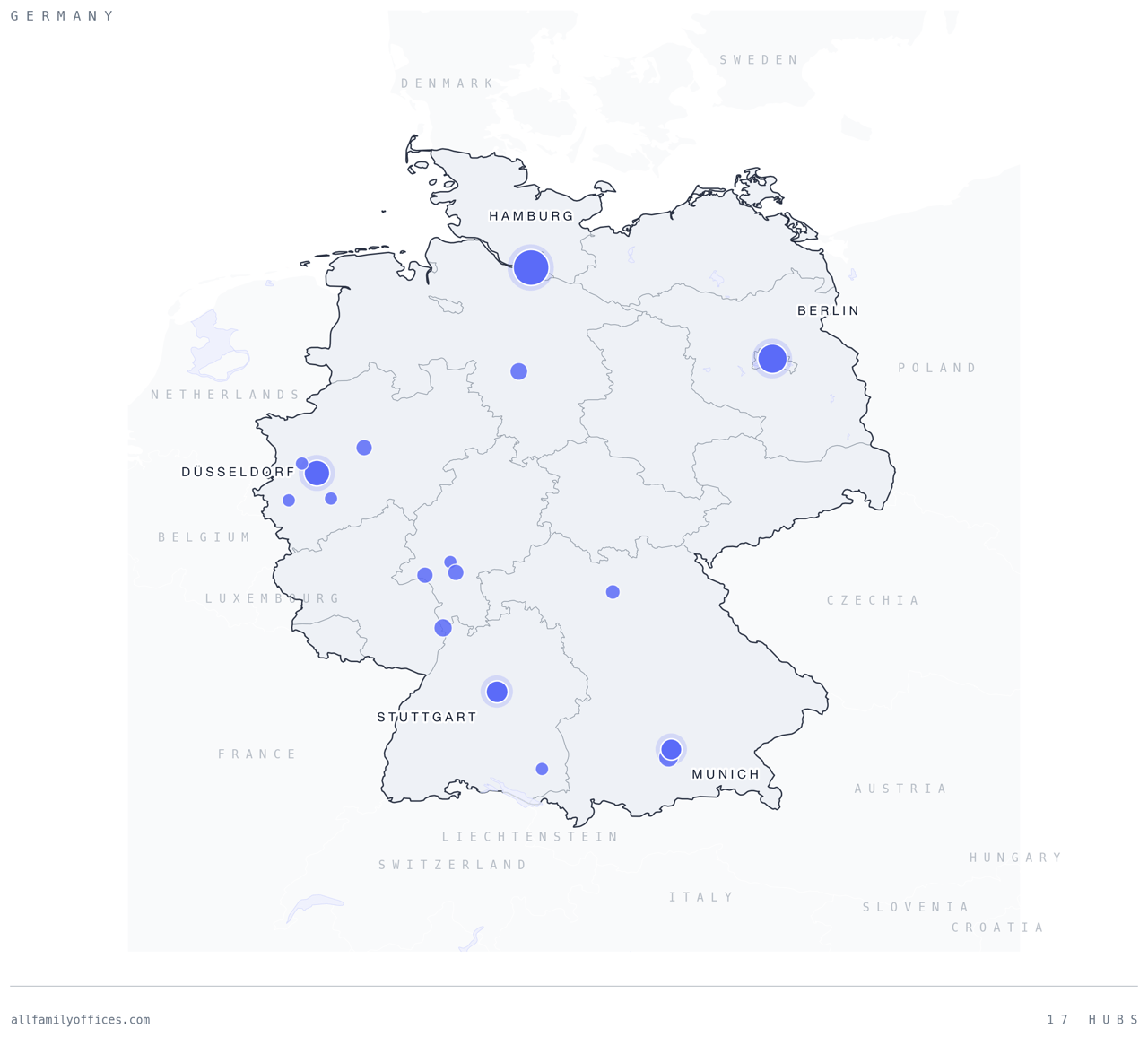
- Munich leads with 27 tracked SFOs. Berlin follows with 26. Frankfurt dominates among the offices with the highest assets under management.
- The largest German family offices include Athos Service (~€30B), HQ Capital (~$28B), and Spudy & Co. ($12.7B). Their wealth traces to industrial dynasties in automotive, pharma, and Mittelstand enterprises.
- German SFOs are shifting capital from traditional safe assets toward private equity, venture capital, and renewable energy.
- Multi-family office client thresholds typically start at €15 million in investable assets. An additional 13 bank-affiliated institutes offer family office services.
- Healthcare, biotech, real estate, fintech, SaaS, and cleantech rank among the top sectors attracting family capital in Germany.
Germany's Family Office Landscape
This list of German family offices reflects an ecosystem rooted in the country's Mittelstand industrial base. Families who built global companies in manufacturing, pharma, automotive, and engineering now manage generational wealth through dedicated vehicles. Many operate quietly as GmbH holding structures, which explains why official SFO counts range from 355 to roughly 1,000 depending on the source.
Alongside these SFOs sit 174 independent MFOs and 13 bank-affiliated institutes. Together they create a layered wealth management market serving ultra-high-net-worth (UHNW) families at every scale.
Munich and Berlin anchor the SFO landscape, each hosting more than 25 tracked offices. Frankfurt claims a different kind of dominance: five of the ten largest offices by AUM sit there. Hamburg, Düsseldorf, Stuttgart, and Cologne serve as secondary hubs. Many SFOs remain regionally anchored near their family company origins, in towns like Schiltach, Siegburg, and Neustadt.
Mittelstand succession events create new family offices each year as founders sell businesses and professionalize their capital deployment. EU renewable energy policy channels capital into cleantech. German families are also moving beyond simple holding structures (often organized as a GmbH or Stiftung) toward multi-asset vehicles that rival institutional investors.
Strong cross-border activity with Swiss offices in Zurich and Zug extends reach beyond the DACH region. Outbound allocations into the US and Israel further demonstrate German family capital's global ambitions.
Family Office Comparison at a Glance
The following table compares leading family offices in Germany by type, estimated AUM, and focus area. Figures appear only where publicly available. Offices without disclosed amounts are marked as undisclosed.
| Family Office | Type | AUM Estimate | Investment Focus | Location |
|---|---|---|---|---|
| Franz Haniel & Cie | MFO | €36B+ | Healthcare, B2B services, circular economy | Duisburg |
| Athos Service GmbH (Strüngmann) | SFO | ~€30B | Pharma, biotech | Germany |
| HQ Capital / Harald Quandt | SFO | ~$28B | PE, real estate, multi-asset | Germany |
| Spudy & Co. Family Office | SFO | $12.7B | Late-stage allocations | Hamburg |
| SKion GmbH (Klatten) | SFO | Undisclosed | Industrial goods, renewables, medtech | Bad Homburg |
| THI Investments (Thiele) | SFO | $2B | Multi-sector, M&A-active | Stuttgart |
| Reimann Investors | SFO | Undisclosed | Digital commerce, fintech, SaaS | Munich |
| Syngroh Capital (Grohe) | SFO | Undisclosed | PE, Mittelstand (€10–50M EV) | Schiltach |
| Wirtgen Invest | SFO | Undisclosed | Energy, real estate, renewables | Neustadt |
| FORUM Family Office | SFO | Undisclosed | Subscription models, healthcare, software | Munich |
| TRESONO Family Office AG | MFO | Undisclosed | Broad portfolio mandates | Munich |
| FINVIA | MFO | Undisclosed | Institutional-grade services | Frankfurt |
Germany's largest offices by managed assets tend to be SFOs rooted in pharma or automotive dynasties. MFOs like Franz Haniel and FINVIA serve broader client bases with wider mandates.
Top Picks by Strategy
- Largest AUM: Athos Service GmbH (~€30B) is Germany's largest known single family office by assets. The Strüngmann twins' pharma-rooted SFO gained prominence through its early BioNTech backing.
- Strongest in Direct Investments: Syngroh Capital targets DACH Mittelstand companies at €10–50M enterprise value, completing deals like TermaCook (2022) and Benzinger (2024).
- Top Real Estate and Energy Allocator: Wirtgen Invest deploys the family's construction-machinery fortune into the T8 skyscraper in Frankfurt, the A-Rosa Hotel Sylt, and a 50MW wind park in Greece.
- Leading MFO Platform: Franz Haniel & Cie manages €36B+ from Duisburg, investing in healthcare, B2B services, and circular economy themes since 1756.
- Best for Venture Capital: Reimann Investors holds 18 portfolio companies in digital commerce, fintech, and SaaS from its Munich base.
- Top Pick for Biotech: SALVIA GmbH, led by early BioNTech backer Helmut Jeggle, runs a focused SFO targeting biotech and deep-tech ventures.
- Emerging Digital Player: BLN Capital, created by Kolibri Games founders, backs seed and pre-seed rounds in tech and gaming from Berlin.
Top German Family Offices in Detail
Athos Service GmbH (Strüngmann Family)
The Strüngmann twins' early BioNTech backing made Athos Service one of Europe's most impactful life-science investors. The twins built their fortune by founding generic pharma company Hexal and selling it to Novartis. Athos now manages roughly €30 billion with a sharp focus on pharma and biotech.
BioNTech, which developed one of the first mRNA COVID-19 vaccines, stands as the office's signature deal. Capital remains concentrated in healthcare. Biotech founders seeking German family capital at scale consider Athos the default reference point.
HQ Capital / Harald Quandt Holding
The Quandt dynasty oversees one of Germany's largest private wealth platforms. HQ Capital manages roughly $28 billion. Harald Quandt Holding controls an additional €17B+ in assets.
The office deploys capital in private equity, real estate, and listed markets. Its institutional scale and multi-asset approach position it closer to a sovereign wealth fund than a traditional SFO. Fund managers seeking co-investment partners with deep pockets and patient capital find HQ Capital among the most relevant German counterparts.
SKion GmbH (Susanne Klatten)
BMW heiress Susanne Klatten channels her personal wealth through SKion into companies with €300 million to €2.5 billion in revenue. The office targets industrial goods, electrical engineering, optics, renewable energy, and medical technology. SKion's focus on closed-loop material cycles and clean energy reflects a conviction-driven approach to wealth preservation.
The Bad Homburg-based SFO operates as a buy-and-hold investor. It favors operational ownership over passive positions.
Spudy & Co. Family Office
Spudy & Co. ranks among the largest tracked SFOs in Germany with $12.7 billion in capital managed. The Hamburg-based office takes a late-stage orientation, preferring mature opportunities over early-stage risk. This conservative posture distinguishes it from the growing number of German wealth firms pivoting toward venture capital.
Institutional allocators or fund managers seeking a stable, large-scale German partner find a clear profile in Spudy's track record of later-stage deals.
Franz Haniel & Cie
Managing €36B+ in industrial holding value, Franz Haniel ranks as Germany's oldest and largest documented multi-family office. The Duisburg-based firm, active since 1756, invests around three pillars: people (healthcare, education), planet (circular economy, sustainability), and progress (robotics, industrial technology, logistics).
Few German offices operate as an MFO at this scale. Haniel combines the patience of generational capital with the rigor of a private equity approach.
THI Investments (Thiele Family)
THI stands out for its M&A intensity, with 69 deals on record and 9 current portfolio companies. The Thiele family, former controlling shareholders of brake-system manufacturer Knorr-Bremse, run this $2 billion SFO from Stuttgart.
This deal-heavy approach makes THI one of the more transaction-oriented family offices in Germany. It operates closer to a mid-market PE fund than a passive wealth vehicle. Business owners seeking active buyers for Mittelstand companies should note THI's track record.
Reimann Investors
Reimann Investors focuses exclusively on digital commerce, fintech, and SaaS companies in their expansion phase. The Munich-based SFO holds 18 portfolio companies in Germany, Austria, and select European markets.
Its tight sector focus on digital business models sets it apart from the broad approach common among older German family offices. Tech founders raising Series A or B rounds in fintech or SaaS will find Reimann's mandate closely aligned with their growth stage.
Syngroh Capital (Grohe Family)
The Grohe family channels private equity through Syngroh Capital into DACH-region Mittelstand companies with enterprise values between €10 million and €50 million. Hansgrohe SE, the family's plumbing fixtures business, generates over €1.5 billion in annual revenue.
Recent deals include hob manufacturer TermaCook in 2022 and machine-engineering firm Benzinger in 2024. Syngroh's approach mirrors classic family equity: buy small industrial companies, improve operations, and hold long-term. The Schiltach-based office shows how German industrial families reinvest wealth into the Mittelstand.
Wirtgen Invest
After the Wirtgen family sold their construction-machinery company to John Deere at a billion-dollar valuation, they created one of Germany's most active SFOs. Wirtgen Invest deploys capital in energy, real estate, venture capital, and financial markets from Neustadt.
Notable holdings include the T8 skyscraper in Frankfurt, the A-Rosa Hotel on Sylt, and a 50MW wind park in Greece. The office also backs European solar projects, making it a leading example of German family capital flowing into renewable energy.
FORUM Family Office
FORUM invests €5 million to €50 million in companies built on subscription business models, with a focus on healthcare and software. The Munich-based SFO requires targets to show at least €5 million in revenue or €1 million in EBIT.
This narrow mandate, centered on recurring revenue, gives FORUM a distinct thesis among German private wealth offices. The office has held this discipline since 1997, making it one of the longer-running specialist SFOs in the market.
Investment Trends Shaping German Family Offices
Direct Deals and Mittelstand Buyouts
German SFOs increasingly bypass fund structures to make direct investments in Mittelstand companies. Succession events, where founding families sell without a next-generation operator, create steady deal flow. Syngroh Capital, EMH Partners, and Liberta Partners (16 portfolio companies) all focus on direct equity in DACH-region SMEs with €10 million to €500 million in revenue.
Renewable Energy and Cleantech
EU energy policy and Germany's Energiewende continue to channel family capital into solar, wind, and sustainable industrials. Wirtgen Invest has acquired wind parks and solar projects throughout Europe. SKion invests in closed-loop material cycles and renewable energy. Younger offices like 4L Vision in Saarland focus entirely on impact-driven startups in the sustainability space.
Venture Capital from Private Wealth Offices
German family offices deployed $3.18 billion in 544 seed rounds and $32.9 billion in 917 early-stage rounds over the past five years. BLN Capital (Kolibri Games founders) backs pre-seed tech and gaming startups. Reimann Investors and DvH Ventures (Holtzbrinck publishing family) both target digital and fintech companies. This venture activity positions German family offices as a growing alternative to traditional VC funds.
ESG and Impact Integration
Sustainability mandates are moving from niche to mainstream among German family offices. Franz Haniel structures its entire portfolio around circular economy and social impact themes. CSSP Holding and Stinson GmbH explicitly target impact-driven capital deployment. Next-generation wealth holders reinforce this shift by prioritizing environmental and social outcomes alongside financial returns.
How to Evaluate a German Family Office
German family offices rank among Europe's most discreet. Most do not publish managed assets, portfolio data, or fee structures. Start with wealth databases and industry platforms that track German SFO deal activity and contact data. Market research covers over 350 SFOs, while deal-activity platforms track 170+ with portfolio details.
The first step is distinguishing office types. A basic GmbH holding structure that manages family company shares operates differently from a multi-asset SFO like Wirtgen Invest or an independent MFO like FINVIA. German industry associations VuV (Verband unabhängiger Vermögensverwalter) and VuFo (Verband unabhängiger Family Offices) help verify credentials and independence.
MFO independence deserves scrutiny. Germany's 13 bank-affiliated institutes may push proprietary products. Independent MFOs like TRESONO and FOCAM operate on fee-based models without product conflicts. For families weighing MFO options, this distinction affects both cost and objectivity.
Warm introductions remain essential, as cold outreach to German family offices rarely succeeds. Research the family's industrial origins, values, and thesis before contact.
Stage alignment also matters. Offices range from pre-seed (BLN Capital at sub-€3M checks) to large-cap industrials (SKion at €300M+ revenue targets). BaFin, Germany's financial regulator, does not directly oversee most SFOs, but regulated MFOs must meet compliance standards that affect service scope.
Which Family Office Fits Your Needs?
UHNW families seeking full-service wealth oversight should explore Germany's independent MFOs. TRESONO, FINVIA, and FOCAM offer portfolio management, tax planning, and generational wealth transfer starting from €15 million in investable assets. These firms handle complex family governance and succession planning without the overhead of building a standalone SFO.
German SFOs with Mittelstand buyout expertise understand the nuances of selling a family business in the DACH region. Syngroh Capital, EMH Partners, and Liberta Partners specialize in this niche. THI, with 69 deals on record, offers another path for owners seeking a family-capital buyer rather than a traditional PE fund.
Next-generation wealth holders drawn to technology will find natural partners in Reimann Investors (fintech, SaaS), BLN Capital (gaming, pre-seed tech), and DvH Ventures (digital media). Institutional allocators seeking co-investment at scale should consider HQ Capital (~$28B), Athos Service (~€30B), or Spudy & Co. ($12.7B). All three deploy capital at levels comparable to mid-sized PE firms.
Methodology
This list of German family offices draws on wealth databases, deal-activity platforms, industry research, and public filings. Selection prioritized offices with verifiable deal activity, documented portfolio companies, and public AUM data where available.
Office type classifications (SFO, MFO, holding structure) follow standard definitions from VuV and VuFo, Germany's independent wealth management and family office associations. AUM estimates reflect 2025 figures and may vary between sources due to the private nature of German family offices.
The comparison table and profiles include only offices with enough publicly available data to support editorial analysis.