On This Page
Key Facts
- Over 100 family offices operate in Austria, spanning single family offices (SFOs), multi-family offices (MFOs), and up to 200 Privatstiftungen with ultra-high-net-worth (UHNW) founders.
- Austrian family offices invested $5.3 billion in 2024, up from $3.5 billion in 2023, despite fewer total transactions.
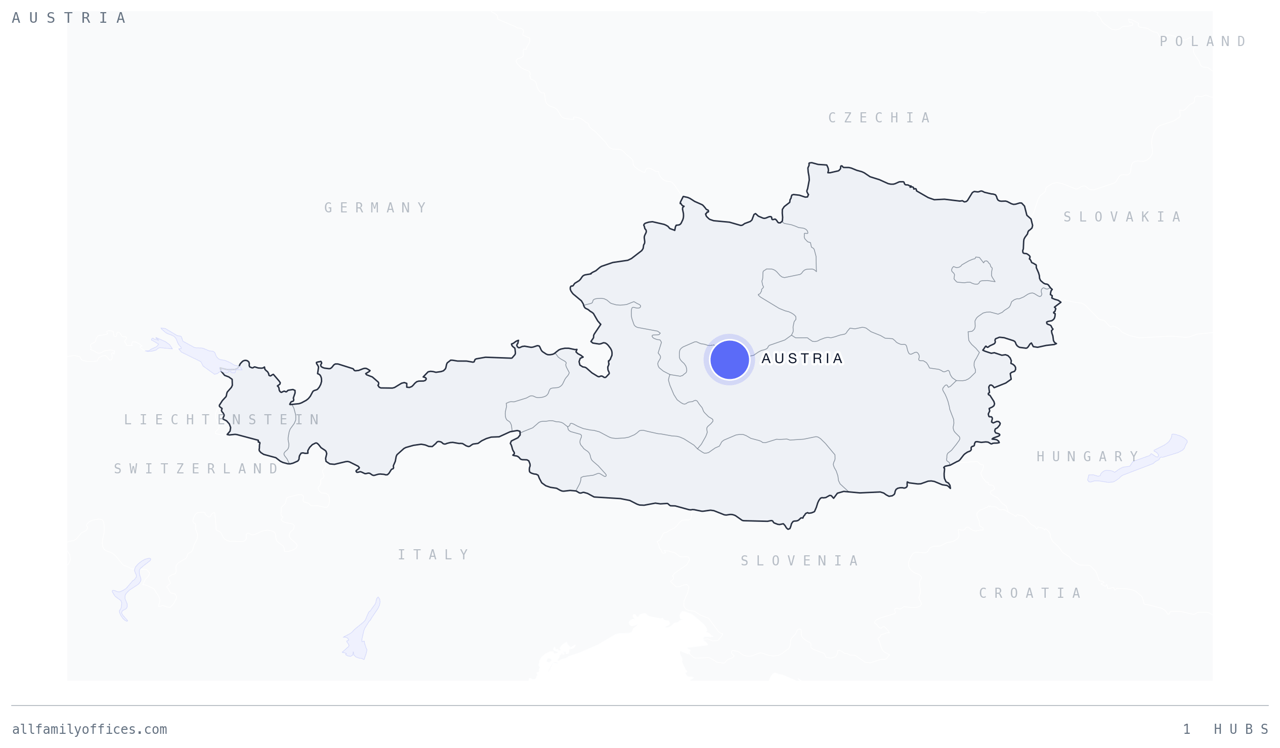
- Vienna serves as the primary hub, with secondary concentrations in Salzburg, Graz, Innsbruck, and Baden bei Wien.
- Industry researchers have identified roughly 40 of the largest SFOs and 10 of the largest MFOs.
- Real estate commands 59% of invested capital, nearly double the global average of 30%.
- A record 58% of all Austrian family office deals in 2024 carried a social or environmental impact component.
- Startup allocations reached 36% of total capital, having doubled since 2015.
Austrian Family Office Landscape Overview
Austria's family office market rests on a distinctive legal foundation: the Privatstiftung (private foundation). This ownerless entity, governed by the Austrian Private Foundation Act with a minimum capital of €70,000, functions as the primary wealth structuring vehicle for many of the country's wealthiest families. Specialist researchers track up to 200 Privatstiftungen with UHNW founders, making Austria's ecosystem unusually foundation-heavy compared to neighboring Switzerland or Germany.
The market is growing in both scale and ambition. Total capital deployment rose 51% year over year to $5.3 billion in 2024. A Deloitte study from the same year found that 70% of Austrian MFOs expect further growth in managed wealth (Vermögensverwaltung), and 40% plan new hires.
The shift toward fewer but larger deals signals a maturing market. Families now deploy capital with greater precision. Vienna dominates the landscape, hosting most major MFOs and SFOs. Secondary cities like Salzburg, Graz, and Innsbruck contribute smaller clusters, often tied to regional industrial families.
One critical detail for anyone navigating this market: "multi-family office" is not a protected term in Austria. No certification or license is required to use the designation. This means thorough due diligence on MFO operators is essential.
Family Office Comparison
The following table maps the Austrian wealth management firms with the most available profile data. Because most Austrian offices do not disclose assets under management, the AUM column reflects only the single confirmed figure in the dataset.
| Family Office | Type | AUM Estimate | Investment Focus | Services | Location |
|---|---|---|---|---|---|
| KRONOS Advisory | MFO | ~€600M | Wealth structuring, manager selection, risk management | Wealth structuring, asset controlling, family counselling, real estate | Vienna |
| Porsche-Piëch Privatstiftungen | SFO | — | Automotive (VW, Porsche AG), defense tech | Investment management | Austria/Germany |
| Weilburg Family Office | MFO | — | Strategic advisory, PE, wealth management | Advisory, PE (via Weilburg PE Partners), generational planning | Baden bei Wien |
| Schelhammer Capital Family Office | MFO | — | Portfolio management, core-satellite strategy | Tax optimization, succession planning, reporting | Vienna/Graz |
| Magenhouse (FTC Capital subsidiary) | MFO | — | Complex asset structuring, portfolio management | Business consulting, monitoring of financial providers | Vienna |
| Advantage Family Office | MFO | — | Investor networking, real estate | Investment conferences, consulting, investor platform | Vienna |
| Flick Privatstiftung | SFO | — | PE fund commitments, financial advisory | Investment management | Vienna |
| AMCS Private Trust | SFO | — | Long-term equity investments | Investment management | Vienna |
| AQTON SE | SFO | — | Auto, digital security, PV/smart grid | Direct investments | Austria/Germany |
| Lennertz & Co. | MFO | — | Wealth management, investment advisory | Full-service MFO (100+ employees, DACH offices) | Vienna |
KRONOS Advisory is the only office in the dataset with a disclosed AUM figure of roughly €600 million. Most Austrian private wealth offices, especially those structured as Privatstiftungen, operate with high discretion and do not publish asset figures.
Top Picks by Strategy
- Largest disclosed AUM: KRONOS Advisory, managing roughly €600 million with bank-independent wealth structuring and institutional-grade oversight.
- Best for Private Equity access: Weilburg Family Office, which launched a registered AIFM (Weilburg PE Partners) in 2022 and backed care platform HeldYn in 2024.
- Top Industrial Holdings: Porsche-Piëch Privatstiftungen, controlling 31.9% equity and 53.3% voting rights in Volkswagen plus a direct stake in Porsche AG.
- Strongest MFO platform by headcount: Lennertz & Co., operating with over 100 employees from offices in Vienna, Denkendorf, Munich, and Paderborn.
- Best for Investor Networking: Advantage Family Office, running Austria's first dedicated platform for family offices and institutional investors, including DACH-region conferences.
- Leading Bank-Affiliated MFO: Schelhammer Capital Family Office, combining core-satellite portfolio management with tax optimization from its Vienna and Graz offices.
- Best for Complex Asset Structuring: Magenhouse, a subsidiary of FTC Capital (founded 1995, licensed AIFM), specializing in strategic structuring of multi-layered family wealth.
Top 10 Family Offices in Austria in Detail
KRONOS Advisory
With roughly €600 million in managed assets, KRONOS Advisory operates as Vienna's most transparent MFO by disclosed scale. Its core proposition is bank independence: KRONOS selects and monitors external asset managers rather than running proprietary funds. Services span wealth structuring, risk management, and allocation oversight for families and Privatstiftungen alike. The firm also offers interim management and real estate expertise, making it a practical choice for families transitioning between generational leadership.
Porsche-Piëch Privatstiftungen
Few family wealth structures carry as much economic weight as the Privatstiftungen behind the Porsche and Piëch families. These foundations control 31.9% of Volkswagen's equity and 53.3% of its voting rights, plus a direct Porsche AG stake. In 2025, the family expanded into defense and dual-use technology.
The structure itself illustrates how Austrian foundation law can concentrate control without traditional share ownership. It separates family oversight from operational management entirely.
Weilburg Family Office
Austria's clearest example of an SFO-turned-MFO, this Baden bei Wien firm serves entrepreneurs, Privatstiftungen, and professional athletes. An entrepreneur family founded Weilburg in 2019 and opened its doors to external clients shortly after. The 2022 launch of Weilburg Private Equity Partners as a registered AIFM gave institutional and private investors structured access to PE deals. Its 2024 financing of HeldYn, a care platform, reflects the office's tilt toward impact-oriented direct investments.
Schelhammer Capital Family Office
Coordinated wealth management from Vienna and Graz defines Schelhammer Capital's value. The firm pairs bank-affiliated credibility with a core-satellite approach to portfolio allocation. Its service mix targets families needing coordinated management: portfolio reporting, tax optimization, succession planning (Nachfolgeplanung), and tendering of external mandates.
For families who prefer a single coordinator managing multiple specialist teams, Schelhammer reduces the friction of dealing with separate advisors for each wealth function.
Magenhouse
Institutional-grade oversight for private family wealth sets Magenhouse apart. As a subsidiary of FTC Capital, a licensed AIFM founded in 1995, this Vienna-based MFO focuses on strategic structuring of complex assets. That often means untangling holdings spanning real estate, operating companies, and financial portfolios.
Magenhouse monitors external financial service providers on behalf of its clients. This positions it as an independent check on banks and asset managers, rather than a competitor to them.
Advantage Family Office
A bridge between deal flow and family capital, Advantage fills a gap in Austria's private wealth ecosystem. The firm hosts conferences and investor lunches in the DACH region, connecting family offices with co-investment opportunities they might otherwise miss. For families or institutional allocators seeking partners in Austria, Advantage operates as both advisor and connector. It describes itself as Austria's first platform dedicated to family offices and institutional investors.
Flick Privatstiftung
PE fund commitments and financial advisory form the core of the Flick family's Vienna-based SFO. Wealth databases track Flick Privatstiftung globally, reflecting its position among Austria's established foundation-based offices. The structure exemplifies the classic Austrian model: a Privatstiftung serving as the legal and operational shell for family capital deployment. Specific holdings remain undisclosed, consistent with the high discretion typical of Austrian foundations.
AMCS Private Trust
Proceeds from Christian Planegger's sale of Ventrex Automotive in 2017 seeded this SFO. AMCS Private Trust targets equity allocations in regions and sectors with long-term growth potential. The trajectory is instructive: wealth generated from an industrial exit, redeployed into a broad equity strategy. For entrepreneurs planning a liquidity event, AMCS illustrates how Austrian SFOs can shift from single-asset concentration to diversified portfolio management.
AQTON SE
Stefan Quandt's vehicle spans automotive, digital security, and photovoltaic/smart grid sectors. AQTON operates as an SE (European company) with roots in both Austria and Germany, reflecting the cross-border nature of many DACH-region family offices. The Quandt family's broader wealth, anchored in BMW ownership, provides context for AQTON's sector choices: industrial technology with defensive characteristics.
GSK Advisory
International families seeking an Austrian base will find a practical entry point in GSK Advisory. The Vienna firm offers company and foundation formation in the EU alongside traditional family office services. Its network of lawyers, asset managers, and bank advisors makes it especially suited for non-Austrian families establishing a Privatstiftung or holding company. GSK bridges legal, financial, and personal advisory under one roof.
Investment Trends Shaping This Market
Real Estate Still Dominates, but the Mix Is Shifting
Austrian family offices allocate 59% of invested capital to real estate, nearly double the global average of 30%. Yet the aftermath of the Signa collapse has injected caution. Austrian counterparties now scrutinize leverage, disclosure, and recourse terms more carefully. Conservative deal structures and creditor-friendly covenants have become the baseline for real estate transactions involving offices like KRONOS Advisory and Schelhammer Capital.
Impact Allocations Hit Record Levels
In 2024, 58% of all Austrian family office deals carried a social or environmental impact component, the highest share on record. Healthcare, education, and energy projects attract most of this capital. Next-generation family members drive the shift. Weilburg's HeldYn financing and the broader growth of care-focused platforms reflect how Austrian wealth holders channel returns toward measurable ESG outcomes.
Startup Capital Doubles in a Decade
Austrian family offices invested $145 million in 16 startup deals in 2022 alone. The startup allocation share has reached 36%, having doubled since 2015. Hot sectors include SaaS, FinTech, AI, and telecommunications. This trend intersects with the European rearmament agenda, where dual-use technology draws fresh interest from firms like AQTON SE and defense-adjacent Privatstiftungen.
Fewer Deals, Larger Tickets
The Austrian market mirrors a global pattern: family offices concentrate capital into fewer, more targeted deals. Total deal value rose 51% from 2023 to 2024 while transaction counts declined. Families move away from scattered small bets and toward direct co-investment where they can exercise greater control. Advantage Family Office's networking platform reflects this shift, connecting offices seeking larger joint positions.
How to Evaluate a Family Office in Austria
Start with regulatory status. Because "multi-family office" is unprotected in Austria, any firm can claim the title. Check whether the MFO holds an AIFM registration (as Weilburg PE Partners does) or operates under a banking license (as Schelhammer Capital does). Unregulated operators are not inherently problematic, but the absence of licensing shifts due diligence entirely to the client.
Understand the Privatstiftung layer. Many Austrian firms operate through or alongside a Privatstiftung, where a foundation board holds decision-making power rather than shareholders. Before engaging with any Austrian office, clarify who approves allocations: the Stiftungsvorstand (foundation board), an operating company management team, or a family oversight body. The Porsche-Piëch structure, for example, separates family control from VW's operational leadership entirely.
Evaluate bank independence carefully. Austrian MFOs range from fully independent (KRONOS Advisory selects external managers without proprietary fund conflicts) to bank-affiliated (Schelhammer Capital coordinates specialist teams within a banking framework). Neither model is superior. However, fee-based advisory (Honorarberatung) eliminates commission-driven product placement. Ask explicitly how the office earns its revenue.
Assess cross-border capability against actual need. With 96% of Austrian family office capital staying within Europe, most offices orient toward European deals. Families needing non-European exposure may find limited in-house expertise. Verify whether the office partners with international networks (as GSK Advisory does) or relies solely on domestic deal flow.
Which Family Office Fits Your Needs?
UHNW families with €200 million or more in assets who want full operational independence should consider establishing a Privatstiftung with dedicated SFO management, following the model the Porsche-Piëch families or AMCS Private Trust use. Families below that threshold often find that a dedicated SFO's annual costs (typically €1 million or more) erode returns.
Business owners approaching a liquidity event can look to MFOs with PE expertise. Weilburg Family Office explicitly serves entrepreneurs and offers structured access to private equity through its AIFM subsidiary. Advantage Family Office provides networking with co-investment partners through its conference platform. This is valuable for founders who want to stay active as investors after selling an operating company.
Next-generation wealth holders drawn to impact and startups will find alignment with Austria's broader market direction: 58% impact deal share and a doubling of startup allocations since 2015. KRONOS Advisory and Magenhouse both offer the independent oversight that younger family members often prefer over bank-affiliated models. For international families considering an Austrian base, GSK Advisory and Dunaj FO specialize in Privatstiftung formation and cross-border structuring within EU frameworks.
Methodology
This family office österreich liste draws on publicly available data from industry studies analyzing over 100 Austrian family offices between 2014 and 2024, curated SFO and MFO databases tracking the 40 largest SFOs and 10 largest MFOs in Austria, and a dedicated Privatstiftung research database covering up to 200 foundations with UHNW founders. Individual office profiles were verified through corporate websites and institutional databases as of early 2026.
AUM figures appear only where publicly confirmed. Most Austrian offices do not disclose this data. This family office österreich liste focuses on offices with verifiable Austrian operations and excludes entities that merely list Austria as a secondary jurisdiction. Trend data reflects 2024 figures unless otherwise noted. Readers should verify current office details directly, as Austria's family office landscape evolves rapidly.
Frequently Asked Questions
 Google AI Mode
Tells Google to show you more from AllFamilyOffices in AI, Search and Discover.