On This Page
Key Facts
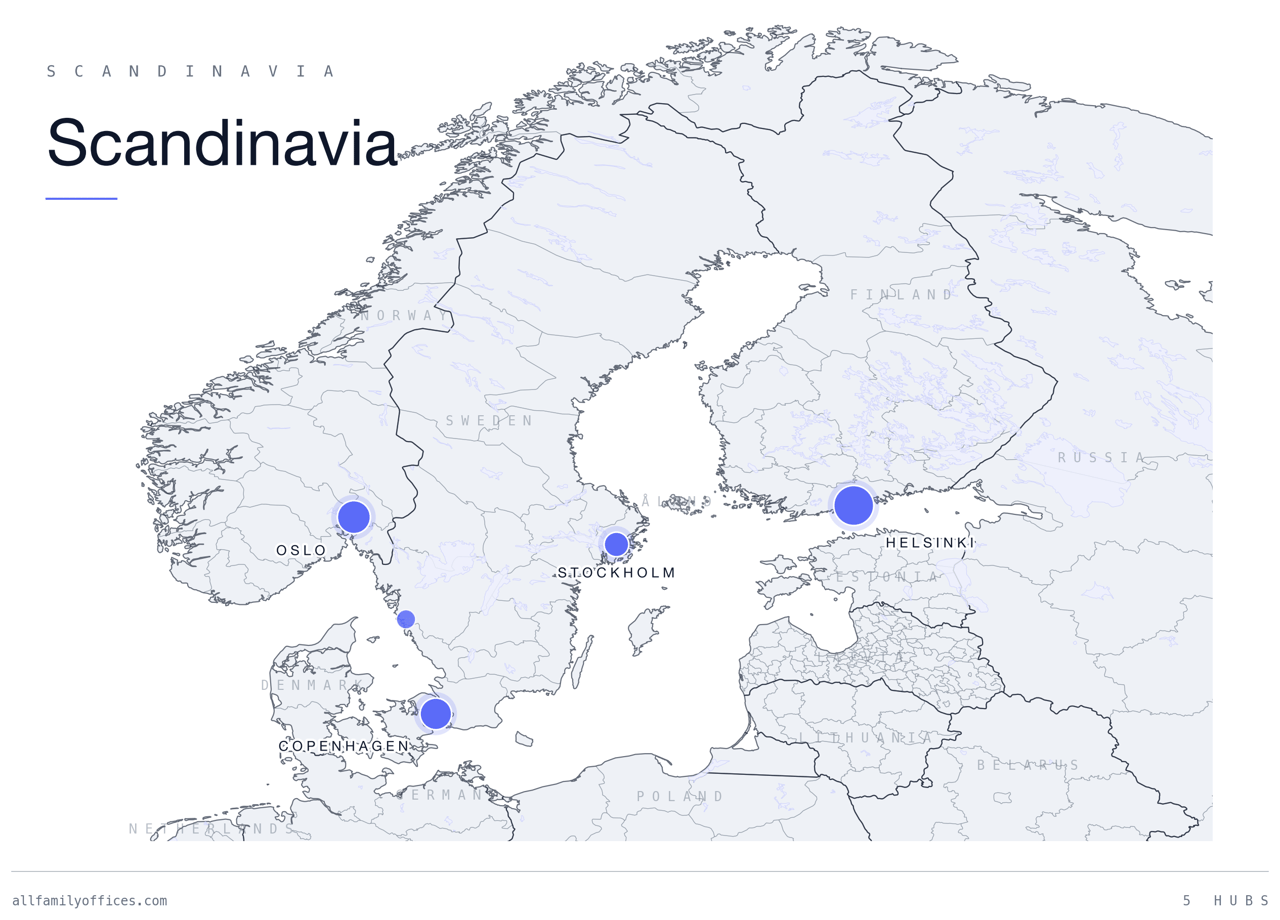
- The Nordic region hosts 163 single family offices (SFOs) that collectively manage over $720 billion in identifiable assets under management.
- Stockholm leads all Nordic cities with 36 tracked SFOs, followed by Helsinki with 23.
- Direct dealmaking by family offices reaccelerated 38% year-on-year in Q3–Q4 2025, with median deal size climbing to €47 million.
- At least 60 active direct investments or co-underwritten transactions closed since January 2024.
- Sweden dominates through listed holding companies like Investor AB and Kinnevik. Denmark leads in foundation-governed structures such as Novo Holdings and KIRKBI.
- Nordic offices span six structural types: SFO, multi-family office (MFO), listed holding company, foundation-governed arm, private holding company, and virtual family office.
Landscape Overview
The Nordic family office ecosystem represents one of Europe's most disciplined pools of long-term private capital. These investors built fortunes in shipping, retail, pharma, and gaming before becoming allocators. Unlike wealth management firms in London or Zurich, most Nordic offices deploy capital directly into companies they intend to own for decades.
Sweden anchors the region. The Wallenberg family controls roughly one-third of the Swedish stock exchange by market value through Investor AB and related entities. Stockholm hosts the greatest density of listed holding companies, including Kinnevik, L E Lundbergföretagen, and Nordstjernan.
Denmark houses maritime dynasties and foundation-governed structures capable of executing billion-dollar deals within three-week diligence windows. Norway contributes impact-oriented and consumer holding companies such as Ferd and Canica.
Finland has emerged as a hub for tech-entrepreneur wealth. Offices like Illusian (Supercell co-founder Ilkka Paananen) and First Fellow Partners (former Nokia chairman Risto Siilasmaa) deploy venture capital without LP constraints. Iceland has minimal family office presence in available data.
The MFO segment remains small. Nordic Family Office ApS in Copenhagen, regulated by the Danish Financial Supervisory Authority, is one of the few formal multi-family office providers. The vast majority of Nordic capital flows through SFOs, private holdings, and foundation-governed vehicles that function as their own funds.
Comparison at a Glance
The table below spans the full range of leading offices, from foundation-governed giants managing $100 billion to first-generation tech-entrepreneur vehicles backing seed-stage startups.
| Family Office | Type | AUM Estimate | Investment Focus | Location |
|---|---|---|---|---|
| Novo Holdings | Foundation-governed | $100B+ | Healthcare, biotech, life sciences | Copenhagen, Denmark |
| Investor AB | Listed holding (Wallenberg) | SEK 960B+ NAV | Industrial, AI, digital security, semiconductors | Stockholm, Sweden |
| A.P. Moller Holding | Holding company | $35B+ (family assets $116B) | Shipping, energy, logistics | Copenhagen, Denmark |
| L E Lundbergföretagen | Holding company (Lundberg) | SEK 140B NAV | Long-term industrial compounding | Stockholm, Sweden |
| KIRKBI A/S | SFO (LEGO family) | DKK 23B profit (2024) | Clean energy, renewables, gaming | Billund, Denmark |
| Ferd | Investment company (Andresen) | NOK 50.4B (~$8.5B) | Impact investing, climate tech, venture | Oslo, Norway |
| Nordstjernan | Listed holding | $2.7B PE assets | Enterprise apps, fintech | Stockholm, Sweden |
| Lars Larsen Group | Holding company (Brunsborg) | — | Private equity, forestland, retail | Denmark |
| Kinnevik | Listed holding (Stenbeck) | — | Digital healthcare, fintech, logistics | Stockholm, Sweden |
| Stena AB | Private holding (Olsson) | SEK 1.1B+ EBITDA | Shipping, logistics, real estate | Gothenburg, Sweden |
| Ramsbury Invest | SFO (Persson/H&M) | — | Retail consolidation, urban real estate | Stockholm, Sweden |
| Illusian | SFO (Paananen) | — | Venture capital, SaaS, AI | Helsinki, Finland |
Sweden and Denmark account for the majority of identifiable AUM. Foundation-governed and listed holding structures offer greater public transparency than private SFOs, many of which do not disclose asset figures.
Top Picks by Strategy
- Largest AUM: Novo Holdings, with $100B+ in assets governed by the Novo Nordisk Foundation, is the single largest Nordic family-controlled investment entity.
- Industrial Powerhouse: Investor AB's SEK 960B+ NAV vehicle executed seven private-market transactions in 2025 spanning digital security, AI compute, and semiconductors.
- Top Maritime & Logistics Allocator: A.P. Moller Holding privatized Svitzer at a 42.5% premium, then built cross-border logistics positions in Spain and the Philippines.
- Leading Impact Investor: Ferd operates six divisions including dedicated impact and social entrepreneur arms, a structure rarely seen at its $8.5B scale.
- Clean Energy Pioneer: KIRKBI channels LEGO profits into onshore wind, battery storage, and educational gaming, with two clean-energy deals closed in early 2025.
- Most Active Venture Office: Illusian completed 48 investments total, making it the most active Nordic venture investor in 2025.
- Rising Tech Seed Funder: First Fellow Partners, led by Risto Siilasmaa, backs seed-to-Series A SaaS and AI companies with exits including Wolt and Small Giant Games.
Leading Nordic Offices in Detail
Novo Holdings
No other Nordic office matches Novo Holdings for deal-making scale. The foundation-governed arm of the Novo Nordisk Foundation manages over $100 billion and deploys capital at a pace that rivals sovereign wealth funds.
Its $16.5 billion Catalent deal in 2024 ranked among the largest family-driven transactions in European history. In 2025, Novo Holdings launched a €600 million bioprocessing joint venture in Belgium and backed an AI-enabled clinical trial firm in Germany. UHNW families and institutional allocators seeking co-investment in healthcare and biotech find Novo Holdings among the most relevant partners.
Investor AB
Digital sovereignty has replaced industrial stewardship as the Wallenberg family's central thesis. With a net asset value exceeding SEK 960 billion, Investor AB closed seven private-market transactions in 2025. These focused on digital security, AI compute, and semiconductor supply chains.
Its AI Factory initiative, co-developed with domestic OEMs and global chip makers, now anchors Sweden's digital-sovereignty strategy. Fifth-generation leadership under Peter Wallenberg Jr. maintains a 105-year tradition of long-term ownership with active board seats in portfolio companies.
A.P. Moller Holding
Maritime capital deployment at this scale exists nowhere else in Europe. The Møller family's consolidated assets exceed $116 billion. A.P. Moller Holding directly manages over $35 billion.
The 2025 Svitzer privatization offered DKK 285 per share at a 42.5% premium, consolidating control over 456 vessels in 141 ports. That same year, A.P. Moller committed $100 million to C2X green methanol production with Maersk and ENEOS. The firm also acquired 51% of Spain's Bergé and launched a maritime digital-operations joint venture with a Singapore AI firm.
KIRKBI A/S
Clean energy at industrial scale defines the LEGO family's wealth strategy. KIRKBI generated DKK 23 billion in profit before tax in 2024 and entered 2025 with record cash.
Two clean-energy deals followed: a German onshore wind purchase and a UK battery storage position, both managed through KIRKBI Energy. A minority round in an educational gaming startup continued the family's dual thesis of sustainability and play-based learning. This combination of wealth preservation through renewables and values-aligned capital makes KIRKBI a model for families converting consumer brand profits into long-duration energy assets.
Ferd
Six dedicated divisions, including impact and social entrepreneur arms, make Ferd the most structurally committed ESG investor in the Nordics. The Andresen family manages NOK 50.4 billion (roughly $8.5B) and treats measurable social returns as core to every allocation.
In 2025, Ferd backed Nofence's €30 million Series B for GPS virtual livestock fencing, Europe's largest agtech round that year. It also participated in a $40 million Series B for an Oslo battery-materials firm and seeded Kvist Solutions for construction sustainability reporting. Families seeking capital that embeds ESG metrics into return targets should study Ferd's structure closely.
Kinnevik
Growth-stage digital healthcare separates Kinnevik from most Nordic wealth platforms, which favor industrial and energy assets. The Stenbeck family's listed holding company closed five portfolio expansions and two exits in the first half of 2025.
A Series C round for a Finnish telemedicine platform and a secondary exit of a logistics SaaS provider valued above €400 million reflect its thesis-driven approach. Kinnevik's shift from consumer internet pioneer to disciplined growth vehicle shows how family oversight can enable reinvention without losing focus.
Illusian
Gaming wealth turned venture capital is reshaping Helsinki's startup ecosystem. Supercell co-founder Ilkka Paananen's private wealth office has built a portfolio of 48 investments, making it the most active Nordic venture investor in 2025.
Recent deals include a €14 million Series A in Riff (enterprise vibe coding) and a Series B in Vibe.co (business productivity software). The operational team draws on alumni from Wolt and Aiven. Tech entrepreneurs with global scaling ambitions get a peer investor who understands founder dynamics firsthand.
First Fellow Partners
Nokia alumni networks and a track record of global exits give First Fellow Partners an edge that pure financial investors cannot replicate. Former Nokia chairman and F-Secure founder Risto Siilasmaa runs the SFO without LP constraints, focusing on seed-to-early-stage SaaS and AI companies.
In 2025, First Fellow led an $8.3 million Series A for IXI, participated in Inven's €11.2 million Series A, and committed to a €15 million seed round for Donut Lab. Its exit record includes Wolt, Small Giant Games, and Detectify. Portfolio companies gain enterprise sales channels and technical mentorship from the Nokia network.
Lars Larsen Group
A DKK 7.5 billion commitment to IIP Denmark in April 2025 signaled the JYSK furniture dynasty's pivot from retail to asset management. The Brunsborg family's allocation included a 25% stake and fund commitment through 2032. It ranked among the largest single capital moves by any Nordic family that year.
A €67 million joint venture with Dalgas for Baltic forestland in Estonia, Latvia, and Lithuania added real assets to the portfolio. The group is reorganizing into "JYSK + Investments" for FY26, marking a generational transition from retail operations to diversified private equity and natural resources.
Stena AB
Green fleet conversion and near-perfect property occupancy define Stena's operational endurance. The Olsson family's privately held conglomerate approved five new vessel retrofits under its Green Fleet program in 2025 and committed €120 million to logistics automation in its freight division.
Real estate occupancy held at 98%, a remarkable figure in a year when most European property portfolios contracted. Operational EBITDA climbed past SEK 1.1 billion. For counterparties seeking long-term industrial partnerships, Stena's track record of real assets and real profits offers proof over projection.
Trends Shaping Nordic Family Capital
Defense Tech and Industrial Sovereignty
Sweden's NATO accession and Finland's integration have opened a new corridor for capital deployment. At least 11 Nordic families, including Wallenberg, Lundberg, and Møller, screen for dual-use themes such as autonomous systems and encrypted communications. Investor AB's seven private-market deals in 2025 included digital security and semiconductor positions linked to its AI Factory initiative.
Direct Deals and Co-Investment Acceleration
Nordic direct dealmaking rose 38% year-on-year in Q3–Q4 2025 versus 2024. Median deal size reached €47 million. Roughly 40% of 2025 deals originated from live signals (corporate restructurings, executive moves, family-controlled spinouts) rather than banker-led auctions. This shift toward intelligence-driven sourcing favors offices with in-house deal origination, such as Novo Holdings and A.P. Moller Holding.
Healthcare Manufacturing and Biotech
Novo Holdings' $16.5 billion Catalent deal catalyzed a broader Nordic push into healthcare production capacity. Its €600 million Belgian bioprocessing joint venture and co-investments in metabolic disease funds reflect a thesis that biologics manufacturing is a strategic asset. Kinnevik reinforced this trend with a Finnish telemedicine Series C.
Green Logistics and Maritime Decarbonization
Stena's Green Fleet retrofits and A.P. Moller's $100 million green methanol commitment represent the largest privately financed maritime sustainability projects in Europe. Canica added two direct allocations in logistics automation and packaging sustainability. These offices finance the green transition that most European capital merely discusses.
Venture Capital from Family Wealth
Finnish tech-entrepreneur offices deploy capital at seed and Series A stages without institutional LP constraints. Illusian's 48 investments and First Fellow Partners' exits from Wolt and Detectify prove that first-generation wealth can compete with established venture firms on deal quality and founder access.
How to Evaluate a Nordic Family Office
Operational mastery matters more than financial engineering in this market. Nordic families are operators first and allocators second. When assessing a potential partner, evaluate their industrial track record, cost discipline, and oversight clarity before examining AUM figures. Ferd and Stena both take board seats and bring hands-on expertise to portfolio companies.
Structure directly affects deal speed. Foundation-governed offices like Novo Holdings and KIRKBI can execute in three-week diligence windows when strategic fit is strong. Listed holdings like Investor AB and Kinnevik offer more transparency but move within public-market disclosure constraints. Private holding companies such as A.P. Moller Holding and Canica combine discretion with operational control.
Data precision separates Nordic offices from most global peers. These investors demand traction metrics, not projections. The fact that 40% of 2025 deals came from live intelligence signals rather than pitch decks reflects a culture that prizes evidence over narrative. Fund managers approaching Nordic capital should lead with verifiable operational data.
Country-specific regulation also shapes the landscape. Danish MFOs like Nordic Family Office ApS operate under Financial Supervisory Authority oversight. Swedish listed holdings follow Nasdaq Stockholm rules. Norwegian private holdings have fewer disclosure requirements. Understanding these differences helps families and allocators match their own expectations to the right structure.
Which Family Office Fits Your Needs?
Ultra-high-net-worth families focused on wealth preservation over multiple generations should study the foundation-governed and long-term compounding models. Novo Holdings and L E Lundbergföretagen both show how patient capital, combined with minimal leverage, compounds wealth steadily. KIRKBI's transition from LEGO profits to renewable energy assets offers a blueprint for families converting business income into durable, inflation-protected holdings. Family governance and succession planning benefit from studying how these structures separate operational control from beneficial ownership.
Business owners seeking operational partners will find Ferd and Canica most aligned. Two-thirds of new Nordic family capital deployments in 2025 involved operational partnerships rather than passive stakes. Both offices take board seats, contribute industrial expertise, and commit capital in structures that reward long-term value creation. A.P. Moller Holding and Investor AB offer co-investment frameworks for institutional allocators targeting defense tech, logistics, and healthcare at scale.
Next-generation wealth holders and tech entrepreneurs should look to Helsinki. Illusian and First Fellow Partners invest without LP constraints, understand founder dynamics from personal experience, and offer networks from Supercell, Nokia, Wolt, and Aiven. Impact-oriented families seeking ESG as a core strategy, not a compliance layer, will find Ferd's dedicated social entrepreneur division and KIRKBI's sustainability focus the strongest models in the region.
Methodology
This guide draws on public filings, wealth databases, market research platforms, and family office summit reports. Office selection prioritized entities with identifiable assets, active deal flow since January 2024, and verifiable focus areas.
Offices appear ranked by managed assets where figures were available, supplemented by deal activity, sector coverage, and oversight quality. AUM figures use original currencies (USD, SEK, NOK, DKK) to avoid conversion distortions. Information reflects conditions as of Q1 2026, with deal data covering 2024–2025. Only offices appearing in verified data sources earned inclusion; no offices were added from editorial judgment alone.