On This Page
- Key Facts About Munich's Family Office Market
- Munich's Family Office Landscape
- Family Office Comparison at a Glance
- Top Picks by Strategy
- Leading Munich Wealth Offices in Detail
- Trends Shaping Munich's Private Wealth Market
- How to Evaluate a Family Office in Munich
- Which Family Office Fits Your Needs?
- Methodology
- Frequently Asked Questions
Key Facts About Munich's Family Office Market
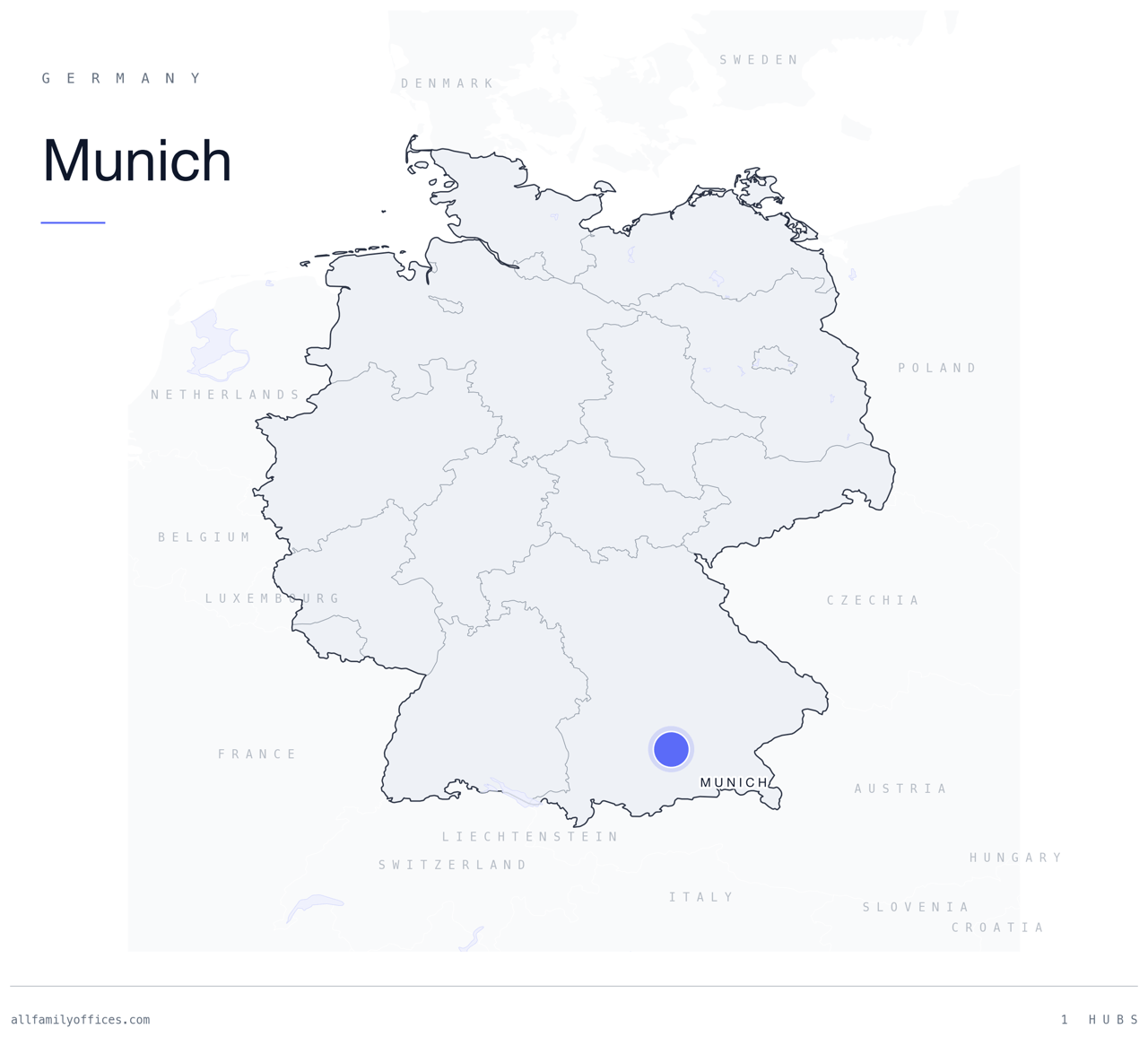
- The AllFamilyOffices database lists 50+ family offices headquartered in Munich (October 2026). The city ranks as one of Germany's top three hubs alongside Frankfurt and Hamburg.
- Athos Service GmbH, the Strüngmann family's single family office (SFO), holds the largest known position. Their BioNTech stake alone exceeded $12.7 billion in value as of late 2020.
- ATON GmbH operates a portfolio generating roughly €2 billion in annual revenue. Its companies employ 17,300 people in engineering, mining, and medtech.
- The market splits roughly 60/40 between SFOs and multi-family offices (MFOs). SFOs dominate due to Bavaria's deep industrial and entrepreneurial wealth.
- An estimated 89% of German family offices hold direct stakes in companies. Munich offices show strength in biotech, engineering, and real estate.
- Grünwald, a suburb south of the city, serves as a popular registration hub for offices seeking favorable local conditions.
- Rising interest rates drive asset allocation shifts. Munich offices increasingly focus on direct private equity and ESG strategies.
Munich's Family Office Landscape
Munich's family office ecosystem draws its strength from Bavaria's industrial dynasties and a deep tradition of Mittelstand entrepreneurship. Families behind companies in engineering, pharmaceuticals, and technology have built SFOs to manage generational wealth. A growing number of MFOs serve ultra-high-net-worth (UHNW) clients from the broader DACH region.
The city ranks behind Frankfurt in total assets under management (AUM) but leads in SFOs with roots in biotech, industrial manufacturing, and venture capital. The geographic footprint extends beyond the city center into Grünwald, a wealthy suburb favored for family office registration. Reimann Investors is based in Grünwald, reflecting the suburb's appeal for privacy-minded wealth managers.
Professionalization is accelerating. Industry research found that nearly all German family offices plan to realign their allocations in response to macro shifts. Munich offices adopt digital reporting tools, institutional-grade oversight, and formal ESG frameworks. Legacy SFOs managing decades-old industrial wealth now coexist with newer MFOs offering structured, tech-enabled services to external families.
Family Office Comparison at a Glance
The table below compares Munich's leading family offices by type, disclosed AUM, and core focus areas.
| Family Office | Type | AUM Estimate | Investment Focus | Key Services | Location |
|---|---|---|---|---|---|
| Athos Service GmbH | SFO | $12.7B+ (BioNTech stake) | Biotech, life sciences | Direct investment | Munich |
| ATON GmbH | SFO | ~€2B (portfolio revenue) | Engineering, mining, medtech, aviation | Industrial portfolio management | Munich |
| Pamera Real Estate | MFO | €850M | Portfolio properties, project development, mezzanine | Real estate investment management | Munich |
| FORUM Family Office | SFO | — | Software, healthcare, water, industrial services | Long-term direct investments | Munich |
| Extorel GmbH | SFO | — | Venture capital, private equity, liquid assets | VC and PE investing, charitable giving | Munich |
| Reimann Investors | SFO/MFO hybrid | — | Digital commerce, fintech, SaaS, ETFs | Corporate and passive investing | Grünwald |
| WEGA Invest GmbH | SFO | — | PE, equities, fixed income, real estate, gold | Endowment-style allocation | Munich |
| Madaus Capital Partners | MFO | — | Direct investments, club deals | Asset structuring, deal sourcing | Munich |
| Spudy Family Office | MFO | — | Risk management, real estate | Full-service wealth management | Munich |
| LEO Familienholding | SFO | — | SMEs with €10–50M revenue | Active SME investing | Munich |
| HRK Family Office | MFO | — | Real estate, corporate, art investments | Foundation management, advisory | Munich |
| PSP München | MFO | — | Full wealth management | Asset controlling, reporting, filing | Munich |
Most Munich SFOs do not disclose AUM publicly. Athos, ATON, and Pamera stand out as the only offices with confirmed figures. Capital deployment spans a wide spectrum, from Pamera's pure real estate model to Reimann Investors' digital-sector bets and WEGA Invest's endowment-style broad mix.
Top Picks by Strategy
- Largest Portfolio by Value: Athos Service GmbH, whose 50.3% BioNTech controlling stake exceeded $12.7 billion, making the Strüngmann brothers Munich's dominant family office force.
- Most Active Industrial Investor: ATON GmbH, with a portfolio spanning 17,300 employees and €2 billion in revenue in engineering, mining, and medtech.
- Top Real Estate Allocator: Pamera Real Estate, managing €850 million in assets focused solely on portfolio properties, project development, and mezzanine capital.
- Leading Club Deal Platform: Madaus Capital Partners, which sources roughly three direct deals per year and has completed 11 exits from a portfolio of 14 companies.
- Strongest Venture Capital Legacy: Extorel GmbH, the Strascheg family office with decades of VC and private equity activity, including early-stage tech and cleantech deals.
- Best Endowment-Style Model: WEGA Invest GmbH, applying a US university endowment framework that splits capital among PE (25%), equities (20%), absolute return (20%), fixed income (15%), real estate (15%), and gold (5%).
- Top Pick for SME Succession Deals: LEO Familienholding, targeting companies with €10–50 million in annual revenue and actively building a portfolio of Mittelstand businesses.
Leading Munich Wealth Offices in Detail
Athos Service GmbH
The Strüngmann brothers' SFO holds the single most valuable position of any private wealth office in Munich. Their 50.3% controlling stake in BioNTech, the developer of the first authorized COVID-19 vaccine, exceeded $12.7 billion in late 2020. BioNTech's stock surged 499% in 12 months and boosted German GDP by an estimated 0.5%.
Beyond BioNTech, Athos focuses on early-stage science ventures in biotech and life sciences. The office does not accept external clients and operates with extreme discretion. Thomas Strüngmann has described the BioNTech partnership as "a dream come true," reflecting a philosophy where patient capital in breakthrough science yields both commercial and societal returns.
ATON GmbH
The Helmig family's SFO operates more like a diversified industrial conglomerate than a traditional wealth manager. ATON's portfolio companies collectively generate €2 billion in revenue and employ 17,300 people in engineering, mining, medtech, aviation, and digital services. The office actively acquires companies; it purchased Antriebssysteme Faurndau GmbH in July 2021.
UHNW families with complex industrial holdings can study ATON as a model for how an SFO can serve as both an operating holding and a wealth preservation tool. The digital services division is a recent addition, reflecting a broader shift among Munich SFOs toward tech-adjacent allocations.
Pamera Real Estate
Munich's dominant real estate-focused MFO manages €850 million in assets, making it the city's largest multi-family office by disclosed AUM. Pamera invests in portfolio properties, project developments, and mezzanine capital. A notable deal involved a combined office and logistics property in Augsburg totaling 22,000 square meters.
Families seeking concentrated real estate exposure will find Pamera's model distinctive. It offers a dedicated platform rather than a generalist wealth manager with a real estate sleeve. The office covers the full lifecycle from acquisition through development to asset management.
FORUM Family Office
FORUM has built a portfolio of 26 companies, each generating between €2 million and €28 million in revenue. Combined headcount exceeds 1,000 employees. The office targets businesses with recurring or subscription-based revenue in software, healthcare, water management, and industrial services.
Twelve of its 26 portfolio companies rank first or second in profitability within their respective industries. FORUM has managed family assets since 1990, giving it one of the longest track records among Munich's SFOs. Business owners with stable, cash-generating companies in these sectors represent its ideal targets.
Extorel GmbH
The Strascheg family office carries one of Munich's deepest venture capital legacies. Falk F. Strascheg built and sold a laser technology company in the 1970s, then established and later sold a VC firm to 3i. Extorel now invests in corporate holdings, private equity, and liquid assets, with focus on semiconductor, IT, and cleantech ventures.
The office also funds the Strascheg Center for Entrepreneurship and the Renate and Falk Strascheg Foundation. This dual role as investor and patron makes Extorel unusual among Munich SFOs, combining financial returns with systematic support for entrepreneurial ecosystems.
Reimann Investors
Reimann Investors bridges old-economy family wealth and modern tech capital deployment as a hybrid SFO/MFO in Grünwald. The Reimann-Dubbers branch of the Reimann family exited their chemical company holdings in the late 1990s and established this office. The portfolio blends passive ETFs and individual stocks with direct corporate holdings in digital commerce, fintech, and SaaS.
Portfolio companies include Spendit, usercentrics, and Klarna (via the sale of Sofortüberweisung). Next-generation wealth holders who prefer tech-forward, digitally oriented strategies will find Reimann's hybrid model relevant.
Madaus Capital Partners
Madaus distinguishes itself through hands-on direct investing alongside classic wealth management services. While many MFOs outsource deal sourcing, Madaus runs its own pipeline and completes roughly three deals per year.
The current portfolio includes 14 companies, with 11 exits already achieved. Families interested in co-investing alongside other UHNW clients through club deals on a deal-by-deal basis can tap its origination capabilities. The office also provides asset structuring, consolidation, and controlling services.
WEGA Invest GmbH
WEGA Invest applies a US university endowment model rare among Munich's private wealth offices. The Wendeln family sold their industrial bakery business in 2000 and relocated their SFO to Munich. The allocation splits into private equity (25%), equities (20%), absolute return (20%), fixed income (15%), real estate (15%), and gold (5%).
This disciplined, multi-asset framework prioritizes long-term wealth preservation over concentrated bets. It stands as a Munich example of systematic, rules-based allocation more commonly associated with American institutional investors.
Spudy Family Office
Spudy Family Office ranks among Munich's most established MFOs, offering structured client onboarding that most SFOs lack. Jens Spudy founded Spudy & Co. in 1994 as one of Germany's first multi-family offices. The current entity combines wealth management services, risk management, and real estate advisory.
For families seeking a full-service MFO with formal engagement paths and decades of credibility, Spudy provides one of the city's most proven platforms.
LEO Familienholding GmbH
Several Munich entrepreneurial families pool their capital through LEO Familienholding, which focuses on active SME investing. The target range is companies generating €10 to €50 million in annual sales. LEO acquired FTA Film- und Theaterausstattung through its portfolio company Cine-Mobil Holding in 2021.
This buy-and-build approach shows how pooled family capital can target Mittelstand succession opportunities. Entrepreneurs considering a transition from operator to investor can study LEO's model closely.
Trends Shaping Munich's Private Wealth Market
Direct Allocations in Mittelstand Companies
An estimated 89% of German family offices invest directly in companies. Munich offices rank among the most active. ATON, LEO Familienholding, and Madaus Capital Partners all target small and mid-sized firms with sub-€20 million turnover.
Bavaria's dense Mittelstand fabric, with thousands of owner-operated industrial firms approaching generational transitions, creates a steady pipeline of succession deals. These Munich offices benefit from proximity and deep local networks.
Biotech and Life Sciences Capital
The Strüngmann family's BioNTech bet demonstrated what concentrated biotech allocation can yield. Munich's proximity to major research hospitals and the Technical University of Munich feeds a growing appetite for early-stage life sciences deals.
Athos Service GmbH remains the dominant force in this space. Smaller offices are beginning to explore biotech co-investment alongside institutional funds, building on Munich's strength as a life sciences cluster.
Real Estate Reallocation
Rising interest rates have prompted Munich wealth offices to revisit real estate weightings. Pamera Real Estate continues to deploy capital in office and logistics properties, including a 22,000 square meter deal in Augsburg. WEGA Invest allocates 15% to real estate within its endowment model. The shift favors income-producing commercial assets over speculative residential development.
ESG and Impact Adoption
Among German family offices, 56% now consider resource scarcity when selecting portfolio holdings. Another 47% track carbon footprint and water consumption. Roughly half view impact allocations as important or very important.
Munich offices integrate these criteria into existing portfolios rather than creating separate impact vehicles. This pragmatic approach reflects the city's industrial heritage, where families prefer measurable outcomes over symbolic gestures.
Early-Stage Tech and Venture Co-Investments
Vimajo Family Office, run by the Stengel family, invests an average of $3.3 million per early-stage round in German tech startups such as Kini, CareerOS, and Filu. Extorel maintains its VC legacy in semiconductor and cleantech. Reimann Investors backs digital commerce and fintech companies.
These offices build Munich's reputation as a credible source of family-backed venture capital in the DACH region, competing with Berlin's more visible startup ecosystem.
How to Evaluate a Family Office in Munich
The most important first step is determining which offices accept new clients. SFOs like Athos and ATON do not take external families. MFOs such as Spudy, HRK, and PSP München offer structured onboarding, making them accessible starting points.
Third-party ratings provide a useful shortcut in Munich's opaque market. HRK Family Office earns a "summa cum laude" rating year after year in the Handelsblatt Elite Report. Vermögenskultur AG holds a five-star rating from Capital magazine, based on a review of more than 16,000 portfolios. These assessments carry weight because most Munich offices do not publicly disclose performance data.
Sector expertise should match the source of your wealth. A family with industrial holdings will find more relevant advice at ATON or FORUM than at a generalist MFO. Biotech entrepreneurs should examine how Athos structured its BioNTech position. Real estate families belong with Pamera, not a broad-mix shop.
Digital reporting quality varies sharply among Munich offices. PSP München offers a digital filing cabinet with daily reporting and real-time asset controlling. Other firms still rely on quarterly PDF reports. For families managing complex, multi-asset portfolios, this service gap matters.
Fee structures in Munich MFOs range from flat retainers to AUM-based fees with performance overlays. Madaus Capital Partners charges on a deal-by-deal basis for club deal sourcing, a different model from Spudy's full-service fee. Comparing these structures requires requesting detailed fee schedules, as most offices do not publish pricing.
Which Family Office Fits Your Needs?
UHNW industrial families managing complex operating portfolios can study ATON and Athos as models for how Munich SFOs handle large-scale, concentrated holdings. Families with comparable structures should consider building a dedicated SFO. They could also engage Fides Family Office for guidance on portfolio construction, family governance, and succession planning.
Business owners approaching a liquidity event or generational transition will find relevant templates in LEO Familienholding and FORUM Family Office. Both specialize in acquiring and operating SMEs with recurring revenue. Entrepreneurs shifting from operator to investor will find natural partners in either firm. Madaus Capital Partners offers an alternative path through club deals, letting families co-invest alongside other wealthy families without building full in-house sourcing.
Families seeking broad MFO services, including asset controlling, wealth reporting, and foundation consulting, should evaluate PSP München, Vermögenskultur, and Spudy Family Office. Each offers a wide service platform, but they differ in focus. PSP leads in digital reporting, Vermögenskultur in rated portfolio management, and Spudy in risk management. Real estate-focused allocators have a clear choice in Pamera's dedicated €850 million platform.
Methodology
This guide covers family offices in Munich's metro area, including the Grünwald suburb. Office data draws from multiple wealth databases, industry directories, and public deal records. Ratings and rankings were cross-referenced with the Handelsblatt Elite Report and Capital magazine assessments.
AUM figures appear only where publicly available or confirmed through reporting. Many Munich SFOs do not disclose assets, reflecting the privacy norms of German family offices. Deal activity reflects 2023 to 2025 reporting periods. Market-level statistics on allocation trends and ESG adoption come from a 2023 academic study of the German family office sector.
Frequently Asked Questions
 Google AI Mode
Tells Google to show you more from AllFamilyOffices in AI, Search and Discover.