On This Page
- Key Facts
- Krefeld Family Office: Landscape Overview
- Family Office Comparison at a Glance
- Top Picks by Strategy
- Top Family Offices in Detail
- Investment Trends Shaping Luxury Dynasty Offices
- How to Evaluate a Luxury Dynasty Family Office
- Which Family Office Fits Your Needs?
- Methodology
- Frequently Asked Questions
Key Facts
- Krefeld Invest is the consolidated single family office (SFO) of the Hermès dynasty. The family formed it in 2022 by merging eight separate investment vehicles into one Paris-based entity.
- The office raised its authorized capital to €1 billion. Company statutes restrict share ownership exclusively to descendants of Émile-Maurice Hermès.
- More than 100 Hermès heirs hold a combined fortune of $186 billion, making them the wealthiest family in Europe.
- Dividend income from Hermès International totalled €5.1 billion over the past four years, giving Krefeld a deep pool for new capital deployment.
- Breithorn Holding launched in 2025 as a dedicated fund and asset management subsidiary, led by the same CEO.
- Known deals include French insurer Albingia (part of a consortium buying Eurazeo's 70% stake for €289 million) and a minority stake in Anjac Health & Beauty alongside KKR.
- Despite the name, Krefeld Invest operates from Paris, not from the German city of Krefeld.
Krefeld Family Office: Landscape Overview
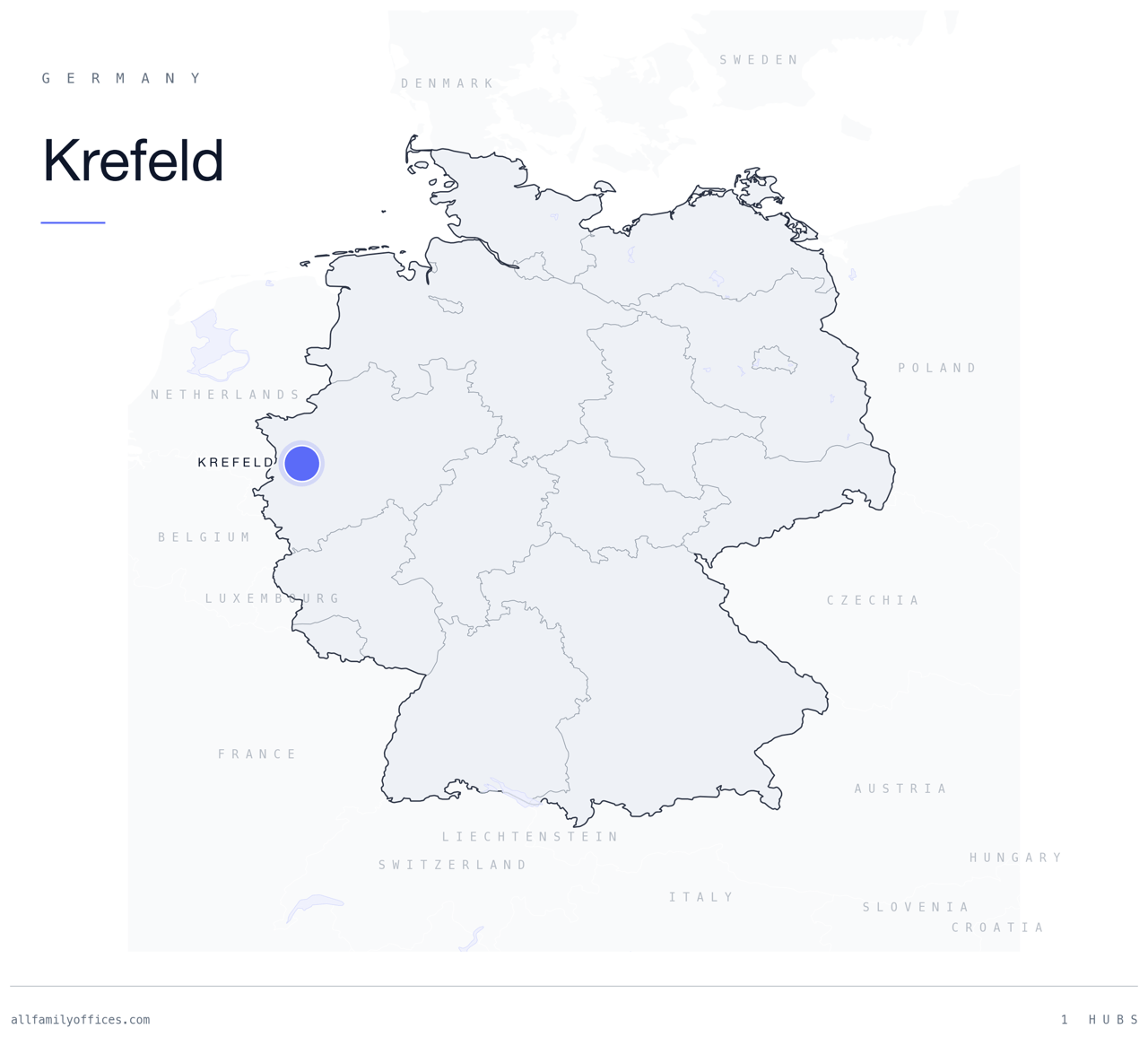
The term "krefeld family office" most commonly refers to Krefeld Invest, the Hermès dynasty's consolidated SFO based in Paris. The name honours Krefeld, the German city where Hermès founder Thierry Hermès was born, but the office itself operates from the French capital. A separate entity called Allegro Invest is an actual single family office in Krefeld, Germany, with a focus on direct investments in Germany, the US, and Asia.
Krefeld Invest emerged from a specific catalyst. After Bernard Arnault's 2010 attempted takeover of Hermès International through LVMH, the family's six branches consolidated eight vehicles into one entity. The branches (Bauer, de Seynes, Guerrand, Mommeja, Puech, and Dumas) sought unified wealth management and a stronger oversight structure to protect their roughly 67% stake in the luxury group.
This consolidation placed Krefeld alongside a tight circle of French luxury dynasty offices. Téthys Invest manages the Bettencourt Meyers fortune derived from L'Oréal. Mousse Partners oversees the Wertheimer brothers' Chanel wealth. Groupe Artémis controls the Pinault family's €28 billion portfolio anchored by Kering.
Paris dominates as the hub for these offices. Europe overall hosts more than 2,000 SFOs that account for nearly one-third of all global family office direct deals. Unlike multi-family office platforms that serve multiple clients, these dynasty vehicles manage wealth for a single lineage.
Family Office Comparison at a Glance
The table below compares leading European luxury dynasty wealth management firms by structure, scale, and focus. Only verified figures from public filings or financial intelligence sources appear.
| Family Office | Family Dynasty | Type | AUM Estimate | Investment Focus | Location |
|---|---|---|---|---|---|
| COFRA Holding AG | Brenninkmeijer | SFO | €35B+ total assets | PE (Bregal), real estate, renewables | Zug |
| Exor N.V. | Agnelli | SFO | $29B NAV | Ferrari, Louboutin, reinsurance | Amsterdam |
| Groupe Artémis | Pinault | SFO | €28B portfolio | Kering, Christie's, Puma, CAA | Paris |
| Compagnie Financière Rupert | Rupert | SFO | $12B+ fortune | Richemont (Cartier, Van Cleef) | Geneva |
| Krefeld Invest | Hermès | SFO (consolidated) | €1B authorized capital | Insurance, health/beauty, fund mgmt | Paris |
| Téthys Invest | Bettencourt Meyers | SFO | — | L'Oréal holdings, diversified | Paris |
| Mousse Partners | Wertheimer | SFO | — | Chanel holdings, diversified | Paris |
| Allegro Invest | — | SFO | — | Direct investments, PE | Krefeld, Germany |
COFRA and Exor lead on verified scale. Krefeld Invest's €1 billion authorized capital represents the family's stated investment ceiling, not total assets under management. The underlying Hermès stake alone supports a $186 billion family fortune.
Top Picks by Strategy
- Largest Portfolio Value: Exor N.V., with $29 billion in net asset value spanning Ferrari, Christian Louboutin, Stellantis, and reinsurer PartnerRe.
- Most Diversified Platform: COFRA Holding AG manages €35 billion in total assets through its Bregal private equity arm (€19 billion in managed assets), Redevco real estate, and Sunrock renewables.
- Leading Luxury Consolidator: Groupe Artémis controls a €28 billion portfolio anchored by a 42.3% stake in Kering, full ownership of Christie's, and a 29% stake in Puma.
- Best for Co-Investment Access: Krefeld Invest partnered with KKR on the Anjac Health & Beauty minority stake and joined Fairfax Financial Holdings in the Albingia consortium.
- Strongest Watchmaking Dynasty: Hayek Family Estate holds 44% voting rights in Swatch Group, overseeing 18 brands from Harry Winston to Tissot, with active share buybacks totalling CHF 11 million in 2024.
- Top Real Estate Allocator: Pontegadea Inversiones deploys Inditex-derived wealth into a global commercial real estate portfolio from its base in Spain.
- Rising German Player: Allegro Invest operates from Krefeld, Germany, targeting direct allocations and private equity in Germany, the US, and Asia.
Top Family Offices in Detail
Krefeld Invest
Europe's richest family channels luxury-derived capital into new sectors through this single consolidated vehicle for more than 100 Hermès heirs. CEO Charles-Henri Chaliac, recruited from Belgian private equity firm Cobepa, leads the office alongside board chairman Matthieu Dumas and senior executive Claire Zeng, formerly of Morgan Stanley. The office's €1 billion authorized capital funds selective direct deals and minority co-investments (investing alongside another fund or family).
Its Albingia deal, a consortium purchase of Eurazeo's 70% stake in the French commercial insurer for €289 million, marked the first major public investment. A minority stake in Anjac Health & Beauty with KKR followed. In 2025, Krefeld launched Breithorn Holding to oversee fund and asset management. This signals a broader mandate beyond its core luxury holdings. Ownership restrictions limit shares to Hermès descendants, making this one of Europe's most closed family structures.
Groupe Artémis
The Pinault family's €28 billion investment arm anchors one of the broadest luxury portfolios in Europe. A 42.3% stake in Kering gives Artémis control over Gucci, Yves Saint Laurent, and Balenciaga. Full ownership of Christie's auction house and a 29% stake in Puma extend the portfolio beyond fashion.
The 2023 purchase of a majority stake in Creative Artists Agency (CAA) pushed Artémis into entertainment talent management. The office is currently reducing €7.1 billion in debt through strategic restructuring, a shift for a family that has historically pursued aggressive deal-making.
Exor N.V.
The Agnelli dynasty's Amsterdam-listed holding company combines luxury wealth with public market transparency. Exor's $29 billion net asset value spans controlling stakes in Ferrari and Stellantis, full ownership of reinsurer PartnerRe, and media holdings including The Economist.
Recent luxury moves include a 24% stake in Christian Louboutin (€541 million) and a majority position in Chinese luxury brand Shang Xia (€80 million). For investors studying how a dynasty private wealth office allocates capital, Exor's public filings provide unmatched visibility.
COFRA Holding AG
The Brenninkmeijer family, founders of C&A retail, built COFRA into a €35 billion platform that rivals institutional asset managers in scope. Its Bregal Investments arm manages €19 billion in private equity and opened to outside investors in 2016, making it one of the few dynasty platforms accessible to third parties.
Redevco handles real estate. Sunrock focuses on renewable energy. The Anthos unit provides dedicated wealth management with more than 100 professionals in six countries. Ultra-high-net-worth families seeking a complete platform with institutional-grade private equity access will find COFRA's structure a useful benchmark.
Compagnie Financière Rupert
Johann Rupert's Geneva-based office controls 51% of voting rights in Richemont, the luxury group behind Cartier, Van Cleef & Arpels, IWC, and Montblanc. The family fortune exceeds $12 billion. Reinet Investments, listed in Luxembourg, and Remgro, listed in Johannesburg, extend the family's reach into financial services and agriculture.
This firm shows how a single luxury brand stake can serve as a permanent capital base. The family then diversifies into adjacent sectors while maintaining control of the core holding.
Allegro Invest
A private wealth office actually based in the German city of Krefeld, Allegro Invest is distinct from the Hermès family's Paris operation. The firm manages its founding family's assets through direct investments (buying stakes in companies, not through funds) and private equity.
Its geographic reach spans Germany, the United States, and Asia. Allegro targets companies with stable fundamentals and long-term growth potential. The firm maintains a low public profile, with limited data on its portfolio size or specific deals.
Hayek Family Estate
The Hayek family holds 44% of voting rights in Swatch Group, giving them control over 18 watch brands. These span ultra-luxury (Harry Winston, Breguet, Blancpain) to accessible (Swatch, Tissot). Active share buybacks, including CHF 11 million in additional Swatch purchases during 2024, signal continued confidence in the concentrated watchmaking position.
Based in Biel/Bienne, Switzerland, this firm remains tightly focused on horology rather than broad portfolio spreading.
Investment Trends Shaping Luxury Dynasty Offices
Diversifying Beyond Flagship Holdings
Krefeld Invest's pivot from pure Hermès exposure to insurance and health/beauty reflects a broader pattern among luxury dynasties. Groupe Artémis expanded into entertainment and sports while reducing debt. Exor added Christian Louboutin and Shang Xia to complement its Ferrari core.
Dividend income and flagship appreciation generate record cash flows for these families. Krefeld alone received €5.1 billion in Hermès dividends over four years. New deployment channels in insurance, consumer goods, and asset management absorb this surplus capital.
Private Equity Co-Investment Growth
European family offices allocate an average of 27% of portfolios to private equity. Krefeld partnered with KKR on the Anjac Health & Beauty deal. COFRA's Bregal arm, now managing €19 billion in capital, opened to outside investors in 2016.
These co-investment structures give dynasty offices deal-sourcing networks that would otherwise require decades to build. For Krefeld, partnering with established PE firms like KKR provides access to deal flow without building a large internal team.
Generational Succession and Oversight Redesign
Krefeld's consolidation of eight separate vehicles into one entity set a template for dynastic restructuring. Ludo S.p.A. transferred 50.5% of its Prada Group stake to Lorenzo Bertelli, signalling the next generation's rise. Ferragamo Finanziaria maintains multi-generational family governance (rules and structures for family decision-making) over its 55% stake in the fashion house.
For luxury dynasties managing wealth built over three or four generations, succession planning now rivals investment strategy in importance. Krefeld solved this by restricting ownership to Hermès descendants and hiring external professional leadership.
Insurance and Financial Services as a New Frontier
Krefeld's Albingia deal and Exor's ownership of PartnerRe point to a pattern: luxury dynasties buying financial services platforms. Insurance companies generate steady, predictable cash flows that complement cyclical luxury goods revenue. This trend favours patient capital (long-term, unhurried allocation) over quick returns.
Krefeld's choice of Albingia, a specialty commercial insurer, suggests a preference for niche platforms where the family can add value as a long-term owner rather than competing with large institutional buyers.
How to Evaluate a Luxury Dynasty Family Office
Luxury dynasty offices operate with exceptional secrecy. Krefeld Invest kept its operations, leadership, and strategy under wraps for three years after formation. Evaluating these entities requires working from verifiable filings and observable deal activity rather than marketing materials.
Ownership restrictions reveal structural intent. Krefeld limits shareholding to Hermès descendants, creating a permanently closed vehicle. In contrast, COFRA opened its Bregal platform to outside investors. A closed structure signals wealth preservation (protecting family assets from one generation to the next) for a single dynasty, while an open one suggests institutional-scale ambitions.
Executive hiring patterns serve as a quality indicator. Krefeld recruited Chaliac from Cobepa's private equity team and hired Zeng from Morgan Stanley. Artémis brought in deal architects for its CAA purchase. Offices that rely solely on family members for investment decisions, without external professional leadership, present higher risk.
Co-investment partner quality offers a proxy for deal-sourcing capability. Krefeld's partnership with KKR and its Albingia consortium with Fairfax Financial Holdings demonstrate institutional-grade relationships. COFRA's Bregal arm manages €19 billion with outside capital. An office with no verifiable co-investment history may lack the networks needed for competitive deal access.
Engagement with these offices typically requires established private equity relationships or trusted advisory introductions. Direct outreach rarely succeeds given the private nature of dynastic wealth management.
Which Family Office Fits Your Needs?
UHNW families interested in co-investing alongside established luxury dynasties face a narrow set of options. COFRA's Bregal platform is one of the few that accepts outside capital, with €19 billion under management. Krefeld's partnership with KKR on the Anjac deal suggests co-investment channels may exist through institutional PE networks, though direct access remains restricted to Hermès descendants.
Business owners in luxury or consumer goods exploring succession planning can study concrete models from the data. Krefeld's consolidation of eight vehicles into one entity solved a fragmentation problem common among multi-branch families. Ludo S.p.A.'s transfer of Prada control to Lorenzo Bertelli and Ferragamo Finanziaria's multi-generational oversight rules provide alternative frameworks.
Next-generation wealthy families seeking transparency and a broad mix of exposures should consider Exor N.V. Its Amsterdam listing provides public reporting on a $29 billion portfolio. COFRA's Anthos unit offers dedicated family office services with more than 100 professionals in six countries, serving families who want institutional support without building their own operations.
Methodology
This krefeld family office guide draws on regulatory filings from the Registre National des Entreprises, billionaire wealth indexes, and deal records verified through public disclosures. Office profiles rely on family office research databases and investor intelligence platforms. Selection focused on European family offices with primary or significant luxury sector wealth origins. All AUM and deal figures cited reflect verified data from 2024 and 2025 sources. Where capital managed data was unavailable, profiles describe investment focus and known deal activity rather than estimating figures.
Frequently Asked Questions
 Google AI Mode
Tells Google to show you more from AllFamilyOffices in AI, Search and Discover.