On This Page
- Key Facts About Dutch Family Offices
- Largest Dutch Family Offices: Landscape Overview
- Family Office Comparison at a Glance
- Top Picks by Strategy
- Top Dutch Family Offices in Detail
- Investment Trends Shaping the Dutch Market
- How to Evaluate a Dutch Family Office
- Which Dutch Family Office Fits Your Needs?
- Methodology
- Frequently Asked Questions
Key Facts About Dutch Family Offices
- The Benelux region hosts over 100 single family offices (SFOs) and 90 multi-family offices (MFOs). Amsterdam serves as the primary hub for Dutch family capital.
- The average Benelux family office manages €654M in assets under management (AUM) excluding operating businesses. Total family wealth averages €1.393B per office.
- One in three Benelux family offices opened within the past five years. Roughly 60% are first-generation operations launched since 2010.
- Private equity accounts for 27% of average portfolio allocation. Some 42% of offices plan to increase their PE exposure further.
- Amsterdam concentrates more than half of all Dutch family office headquarters. Rotterdam, Laren, and The Hague follow.
- L'Arche Green N.V., the Carvalho-Heineken family's investment vehicle, holds the top position with estimated AUM exceeding €10B.
- About 40% of Dutch family offices are active in impact investing, and 70% engage in charitable giving through foundations or direct grants.
Largest Dutch Family Offices: Landscape Overview
The Netherlands punches well above its weight in European family capital. Dutch family wealth traces back to trading dynasties and industrial conglomerates. SHV Holdings grew from energy distribution. HAL Trust built a maritime empire. The Brenninkmeijer family accumulated its fortune through C&A retail. These legacy platforms now coexist with newer offices founded by first-generation entrepreneurs who built wealth in private equity, technology, and financial services.
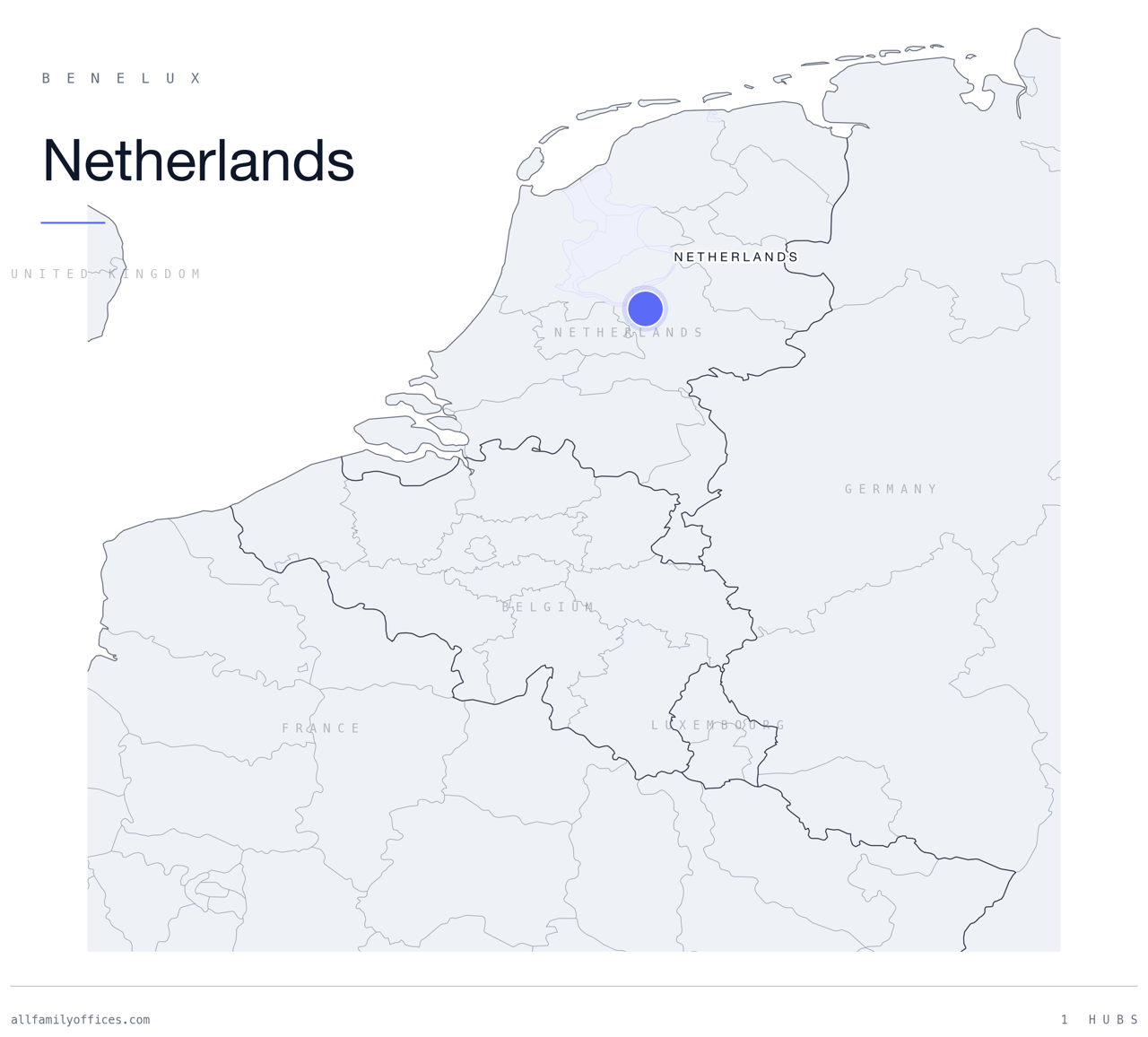
Amsterdam dominates the landscape, hosting more than half of the country's family office headquarters. Rotterdam serves as the center for maritime and industrial family capital, anchored by HAL Investments and First Dutch. Smaller towns like Laren and Blaricum attract private wealth offices such as De Hoge Dennen Capital and HB Capital. Ultra-high-net-worth (UHNW) families in these locations favor proximity to the Het Gooi residential area over city-center offices.
A defining feature of the Dutch market is the prevalence of family-controlled holding companies. HAL Trust, SHV Holdings, and Exor N.V. operate as listed or unlisted holding vehicles that function as de facto family offices while controlling major operating businesses. This structure sets the Netherlands apart from markets where SFOs and MFOs dominate. The sector is also growing fast. Offices are rapidly adding external professionals, investment committees, and formal oversight structures to match expanding mandates.
Family Office Comparison at a Glance
The table below compares the most prominent Dutch family offices by type, estimated AUM, and capital deployment focus. AUM figures appear only where verified data exists.
| Family Office | Type | AUM Estimate | Investment Focus | Notable Investments | Location |
|---|---|---|---|---|---|
| L'Arche Green N.V. | SFO | €10B+ | Heineken holding | 53.17% of Heineken Holding N.V. | Amsterdam |
| HAL Investments / HAL Trust | Holding | — | Maritime, industrial | Boskalis, VolkerWessels | Rotterdam |
| SHV Holdings / NPM Capital | Holding | — | Energy, testing, heavy lifting | Kiwa, Mammoet, Port of Rotterdam | Netherlands |
| Exor N.V. | Holding | — | Healthcare, diversified | Philips (18.7% stake) | Amsterdam |
| Anthos Fund & Asset Mgmt | MFO | — | Multi-asset, sustainability | Equities, PE, real estate | Amsterdam |
| Ramphastos Investments | SFO | $1B | Diversified | 65 M&A deals, 9 portfolio cos. | Rhenen |
| Gryphion | SFO | — | PE, real estate, VC | Healthcare, technology | Amsterdam |
| De Hoge Dennen Capital | SFO | — | PE, real estate, mid-market | RetourMatras, Morssinkhof Rymoplast | Laren |
| First Dutch | SFO | — | Maritime, energy, ventures | Verwater, Shipping Technology | Rotterdam |
| Ingka Investments | Corporate FO | — | Forestland, renewables, real estate | Winnow | Leiden |
| 7-Industries Holding | SFO | $61M | Life sciences, technology | SECO S.p.A, Welltec | Amstelveen |
| Nedvest Capital | SFO | $225M | Diversified | — | Amsterdam |
Holding companies (HAL, SHV, Exor) control the largest pools of family wealth in the Netherlands. Most do not disclose AUM separately from their operating assets. Among pure-play family offices, L'Arche Green and Ramphastos hold the most verifiable capital.
Top Picks by Strategy
- Largest AUM: L'Arche Green N.V. manages €10B+ through its controlling stake in Heineken Holding N.V., the single largest family-controlled asset pool in the country.
- Most Diversified Industrial Portfolio: SHV Holdings spans energy distribution, testing and inspection (Kiwa), and heavy lifting (Mammoet). NPM Capital runs growth and buyout deals alongside the family's BORON vehicle.
- Leading MFO Platform: Anthos Fund & Asset Management evolved from the Brenninkmeijer family's C&A fortune into a multi-family office with professionals in six countries and a multi-asset mandate.
- Top Maritime and Energy Specialist: First Dutch, based in Rotterdam, completed the Verwater buyout in late 2024 and maintains active shipping technology partnerships.
- Strongest Impact Focus: DOB Equity channels capital to East African entrepreneurs in food security, education, and healthcare, with allocations in M-KOPA, Twiga Foods, and Sendy.
- Most Active Deal Maker: Ramphastos Investments has completed 65 M&A transactions and manages $1B in assets from its Rhenen headquarters.
- Rising Star in Life Sciences: 7-Industries Holding targets minority stakes in life sciences and technology companies, including SECO S.p.A and Welltec, from its Amstelveen base.
Top Dutch Family Offices in Detail
L'Arche Green N.V.
No other Dutch family office commands comparable scale. L'Arche Green N.V. manages an estimated €10B+ in assets, anchored by its 53.17% controlling stake in Heineken Holding N.V. The Carvalho-Heineken family owns 88.98% of the Amsterdam-based vehicle; the Hoyer family holds the remaining 11.02%. Through this multi-tiered structure, the family exercises long-term strategic control over one of the world's most recognized brewers.
L'Arche Green operates as a low-profile private wealth vehicle. Reports indicate an advisory relationship with London-based Capgen Partners, where Michel de Carvalho serves as chairman. For allocators studying concentrated single-stock family wealth strategies, this office is the definitive Dutch case study.
HAL Investments / HAL Trust
The Van der Vorm family's Rotterdam holding operates more like a patient industrial conglomerate than a traditional wealth manager. HAL Trust reported €1.024B in net income and €847M in net asset value growth during the first half of 2025. In July 2025, HAL signed a letter of intent involving Boskalis and VolkerWessels, extending its role as a Dutch industrial orchestrator.
HAL's playbook centers on concentrated, long-horizon ownership of businesses with durable competitive positions. Sponsors seeking co-investment partners should note HAL's preference for board-level engagement and decade-long holding periods.
SHV Holdings & NPM Capital
Three generations of the Fentener van Vlissingen family built SHV into one of Europe's most diversified private conglomerates. The group spans energy distribution (SHV Energy), testing and inspection (Kiwa), and heavy lifting (Mammoet). NPM Capital, SHV's growth and buyout arm, partnered with the Port of Rotterdam Authority in August 2025.
BORON, the J.A. Fentener van Vlissingen branch's vehicle, took a majority stake in real-estate software firm Omniboxx in June 2025. This "cluster" model of multiple vehicles under one family umbrella is the clearest example of how large Dutch families professionalize wealth preservation while keeping direct control over operating companies.
Exor N.V.
Amsterdam-domiciled but rooted in the Italian Agnelli family's automotive fortune, Exor N.V. occupies a unique position in the Dutch landscape. Its decisive pivot into healthcare became clear when it raised its Philips stake to 18.7% in March 2025, becoming the company's largest shareholder.
Exor brings patient equity and board-level oversight to multi-year turnarounds. This makes it an unusual partner for regulated healthcare and medtech platforms. UHNW families with global portfolios can study Exor's approach as a model for using a Netherlands domicile to manage cross-border holding structures.
Anthos Fund & Asset Management
Built on the Brenninkmeijer family's C&A retail wealth, Anthos is the strongest multi-family office platform based in the Netherlands. The family established its original service office in Amsterdam in the 1930s. Today, Anthos employs over 100 professionals in the Netherlands, Germany, Switzerland, Belgium, the United Kingdom, and North America.
Its mandate covers equities, fixed income, real estate, and private equity, with sustainability woven into the process. Anthos also offers private wealth management and estate planning. For wealthy families seeking integrated advisory alongside portfolio management, it is the most complete MFO option in the Dutch market.
Ramphastos Investments
With $1B in managed assets and 65 completed M&A transactions, Ramphastos is one of the most active deal-making family offices in the Netherlands. Based in Rhenen, it currently holds nine portfolio companies with a diversified sector spread.
The volume of completed deals signals a well-resourced team and a repeatable sourcing process. Business owners evaluating exit options or co-investment partners will find Ramphastos notable for its hands-on operational approach and willingness to take controlling positions.
Gryphion
Rob Thielen founded Gryphion in 2018 after building Waterland Private Equity into one of Europe's top-performing mid-market buyout firms. This Amsterdam-based single family office channels post-exit wealth into private equity, real estate, venture capital, and charitable giving.
Gryphion's healthcare, medtech, and technology focus reflects Thielen's deep sector expertise from his Waterland years. The office represents the growing category of Dutch SFOs created by first-generation PE founders who bring institutional deal-making skills to family capital deployment.
De Hoge Dennen Capital
Mid-sized Dutch companies with a sustainability angle are De Hoge Dennen Capital's sweet spot. This Laren-based SFO combines active ownership with patient capital through direct PE and real estate holdings. Portfolio companies include RetourMatras (mattress recycling) and Morssinkhof Rymoplast (plastics recycling).
Both holdings position the office at the intersection of circular economy themes and mid-market buyouts. Fund managers seeking LP commitments from offices with genuine sector conviction in industrial sustainability will find De Hoge Dennen a natural fit.
First Dutch
Peter Goedvolk's Rotterdam office draws its identity from the city's maritime and energy heritage. Goedvolk built his wealth through Argos Energies, and First Dutch channels that expertise into maritime ventures, energy deals, and sustainability-linked allocations.
The November 2024 Verwater buyout and ongoing shipping technology partnerships confirm an active deal pipeline. First Dutch fills a niche that few other Dutch wealth platforms occupy: deep technical knowledge of maritime and energy value chains paired with direct capital deployment capability.
Ingka Investments
IKEA's investment arm manages a portfolio spanning forestland, renewable energy, and real estate from its Leiden headquarters. Ingka Investments blends financial returns with sustainability commitments, including backing food waste technology firm Winnow.
Ingka operates with a corporate family office structure rather than a traditional SFO model. This gives it access to the broader IKEA ecosystem for deal sourcing and operational expertise. Its focus on real assets and renewables makes it one of the largest dedicated sustainability capital pools in the Dutch market.
Investment Trends Shaping the Dutch Market
Private Equity Dominance and Rising Allocations
Dutch family offices allocate 27% of their portfolios to private equity, matching listed equities as the largest single category. Some 42% of Benelux offices plan to raise PE exposure further. Ramphastos exemplifies this trend with 65 M&A deals completed. NPM Capital runs a dedicated growth and buyout strategy alongside SHV's industrial holdings.
Direct Deals and Co-Investment Structures
Dutch offices are shifting from passive LP positions toward direct minority stakes and structured co-investment vehicles. 7-Industries Holding takes minority positions with strategic expertise in life sciences. De Hoge Dennen Capital pursues active ownership of mid-market companies.
Common structures include SPVs with preferred equity and protective covenants. These give families co-control alongside fund managers, a model that is spreading as more Dutch offices build in-house deal teams.
Impact Investing and ESG Leadership
About 40% of Dutch family offices are active in impact investing, well above the global average. DOB Equity directs capital to East African entrepreneurs. Momentum Family Office combines sustainability with an Africa focus. One in three Benelux offices runs its own foundation, and 70% engage in charitable giving.
This concentration of impact-oriented capital makes the Netherlands a natural base for fund managers with ESG-aligned strategies. Offices like Ingka Investments and De Hoge Dennen reinforce this pattern through renewables and circular economy holdings.
Energy Transition and Maritime Innovation
The Netherlands' position as a maritime and energy hub shapes family capital flows. First Dutch invests in shipping technology. AtlasInvest bridges family capital with institutional energy PE. Ingka Investments channels IKEA resources into renewable energy.
The Port of Rotterdam's 2025 partnership with NPM Capital illustrates how industrial family capital and public systems increasingly converge. Maritime and energy remain the sectors where Dutch family offices hold the deepest operational expertise.
Succession Planning and New Office Formation
Roughly 60% of Benelux family offices are first-generation, and one in three opened in the past five years. This wave of new offices is professionalizing rapidly, adding investment committees and external advisors. Family governance and succession planning are becoming priorities even for recently formed offices, as founders prepare for second-generation involvement.
How to Evaluate a Dutch Family Office
The first question in the Dutch market is structural. Is the office a family-controlled holding company (like HAL or SHV), a pure-play SFO (like Gryphion), or an MFO (like Anthos)? Each model creates different engagement dynamics. Holding companies typically seek co-investors who bring operational value. SFOs negotiate bespoke terms. MFOs offer standardized advisory to multiple families.
Structural transparency separates strong Dutch offices from opaque ones. Over 40% of Benelux family offices maintain formal mission statements. The best-run offices publish half-year reports with dated KPIs. Check whether the office has a structured investment committee or relies solely on family-member decisions. Anthos and NPM Capital maintain institutional-grade oversight, while smaller SFOs may operate with lighter structures.
Values alignment matters more in the Netherlands than in many other markets. Dutch families prize decade-long ownership horizons, entrepreneurial integrity, and trust-based relationships. Assess whether your timeline and reporting cadence match the office's expectations before discussing commercial terms. Ramphastos, with 65 completed M&A deals, represents one end of the activity spectrum. L'Arche Green operates at the other.
Watch for red flags specific to first-generation offices: no formal oversight despite managing significant capital, no succession plan despite the founder's age, and opaque fee structures. Local network connections also matter. Port authorities, banks, and engineering firms serve as key intermediaries. An office's ecosystem relationships signal its deal-sourcing capability in the Dutch market.
Which Dutch Family Office Fits Your Needs?
UHNW families seeking full-service wealth management should explore Anthos Fund & Asset Management. It offers integrated advisory, estate planning, and multi-asset allocation through 100 professionals in six countries. Clavis provides an alternative for families who want heavier exposure to bonds, alternatives, and private markets within a Dutch MFO structure.
Business owners transitioning from operating to investing will find natural partners in Gryphion and Ramphastos. Rob Thielen built Gryphion after founding Waterland Private Equity, so the office understands founder liquidity events and post-exit portfolio construction. Ramphastos, with $1B in managed assets and 65 deals, offers active co-investment opportunities for entrepreneurs who want to stay involved in deal-making.
Next-generation wealth holders drawn to values-driven investing can look to Bloom Family Office for personalized planning with an impact lens, or Momentum Family Office for sustainability-focused allocations in PE and real assets. Institutional allocators should target NPM Capital for mid-market growth and buyout deals, or De Hoge Dennen Capital for direct holdings in Dutch mid-cap companies. HAL Trust offers liquid exposure to a diversified family-controlled industrial portfolio through its listed shares.
Methodology
This guide to the largest Dutch family offices draws on data from multiple industry sources, including wealth databases, market research platforms, and the 2025 Benelux Family Office Report produced by Van Lanschot Kempen in partnership with Campden Wealth. That report provided key market statistics on allocation trends, office formation rates, and oversight practices.
Selection criteria prioritized verified Dutch-headquartered or Netherlands-domiciled family offices with identifiable activity. AUM figures appear only where public filings, half-year reports, or verified database entries confirmed them. Family-controlled holding companies (HAL Trust, SHV Holdings, Exor N.V.) earned inclusion because they function as the primary vehicles for some of the Netherlands' largest concentrations of family wealth. All data reflects the 2025 reporting cycle.
Frequently Asked Questions
 Google AI Mode
Tells Google to show you more from AllFamilyOffices in AI, Search and Discover.